History of Flight
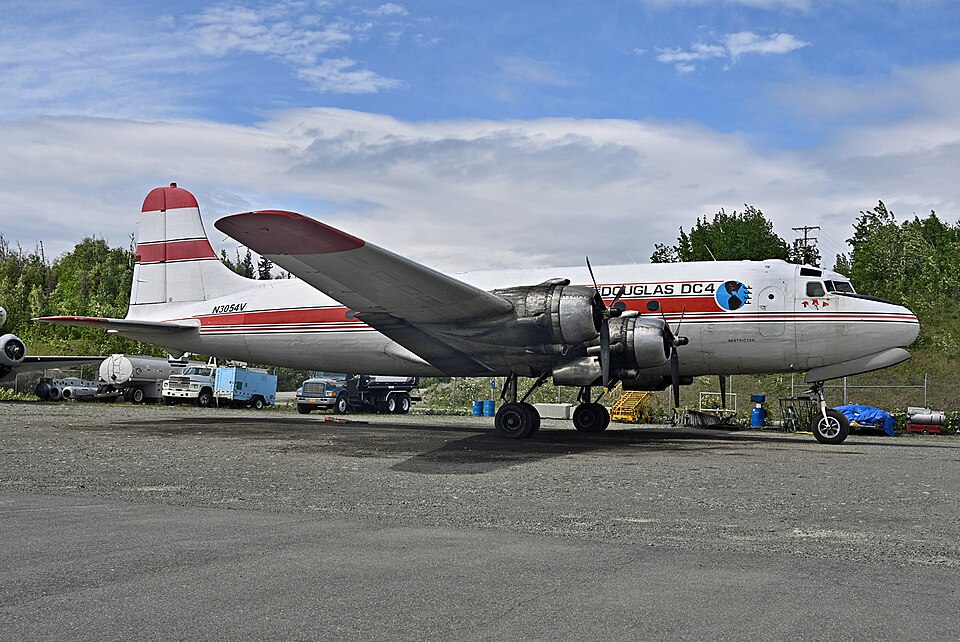
On April 23, 2024, at about 1003 Alaska daylight time, a Douglas C54D-DC airplane, registration N3054V, was destroyed in an accident near Fairbanks, Alaska. The two pilots on board were fatally injured. The aircraft was operated by Alaska Air Fuel Corporation as a Title 14 Code of Federal Regulations Part 91 flight, carrying 3,400 gallons of unleaded fuel and two 100-gallon propane tanks from Fairbanks International Airport to Kobuk Airport.
The airplane departed around 0955. An eyewitness observed the aircraft flying west and noted the far left engine was not running, with a small white plume of smoke emanating from that engine. The airplane began a turn to the south, at which point the engine was on fire. Approximately three minutes after departure, the pilot reported a fire onboard to air traffic control and initiated a left turn back to the airport.
Video surveillance showed white smoke developing behind the No. 1 engine, followed by flames. Seconds later, a bright white explosion occurred just behind the No. 1 engine. The airplane entered an uncontrolled, descending left turn into terrain. The No. 1 engine separated from the wing about 100 feet above ground and landed on a frozen river. About two minutes later, a large explosion was visible. The University of Alaska Fairbanks detected multiple low-frequency sound signals: the first explosion at 1001, impact at 1003, and a second explosion at 1006.
An extensive post-crash fire destroyed much of the aircraft structure. Spidertracks data showed the airplane powered up at 0925, departed at 0955, airspeed decreased from 135 knots to 117 knots at 0958, stabilized at 0959, then increased to 148 knots at 1000.
Aircraft Information
The No. 1 engine had been replaced with a serviceable engine about two weeks before the accident and again with an overhauled engine one week prior. The overhauled engine (by Anderson Aeromotive Inc) was completed in November 2023. According to the operator’s director of operations, several days before the accident, a fuel leak was present in the outboard fuel tank on the left wing near the No. 1 engine. A repair was made the day before the flight to Fairbanks but did not stop the leak. The tank leaked only when full, at a rate of about 5–10 drops of fuel per minute, which dripped into a space behind the No. 1 engine and out of the wing. The aircraft sat for several days with full fuel tanks before the accident flight, allowing fuel to accumulate in that area.
Wreckage and Impact
An aerial search of the in-flight explosion area yielded two large sections of the upper left wing, the aileron bell housing, and numerous small aluminum fragments in a straight line within about 150 yards. The upper skin of one fragment showed evidence of melted metal. The recovered No. 1 engine and airframe portions were retained for examination. The accessory and blower section had separated from the engine case; the propeller remained attached to the gear reduction assembly, which was separated from the engine case. The engine mount remained attached with impact and thermal damage. The carburetor was separated; the fuel pump, propeller governor, and both magnetos were not recovered.
The engine case was mostly intact with impact damage. Several pushrods were separated. Two cylinders were removed for internal inspection via borescope; the crankshaft, master and articulating rods, and pistons were intact with normal operating signatures. Weight markings on piston skirts were consistent with overhaul. The rear cam ring was exposed but in good condition. The crankcase showed no pre-impact damage. The propeller reduction gearcase and nose had separated, exposing planetary gears in excellent condition with timing markings. No pre-impact damage was evident.
The accessory case and blower section had impact and fire damage. Multiple heater pads were damaged or consumed. The area above the carburetor mount had extensive thermal damage. Hoses and wiring were consumed. The carburetor was covered in soot; its intake screen had thermal damage. Fuel hoses were mostly burned; B-nuts remained attached. Throttle and mixture control arms were attached but linkages separated.
A blower vent fitting on the bottom of the engine was separated; safety wire was intact, threads undamaged but corroded. An AN-8 hose fitting was found in the exhaust heat shield area, with the hose burned from the fitting and threads in good condition. A portion of the firewall had a 90° elbow AN-8 bulkhead fitting with a B-nut and hard line on one end; the other end had no B-nut or hose attached, threads intact. That fitting was part of the propeller feathering system.
The exhaust system was impact damaged; oil residue was present externally. The propeller remained attached to the flange; one blade was separated at the hub and not recovered; the other two blades were relatively undamaged and positioned between unfeathered and feathered. A wing leading edge piece exhibited light oil residue.
The propeller feathering system lines transfer engine oil from the nacelle tank to the feathering pump (mounted on the aft side of the firewall) and forward to the governor. The nacelle oil tank supplies oil for lubrication through a standpipe; after the standpipe is depleted, a reserve of 1.8 gallons remains for feathering. High-pressure oil from the feathering system flows through the governor, which automatically disconnects when the system is in operation.