Accident Overview
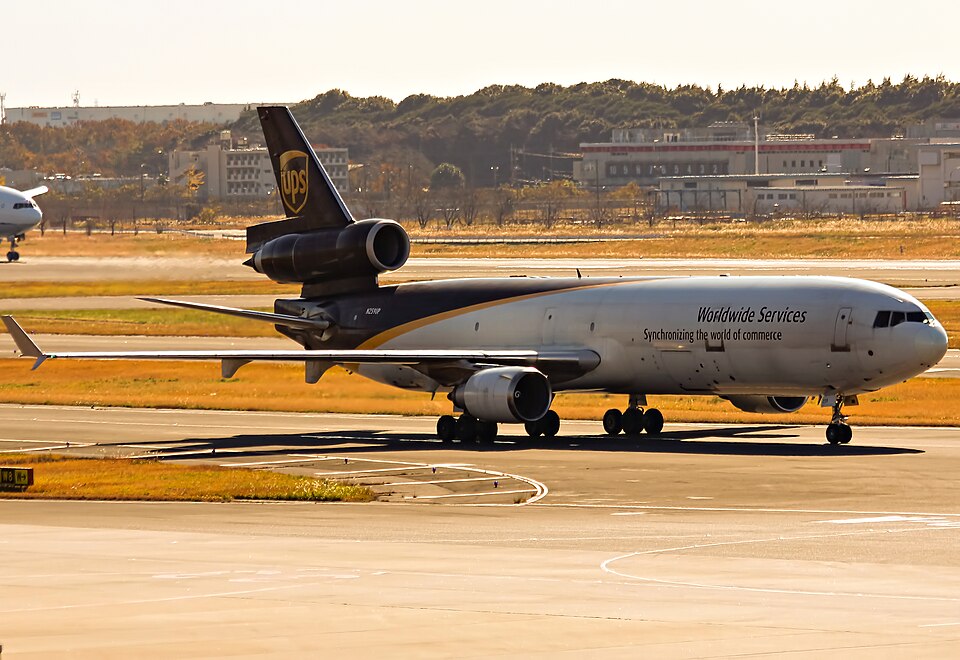
On November 4, 2025, about 1714 eastern standard time (EST), United Parcel Service (UPS) Flight 2976, a Boeing (McDonnell-Douglas) MD-11F airplane, registration N259UP, was destroyed after impacting the ground shortly after takeoff from runway 17R at Louisville Muhammad Ali International Airport (SDF), Louisville, Kentucky. The three crewmembers aboard the airplane and eleven people on the ground were fatally injured. Twenty-three others on the ground were injured. The flight was a domestic cargo operation under 14 CFR Part 121 from SDF to Daniel K. Inouye International Airport (HNL), Honolulu, Hawaii.
Investigation and Parties
The NTSB traveled to SDF on November 5, 2025, to document the accident site and collect perishable data. Qualified parties invited to participate included the FAA, UPS, Boeing, Independent Pilots Association, GE Aerospace, and Teamsters Airline Division. Specialized investigative groups were formed in Structures, Systems, Powerplants, Maintenance, Air Carrier Operations and Human Performance, Hazardous Materials, Aircraft Performance, Materials, Cockpit Voice Recorder (CVR), and Flight Data Recorder (FDR). An NTSB Air Traffic Control specialist collected ATC information, but no ATC group was formed. NTSB Board Member Inman was the Board Member on scene.
History of Flight
UPS Flight 2976 received takeoff clearance from SDF tower about 1711 and the flight crew acknowledged. Taxi and takeoff roll were uneventful until rotation. Airport surveillance video showed the left (No. 1) engine and pylon separating from the wing shortly after rotation, with a fire igniting on the left engine while it traversed above the fuselage and subsequently impacted the ground. A fire ignited near the left pylon attachment to the wing and continued until ground impact. The airplane climbed to no higher than about 30 ft above ground level (agl) according to radio altitude data from the FDR; FAA ADS-B data showed a last data point of 481 ft mean sea level (msl) and 100 ft agl. The airplane cleared the blast fence beyond runway 17R, but the left main landing gear impacted the roof of a UPS Supply Chain Solutions warehouse at the southern edge of the airport. The airplane then impacted a storage yard and two additional buildings, including a petroleum recycling facility, and was mostly consumed by fire. The wreckage area extended from the UPS warehouse to about 3,000 ft south-southeast. The accident site debris was centered near 38° 8’ 49.85” N, 85° 44’ 3.86” W.
Witnesses in the SDF tower reported that takeoff speed appeared normal but the climb rate was not; the airplane did not climb above the tower’s approximately 200 ft agl. Another witness reported the airplane stopped climbing and began to lose altitude before rolling slightly left.
Crew Experience
The captain, serving as pilot monitoring, held an airline transport pilot certificate with an MD-11 type rating and had about 8,613 total flight hours, with 4,918 hours in the MD-11. The first officer (FO), the pilot flying, had about 9,200 total hours, with 994 in the MD-11. The relief officer (RO) had about 15,250 total hours, with 8,775 in the MD-11. All held airline transport pilot certificates with MD-11 type ratings.
Recorders
The airplane was equipped with an FDR and CVR, both recovered and transported to the NTSB Vehicle Recorders Laboratory. Data were successfully downloaded. The CVR contained about 2 hours 4 minutes, including the accident flight. The FDR contained about 63 hours across 24 flights, including the accident flight, recording about 450 parameters. Flight data for the accident flight started about 1707 EST; takeoff roll began about 1712 EST; data ended about 1713:30 EST.
Airplane and Operator Information
The MD-11 is a three-engine widebody passenger airplane originally manufactured by McDonnell-Douglas, later merged with Boeing. The MD-11F is the freighter version. The accident airplane was equipped with GE CF-6 engines. UPS, a cargo airline based in Louisville, operates various aircraft including the MD-11F. The accident airplane was equipped with ADS-B Out per FAA requirements.
MD-11 Engine Pylon-to-Wing Connection
The left (No. 1) and right (No. 3) engines are attached to pylons attached to the underside of each wing. The center (No. 2) engine is attached to the base of the vertical stabilizer. Each left/right pylon attaches to the wing via a forward mount bulkhead, a thrust link assembly, and an aft mount bulkhead. The forward mount contains two vertically aligned spherical bearings. The thrust link assembly is behind the forward mount’s lower spherical bearing. The aft mount is an assembly of two independent fittings bolted together with lugs housing a single spherical bearing. A wing clevis connects to the pylon aft mount via attachment hardware.
Wreckage Examination
The airplane wreckage was spread over a wide area, significantly fragmented and burned. The left engine, left pylon including forward and aft mounts, engine fan blade fragments, and separated pieces were found on and adjacent to runway 17R. Recovered portions were transferred to a secure hangar. The left pylon aft mount’s forward and aft lugs were found fractured near the 2 o’clock (inboard) and 9 o’clock (outboard) positions. The fractured upper portions of the lugs were found adjacent to runway 17R. The left wing clevis, aft mount spherical bearing, and attachment hardware were found with a portion of the left wing; the spherical bearing outer race had fractured circumferentially, exposing the ball element. The right engine remained attached to the right wing pylon, both found at the accident site; the right pylon forward and aft mounts had separated but were found about 87 ft from the right engine. The right pylon aft mount remained attached to the right wing clevis.
NTSB Materials Laboratory Examination
The left pylon aft mount, fractured lugs, and left wing clevis (with the spherical bearing and hardware) were retained for examination at the NTSB Materials Laboratory. The right pylon aft mount and wing clevis assembly, as well as two engine fan blade fragments from runway 17R, were also retained. Examination of the left pylon aft mount lug fractures found evidence of fatigue cracks in addition to overstress failure. On the aft lug, both inboard and outboard fracture surfaces showed a fatigue crack where the aft lug bore met the aft lug forward face. On the forward lug’s inboard fracture surface, fatigue cracks were observed along the lug bore; the outboard fracture surface consisted entirely of overstress with no fatigue indications. The forward top flange of the aft mount assembly showed no deformation or pre-existing fractures. The spherical bearing was removed from the wing clevis for further evaluation.
Maintenance and Inspections
At the time of the accident, N259UP had accumulated about 92,992 hours and 21,043 cycles. It was maintained under a continuous airworthiness maintenance program (CAMP). A general visual inspection (GVI) and detailed visual inspection of the left pylon aft mount, required at a 72-month interval, was last accomplished on October 28, 2021. A 24-month/4,800-hour lubrication task for pylon thrust links and spherical bearings was last accomplished on October 18, 2025. A special detailed inspection (SDI) of the left pylon aft mount lugs would have been due at 29,200 cycles, and of the left wing clevis support at 28,000 cycles; these two SDI tasks had not been accomplished (the airplane had 21,043 cycles).
Safety Actions
UPS grounded its MD-11 fleet on November 7, 2025, as a precautionary measure at Boeing’s recommendation. The FAA issued Emergency Airworthiness Directive (AD) 2025-23-51 on November 8, 2025, prohibiting further flight of MD-11 and MD-11F airplanes until inspections and corrective actions were performed. The FAA subsequently issued Emergency AD 2025-23-53 on November 14, 2025, superseding the previous AD and including both MD-11 and DC-10 series airplanes due to similar design.
Similar Events
On May 25, 1979, American Airlines Flight 191, a McDonnell-Douglas DC-10-10, crashed after left engine and pylon separation during takeoff from Chicago-O’Hare International Airport. The NTSB investigated that accident (NTSB No. DCA79AA017, report AAR-79-17).
Current Status
The NTSB’s investigation of UPS Flight 2976 is ongoing.