History of the Flight
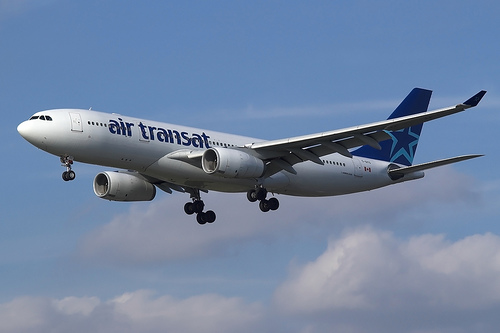
On August 24, 2001, Air Transat Flight TSC236, an Airbus A330-243 aircraft registered C-GITS, was operating a scheduled flight from Toronto Lester B Pearson Airport (CYYZ), Ontario, Canada, to Lisbon Airport (LPPT), Portugal. The aircraft carried 13 crew members and 293 passengers.
At 05:33, while at position 4244N/2305W, the crew noted a fuel imbalance. At 05:45, the crew initiated a diversion from the flight-planned route to land at Lajes Airport (LPLA), Terceira Island, Azores. At 05:48, the crew advised Santa Maria Oceanic Control that the flight was diverting due to a fuel shortage.
At 06:13, the crew notified air traffic control that the right engine (Rolls-Royce RB211 Trent 772B) had flamed out. At 06:26, when the aircraft was approximately 65 nautical miles from Lajes Airport and at an altitude of about flight level 345, the crew reported that the left engine had also flamed out and that a ditching at sea was possible.
Assisted by radar vectors from Lajes air traffic control, the crew performed an engines-out, visual approach at night in good visual weather conditions. The aircraft landed on runway 33 at Lajes Airport at 06:45. After the aircraft stopped, small fires started in the area of the left main-gear wheels; these fires were immediately extinguished by crash rescue response vehicles that were in position for the landing.
The captain ordered an emergency evacuation.
Injuries to Persons
During the emergency evacuation, 16 passengers and 2 cabin crew members sustained injuries.
Damage to Aircraft
The aircraft sustained structural damage to the fuselage and to the main landing gear.
Other Damage
No other damage was reported.
Meteorological Information
Visual weather conditions prevailed at the time of the landing.
Aids to Navigation
Lajes air traffic control provided radar vectors to the aircraft.
Communications
The crew communicated with Santa Maria Oceanic Control and Lajes air traffic control regarding the fuel shortage and engine flameouts.
Flight Recorders
The investigation utilized flight data and cockpit voice recorders; however, specific details from the recorders are not included in this report.
Crash Fire Rescue Services
Crash rescue response vehicles were positioned for the landing and extinguished the fires at the left main-gear wheels.
Passenger Safety and Survival
An emergency evacuation was conducted; 16 passengers and 2 cabin crew members were injured.
The aircraft was an Airbus A330-243 (registration C-GITS) with Rolls-Royce RB211 Trent 772B engines.