Synopsis
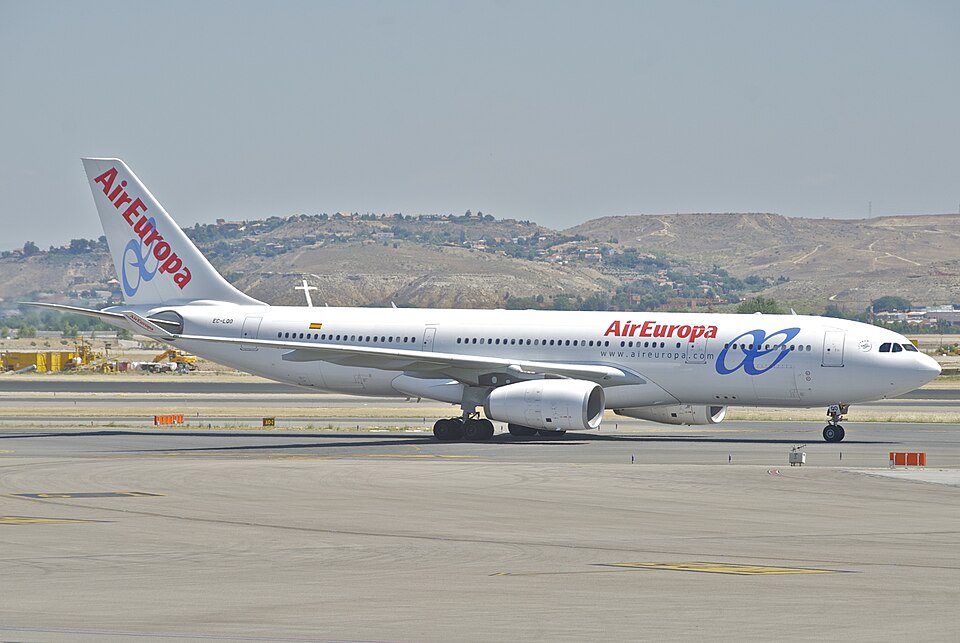
On Monday, December 16, 2019, at 21:34 local time, an Airbus A330-200 (registration EC-LQO) encountered a turbulence area during its approach to Adolfo Suárez Madrid-Barajas International Airport. The aircraft was at coordinates 41°00’07”N, 3°46’08”W, near the RILKO waypoint of the RNAV STAR SOTUK6A for runways 18L/18R, at an altitude of 10,500 feet and approximately 34 nautical miles from the airport. The flight was a scheduled commercial passenger service operated by Air Europa, carrying 10 crew members and 163 passengers.
Sequence of Events
At the time of the turbulence encounter, the cabin crew were executing the procedure to secure the cabin after the flight crew had announced “Cabin crew ready for approach” in accordance with Air Europa’s Operations Manual Part B, A330 Annex 1, Section 1.5. The passenger seat belt sign was illuminated. During the turbulence, one cabin crew member fell and sustained a serious injury. The remaining crew and all passengers were uninjured. The aircraft landed without damage.
Injuries
According to the report, one crew member suffered a serious injury. No other injuries were reported. The source lists the following breakdown: crew: 1 seriously injured, 9 uninjured; passengers: 163 uninjured; total persons on board: 173 (10 crew and 163 passengers).
Damage
The aircraft sustained no damage.
Meteorological Information
The crew had access to various meteorological data sources. However, only the ATIS (Automatic Terminal Information Service) warned of moderate turbulence in the area. The turbulence intensity encountered was higher than forecast.
Probable Cause
The investigation determined that the accident was caused by crossing a turbulence area of higher intensity than forecast during the approach to Adolfo Suárez Madrid-Barajas airport.