Introduction
On 6 May 2022, an air traffic control incident occurred between two Qatar Airways flights within the Colombo Oceanic Control Area. The incident was notified to the Civil Aviation Authority of Sri Lanka by the operator on 9 May 2022. Simultaneously, during a routine ATM inspection on 20 May 2022, a log entry was observed stating the removal of an ATC from duty due to clearing an aircraft to an incorrect flight level in the absence of standard separation.
History of Flight
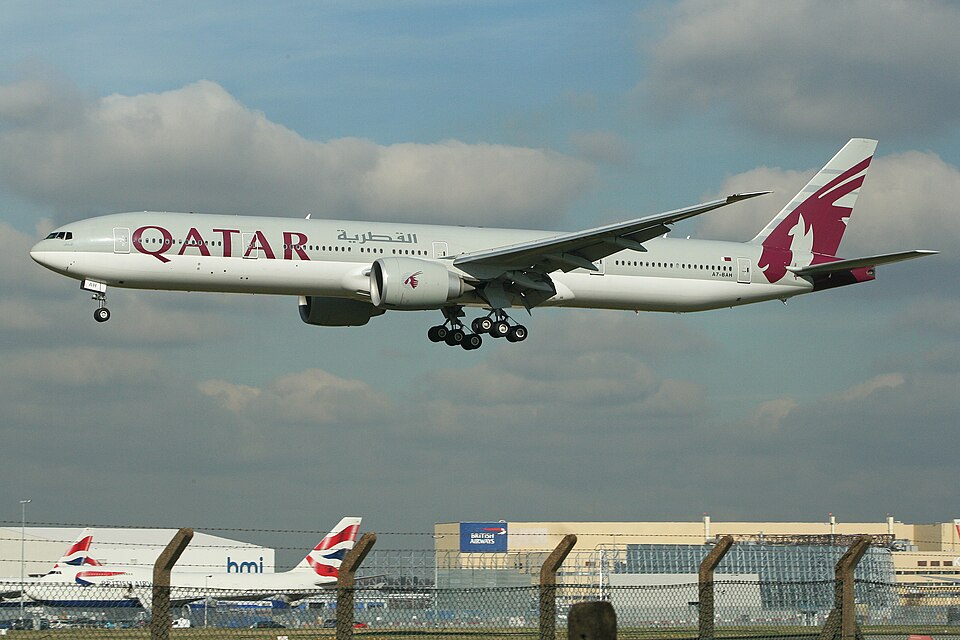
Qatar Airways flight QTR54C, a Boeing B777-300 with registration A7-BAC, was operating from Adelaide International Airport, Australia to Hamad International Airport, Qatar, maintaining FL300. Qatar Airways flight QTR34U, a Boeing B777-300ER with registration A7-BAH, was operating from Perth International Airport, Australia to Hamad International Airport, Qatar, maintaining FL320. Both aircraft were westbound on route N640.
At 20:21:52 UTC, QTR34U reported ELATI at FL320 and requested a weather deviation 30 NM right of track. At 20:22:22 UTC, QTR54C, which was ahead of QTR34U, requested to climb from FL300 to FL340. At 20:22:42 UTC, the weather deviation was approved. At 20:23:20 UTC, the Executive Controller cleared QTR54C to climb to FL340, which required it to pass through QTR34U's level of FL320. At the time of clearance, the longitudinal separation between the two aircraft was less than the required 50 NM standard separation for the Oceanic Control Airspace in Colombo FIR.
Personnel Information
Two controllers were working the Colombo Oceanic Control Sector: an Executive Controller who assumed duties at 2000 UTC, and an ADS Controller handling ADS/CPDLC who had been on position since 1900 UTC. At the time the Executive Controller took over, there were nine active aircraft in the sector, all connected to CPDLC.
Aircraft Information
Both aircraft were operated by Qatar Airways Q.C.S.C. and registered in Qatar (A7). QTR54C was a Boeing B777-300 (MSN 36010) and QTR34U was a Boeing B777-300ER (MSN 37662).
Investigation Findings
The investigation identified several factors, including the controller changeover occurring during a peak traffic scenario, insufficient use of flight progress strips and ATM system prompts, failure to introduce north-south sectorization when sector capacity was expected to be exceeded, insufficient training and currency in the ATM system, and non-reportage of the mandatory occurrence.
Probable Cause
The clearance for level change for QTR54C was given when there was less than the required standard separation between both aircraft.
Safety Recommendations
The report includes safety recommendations aimed at preventing recurrence, such as improving handover procedures, ensuring proper use of tools, reviewing duty rosters, and enhancing training.