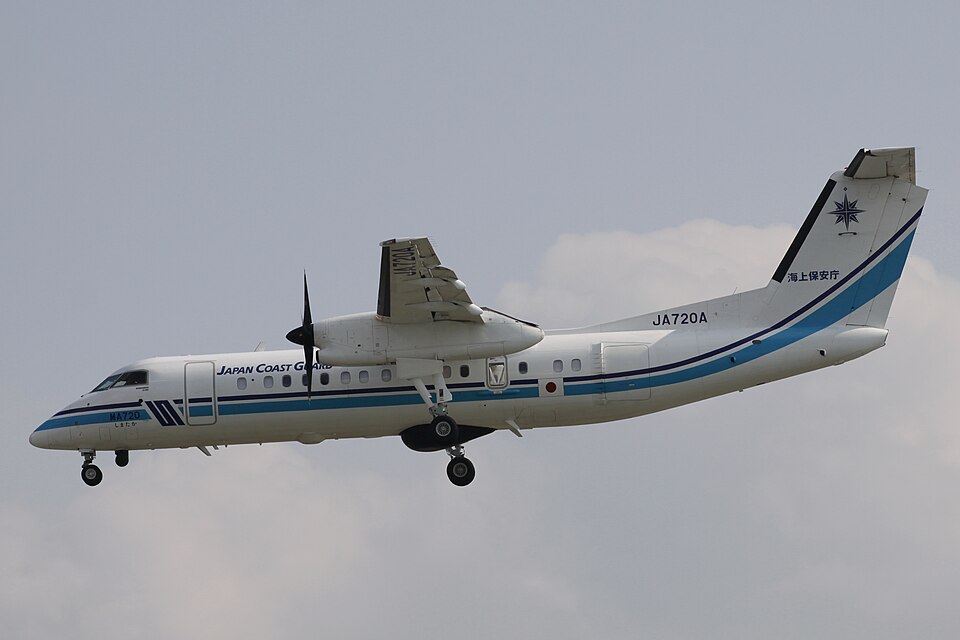
Summary
On January 18, 2012, a Bombardier DHC-8-315 aircraft operated by the Japan Coast Guard (JCG), registration JA720A, was involved in a bird strike incident during a marine patrol flight. The airplane, which had taken off from Naha Airport at 14:48 local time, was flying at approximately 1,000 ft and 170 knots near Kitakojima Island, Ishigaki City, Okinawa Prefecture. The collision occurred at 17:11 local time.
Flight History
According to statements from the pilot in command (PIC) and the first officer (FO), the aircraft had been conducting a marine patrol over the East China Sea with eight crew members on board, including both pilots and seven additional crew. The destination was Ishigaki Airport. Shortly after a left turn near Kitakojima Island, the PIC observed four birds about 100 meters ahead. Despite the sighting, there was insufficient time to avoid a collision, and the aircraft struck one of the birds head-on. The FO also noticed the birds but could not alert the PIC in time.
Response and Landing
Following the impact, the PIC noticed feathers and slight movement of the nose upper door. Deciding that the situation compromised safety, the mission was aborted and the flight proceeded directly to Ishigaki Airport. During the descent, the left seat speedometer exhibited more fluctuation than the right. The flight control, engine, and electrical systems operated normally. The aircraft landed uneventfully at 18:04.
Damage Assessment
The bird strike caused substantial damage to the aircraft's upper nose section. Specifically:
- Upper nose section: damaged area measuring 60 cm long by 90 cm wide.
- Radome bulkhead: upper part curved backward.
- GS antenna support: buckled backward.
- Frame No. 7: upper part deformed in a V shape.
The extent of damage was classified as substantial.
Bird and Weather Information
The bird involved was identified as a Masked Booby, measuring 90 cm in length with a wingspan of 140 cm and weight of 1.3 kg. At the time of the incident, weather conditions were reported by the PIC as fine, with visibility exceeding 10 km, wind from the south-southeast at 15 kt, and scattered clouds.
Analysis
The JTSB analysis noted that the aircraft sustained damage due to a bird strike at 1,000 ft. The PIC reported that the collision was head-on with no time to avoid after spotting the birds, while the FO had no time to warn the PIC. The event occurred instantly after the birds were sighted, suggesting difficulty in executing avoidance maneuvers.
Probable Cause
The Japan Transport Safety Board determined that the accident occurred due to a bird strike at 1,000 ft during marine patrol flight near Kitakojima Island, resulting in damage to the aircraft.
Actions Taken
In response to the incident, the Promotion Administration of Aviation Safety of the JCG informed Regional Coast Guard Headquarters and other pertinent offices on February 1, 2012, to raise awareness regarding bird strikes.