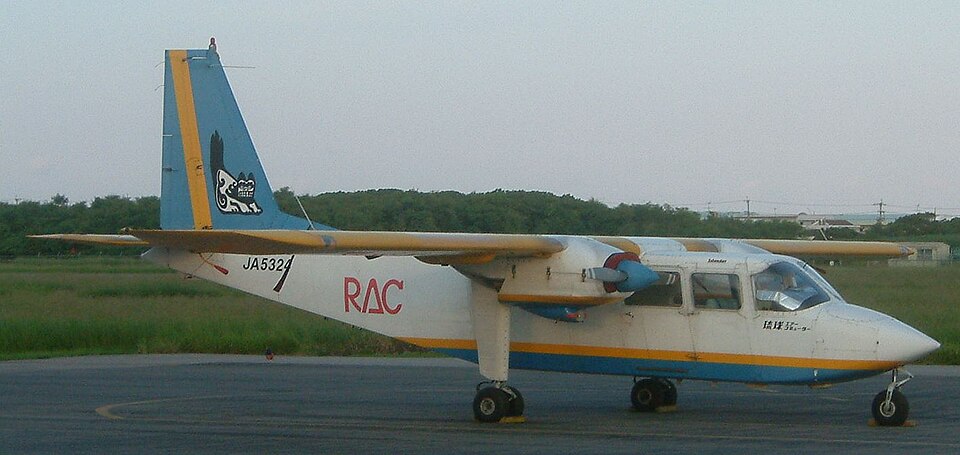
Flight History
On October 16, 2012, a Britten Norman BN-2B-20, registration JA5324, operated by First Flying Co., Ltd., was preparing for an unscheduled flight (flight 106) from Aguni Airport to Naha Airport. The aircraft departed the parking spot at 16:19 local time with the pilot in command and nine passengers on board. While taxiing on Runway 01 for departure, the pilot observed a bird carrying a fish on the runway shoulder. The pilot steered the aircraft slightly toward the bird to repel it, and the bird flew away. After making a 180-degree turn at the runway end, the pilot confirmed no birds in sight and initiated takeoff at 16:22.
During the takeoff roll, when the aircraft became airborne and reached approximately 3 meters above the runway, the pilot noticed an object resembling a bird approaching from the right front. The object appeared to pass below the right wing. The pilot did not feel any impact or abnormal vibration and continued the flight. Upon landing at Naha Airport at 16:46, the aircraft taxied to the apron. During a post-flight inspection, a mechanic discovered a deformation on the right wing leading edge.
Damage and Bird Strike
The right wing leading edge exhibited a dent measuring 100 cm in width and 3 cm in depth, located 110 cm from the wing tip. Slight bloodstains were found on the skin adjacent to the deformed area. The damage was not present during the preflight external check conducted by the pilot. A bird carcass was later found on the runway at Aguni Airport. The bird was identified as an osprey (species *Pandion haliaetus*), measuring 60 cm in length and weighing 1.7 kg. Fish remains were also found near the carcass.
Investigation
The Japan Transport Safety Board (JTSB) investigated the accident. The pilot, a 48-year-old male with a commercial pilot certificate and 13,494 total flight hours (including 2,194 hours on type), held a valid Class 1 medical certificate. The aircraft, a Britten Norman BN-2B-20 (serial number 2297, manufactured in 2000), had a valid certificate of airworthiness and 7,046 total flight hours.
Weather at the time of the accident was reported at 16:00 as wind direction 040° at 17 knots, visibility more than 10 km. The airport administration office had conducted bird patrols and grass mowing approximately one week before the accident. However, the required bird patrol 30 minutes before the aircraft's arrival at 15:55 could not be performed because the runway was occupied by another aircraft conducting touch-and-go training between 15:03 and 15:49. No bird strikes had been reported at the airport in the preceding two years. Although the airport safety management manual called for a wildlife strike control program, such a program had not been developed.
Probable Cause
It was determined that the aircraft sustained damage to the right wing leading edge due to a bird strike immediately after takeoff from Aguni Airport.