Accident Details
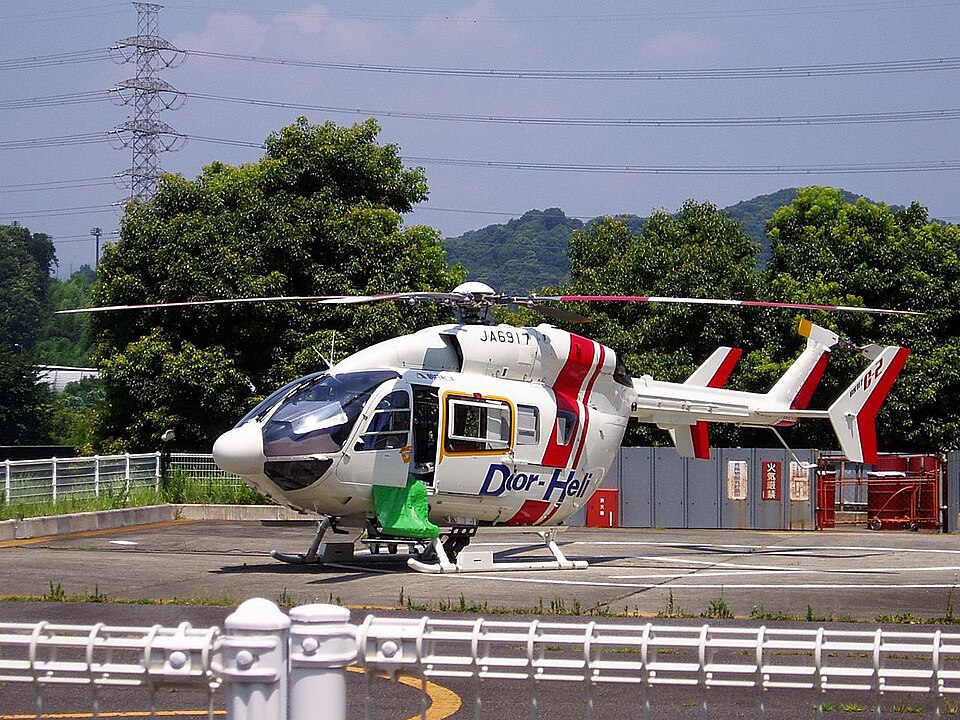
On August 8, 2016, at around 14:04 JST, a Kawasaki BK117C-2 helicopter, registration JA6917, operated by AERO ASAHI Corporation, was damaged during a hard landing at a temporary helipad in Hirasawa, Hadano City, Kanagawa Prefecture, Japan. The helicopter was being used for emergency medical transport of a sick or wounded person.
Flight History
The helicopter had departed from another temporary helipad in Isehara City at approximately 13:56 JST with five persons on board: a pilot, a maintenance engineer, and three medical staff. During the flight, no abnormalities were reported. The pilot initially planned to approach from the south, but due to timing, the rotorcraft turned right and approached from the west, passing over a steel tower approximately 27 m high. The pilot expected an east wind based on conditions at the takeoff point, but reported not feeling any wind effect. A witness reported a weak northerly wind at the surface.
Approach and Hard Landing
The pilot conducted the approach with a large descent angle and rate, intending to pull up the collective pitch lever (CP) to transition to hovering at about 5 m above ground. However, the rotorcraft failed to transition to a hover, began spinning to the right, and continued descending. An overtorque warning sounded. The pilot kept the CP at its last position and applied left rudder, but the spin did not stop. The helicopter touched down with strong impact, causing the tail boom to bend and the aircraft to lean forward before bouncing and coming to rest facing southwest.
Damage to Aircraft
The helicopter was destroyed. Specific damage included the tail boom broken off at the joint with the fuselage, broken tail fin, damaged main rotor, broken tail rotor, and buckling of the skid.
Injuries
There were no injuries to persons on board or on the ground.
Meteorological Conditions
Observations from Hadano Fire Station (about 1.3 km east) at 14:00 JST recorded north wind at 4.9 m/s (maximum instantaneous 14.8 m/s) and temperature 32.1°C.
Aircraft Information
The helicopter was a Kawasaki BK117C-2, serial number 4006, manufactured February 19, 2003. Its estimated weight at the time of the accident was 3,110 kg, within allowable limits. The pilot held a commercial pilot certificate with type rating for the BK117C-2 and had 7,111 hours total flight time (264 hours on type).
Additional Information
The flight manual for the BK117C-2 specifies that during hover or low-speed flight (up to 20 kt), descent should be at 600 ft/min or less. The approach analysis showed average descent rates up to 1,500 ft/min during phases. The report described the phenomenon of vortex ring state (VRS) and its occurrence conditions, but did not explicitly state that VRS caused the accident. Engine teardown found no in-flight abnormality. The flight control system showed no pre-existing anomalies; tail rotor control was broken on impact.