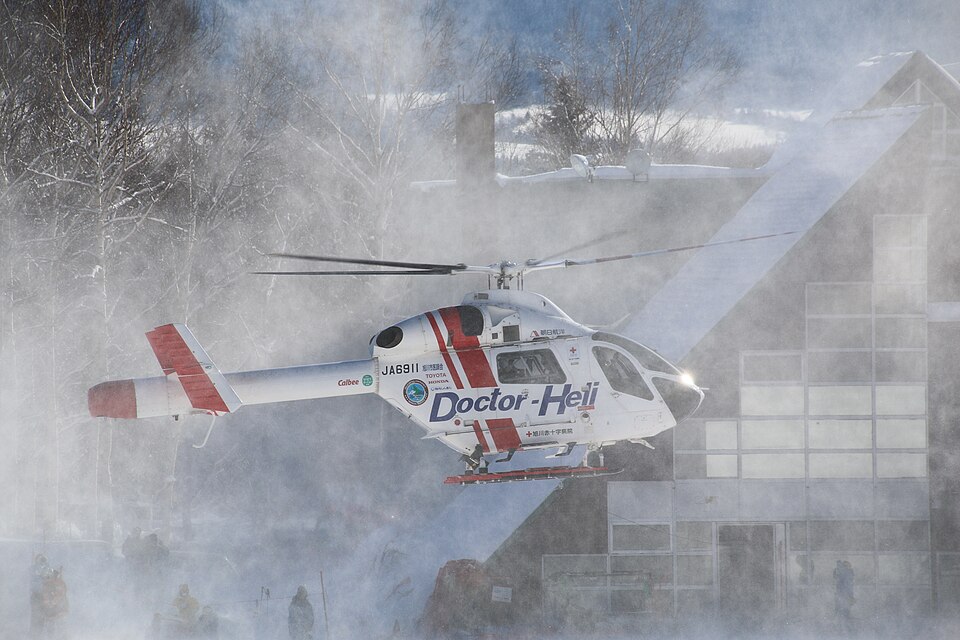
Flight History
On July 8, 2012, at approximately 16:56 Japan Standard Time, a McDonnell Douglas MD900 helicopter, registered JA6911, operated by Aero Asahi Corporation, began takeoff from the roof-top landing field of Japanese Red Cross Asahikawa Hospital. The aircraft was intended to transport an emergency patient from another landing field. On board were the pilot in command and three other persons. After becoming airborne and climbing vertically about 15 ft while turning, a low, hollow booming sound came from the left rear. The engine-out warning alarm then sounded. A passenger momentarily observed a fire spark and black smoke from the left rear. The pilot saw the "ENG OUT" warning annunciator flashing, the No.1 engine tachometer (Np) and torque meter reading zero, while the No.2 engine tachometer was in the green zone but its torque meter indicated the red zone. The pilot increased forward speed to avoid losing altitude and cleared obstacles. Judging that restarting No.1 engine was impossible and that flying to Asahikawa Airport was safer than returning to the helipad, the pilot continued to Asahikawa Airport and landed at 17:09. No persons were injured.
Damage to Aircraft and Engine
The aircraft sustained minor damage. No.1 engine suffered major internal damage. The compressor turbine (CT) vane ring, CT blades, power turbine (PT) stator, PT blades, and turbine support case (TSC) were damaged. CT and PT blades fractured around the full circumference, and other components were heat-damaged. The TSC showed perforation, discoloration, and deformation from heat. Two perforations in the TSC, one aligned with the damaged section of the CT vane ring at the six o'clock position (viewed from the combustion chamber side).
Investigation Findings
The Japan Transport Safety Board (JTSB) conducted the investigation. Teardown and inspection of No.1 engine, with support from Canadian authorities, revealed numerous axial small fatigue cracks on the inner surface of the outer wall of the CT vane ring near the six o'clock position. These cracks were thermal fatigue cracks from repeated high-temperature exposure. One vane at the six o'clock position had burned away. The cracks initiated from corrosion but showed no sulfuric corrosion along the cracks. Evidence of overheating was present at the six o'clock position but not at other locations where minor cracks existed. The engine data recorder indicated the exhaust gas temperature reached 1,011°C at the time of the event, exceeding the operating limit of 850°C. Fuel system components had no anomalies. No weather, pilot, or rotorcraft involvement were identified.