Accident Overview
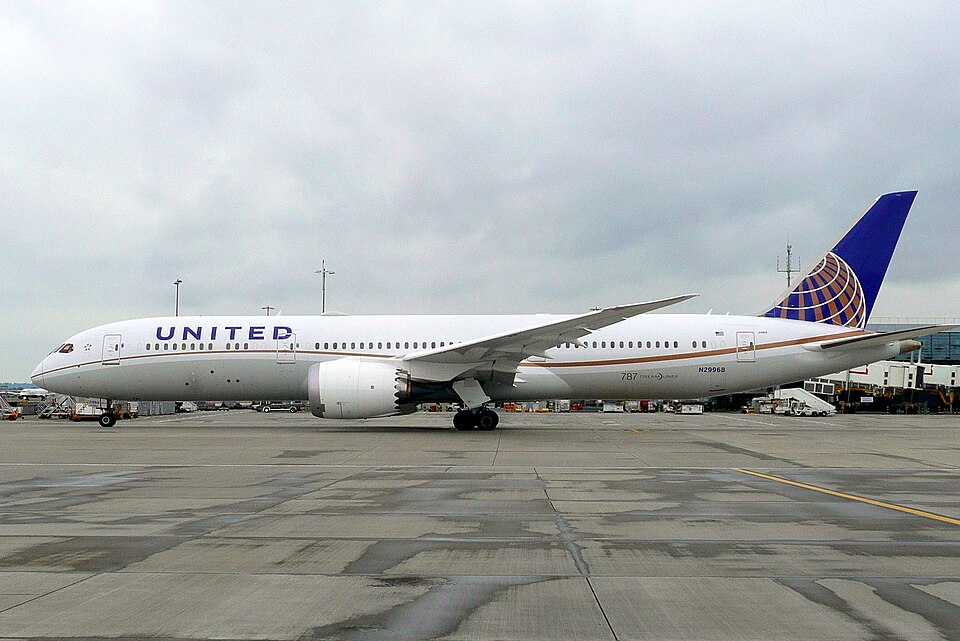
On Saturday, July 1, 2017, a Boeing 787-9 aircraft, registered N29968 and operated by United Airlines, Inc., was operating as scheduled flight 875 from San Francisco International Airport to Tokyo International Airport. While descending through clouds at an altitude of approximately 15,600 feet, about 64 km southwest of Fukushima Airport, the aircraft encountered a jolt. One flight attendant (FA) who was working in the aft galley lost her balance and struck her knee on the floor, suffering a serious injury.
Flight History
The flight departed San Francisco with 261 persons on board: the pilot in command (PIC), 14 other crew members, and 246 passengers. The PIC was in the left seat as pilot-monitoring (PM), and the first officer (FO) was in the right seat as pilot-flying (PF). The aircraft descended while decelerating through several cloud layers toward Tokyo International Airport. The PIC had turned on the seat belt sign prior to the descent, but no additional verbal instruction to be seated was given to the flight attendants because no severe turbulence was expected and the jolt was light during the descent through clouds. The aircraft encountered showers, but no heavy rain was displayed on the onboard weather radar, either in auto mode or when the tilt angle was adjusted manually. The jolt occurred at around 13:10 JST. According to the Continuous Parameter Logging (CPL) records, the vertical acceleration changed to +0.82 G, then +1.68 G, followed one second later by +1.13 G, and three seconds later by +0.76 G. The aircraft was flying with autopilot and auto-throttle engaged. After the jolt, the PIC descended to about 14,000 feet using speed brakes to exit the clouds. No turbulence or significant weather had been forecasted for the route either before or during the flight.
Injuries and Damage
One flight attendant suffered a serious injury. The aircraft sustained no damage.
Personnel and Aircraft Information
The PIC was a 61-year-old male holding an airline transport pilot certificate with a Boeing 787 type rating, total flight time 23,521 hours (2,648 hours on type). The FO was a 51-year-old male with an airline transport pilot certificate and Boeing 787 type rating, total flight time 11,106 hours (254 hours on type). The aircraft was a Boeing 787-9, serial number 60141, manufactured on January 17, 2017. Its weight and center of gravity were likely within allowable limits. The Enhanced Airborne Flight Recorder (EAFR) data were overwritten after the accident.
Meteorological Conditions
At the time, a tropical depression with a central pressure of 1,008 hPa was moving east over the sea south of Shikoku, and a stationary front extended from off the San'in Region to the Noto Peninsula and northern Kanto Region. Radar echoes equivalent to hourly rainfall of 0–5 mm were observed over a wide area, with scattered areas of 5–10 mm. An hourly atmosphere analysis chart showed vertical wind shear (VWS) of 6–9 kt/1,000 ft near the accident location. The temperature lapse rate near 15,000 ft was larger than the dry adiabatic lapse rate, indicating unstable atmospheric conditions. No pilot reports (PIREPs) of turbulence were filed within one hour before the accident.
Probable Causes
The Japan Transport Safety Board stated the probable cause: "In this accident, it is highly probable that because the Aircraft jolted while descending in cloud area near a stationary front, a flight attendant who was working in the aft galley lost her balance and suffered a serious injury."