Flight History
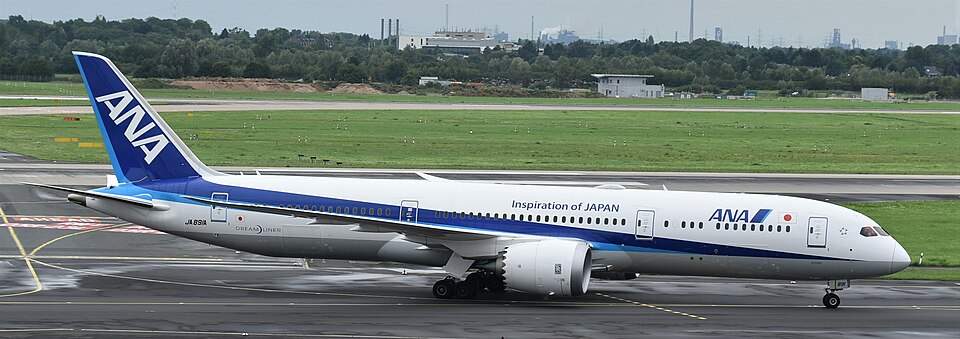
On Wednesday, March 20, 2024, a Boeing 787-9 registered as JA891A, operated by All Nippon Airways, departed from Los Angeles International Airport as scheduled Flight 5. At approximately 15:50 Japan Standard Time, the aircraft began its descent toward Narita International Airport. The flight crew consisted of a Pilot in Command (PIC) aged 60 with 17,508 total flight hours, an Acting PIC aged 58 with 13,225 hours, and a Co-pilot aged 43 with 8,704 hours. The PIC occupied the left seat as Pilot Flying, the Acting PIC the right seat as Pilot Monitoring, and the Co-pilot sat in an observer seat.
During the pre-flight briefing, no information was received about other aircraft being struck by lightning on the approach path. In-flight weather information from a tablet application and ACARS indicated echoes to the south and off the Boso Peninsula, but none significant on the aircraft's path. The crew used airborne weather radar with different sensitivity settings to avoid weak echo areas. After receiving ATC clearances, the aircraft changed heading from 250° to 220° and later to 270°, passing through areas considered clear of weather.
Lightning Strike and Aftermath
At approximately 16:15 JST, while flying at an altitude of about 1,500 meters, approximately 77 km east-southeast of Narita International Airport (35° 30' 00" N, 141° 10' 30" E), the aircraft was suddenly struck by lightning. The aircraft was in thin clouds with the sea surface visible near the cloud base. Immediately after the strike, the message “WXR RADAR SYSTEM L” appeared, but the radar display and other instruments remained normal. A brief burning smell was noticed. The flight crew detected no further anomalies, and the aircraft landed at Narita at 16:29.
Damage
Post-landing inspection revealed substantial damage: two locations of delamination on the outer skin of the forward right side fuselage requiring major repairs, along with ten burn marks on the upper and rear areas of the fuselage and two burn marks on the radome. No injuries were reported among the 207 people on board (including 12 crew and 195 passengers).
Weather Conditions
According to the Japan Meteorological Agency, a low-pressure system with fronts was moving eastward off the Kanto coast, with a weak pressure trough to the south. At 16:00, a line of active cumulonimbus clouds with lightning was observed off the Boso Peninsula, away from the approach path. The temperature at 1,500 m was minus 2°C. Thunder nowcasts indicated increasing lightning activity near the strike point between 15:30 and 16:10.
Aircraft Information
The Boeing 787-9 (serial number 40751, manufactured March 29, 2017) had a total flight time of 29,826 hours at the time of the accident. The aircraft's weight and center of gravity were within allowable limits. The Enhanced Airborne Flight Recorder (EAFR) showed no vibration or impact anomalies; the voice recording had been overwritten.
The fuselage outer skin is made of carbon fiber reinforced plastic (CFRP), which differs from conventional aluminum alloys. The CFRP structure includes toughened epoxy resin layers to prevent delamination.