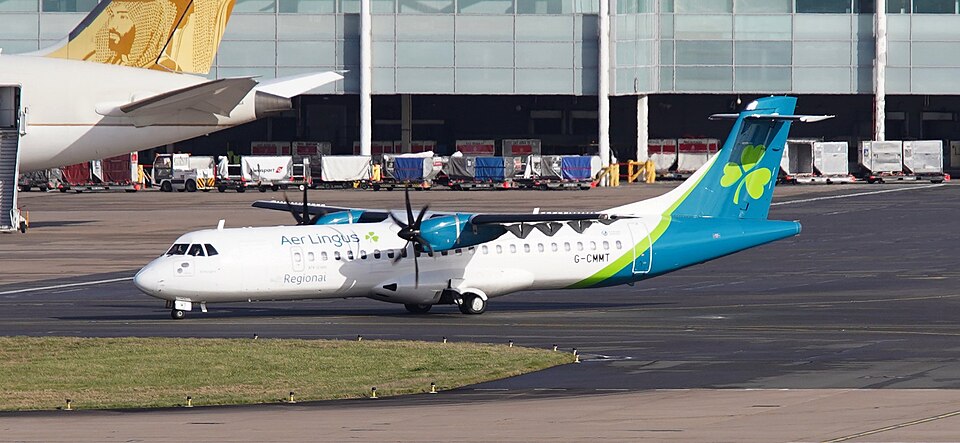
Incident Overview
On 30 December 2023, an ATR 72-212A (registration G-CMMT) operating a scheduled passenger flight from Edinburgh Airport to Belfast City Airport sustained landing gear damage during a heavy touchdown. The aircraft was on its second approach to Runway 22 in gusty wind conditions. After the heavy landing, the commander initiated a go-around and diverted to Belfast Aldergrove Airport, where an uneventful landing was performed. There were no injuries among the four crew and 53 passengers. The left main landing gear and nose landing gear required replacement due to excessive loads and visible damage.
Flight History
The flight crew were aware of the operational challenges at Belfast City Airport when winds exceed 15 kt from a south-easterly direction (100°-160°). The commander flew both approaches. The first approach was discontinued near Decision Height due to destabilising wind effects. The second approach was reportedly uneventful until the flare. During the flare, wind effects destabilised the aircraft, resulting in a firm touchdown on the left main landing gear. The aircraft bounced and then touched down heavily a second time, nose landing gear first. The commander then executed a go-around.
Airfield Considerations
Belfast City Airport's entry in the UK Aeronautical Information Publication includes a warning to pilots about anticipated windshear on approach to Runway 22 when the surface wind direction is between 100° and 160° with speeds of 15 kt or more. Turbulence may be expected on approach or climb out.
Recorded Data
Flight data and cockpit voice recorder information were reviewed. Both approaches were stabilised at 1,000 ft. For the second approach, the last reported wind from ATC was 140/22, within the 28 kt maximum crosswind limit for the runway conditions. Automatic altitude callouts proceeded normally down to 20 ft. Below 500 ft, the recorded calibrated airspeed fluctuated between +10 and -9 kt of the target VAPP of 120 kt. At approximately 70 ft, the speed became more unstable, averaging about 134 kt over eight seconds. In the final two seconds before the first touchdown, CAS values were 124 and 130 kt.
Aircraft Damage
The operator reported damage to the nosewheel tyres and a slightly bent left nosewheel axle. Flight data indicated a normal acceleration of approximately 2.2 g at touchdown. The aircraft manufacturer assessed that both the left main landing gear and nose landing gear experienced loads beyond their design limits, necessitating replacement before the aircraft could return to service.
Conclusion
The landing gear sustained damage during a heavy touchdown after the aircraft became destabilised due to wind effects experienced during the flare, immediately before touchdown.