History of the Flight
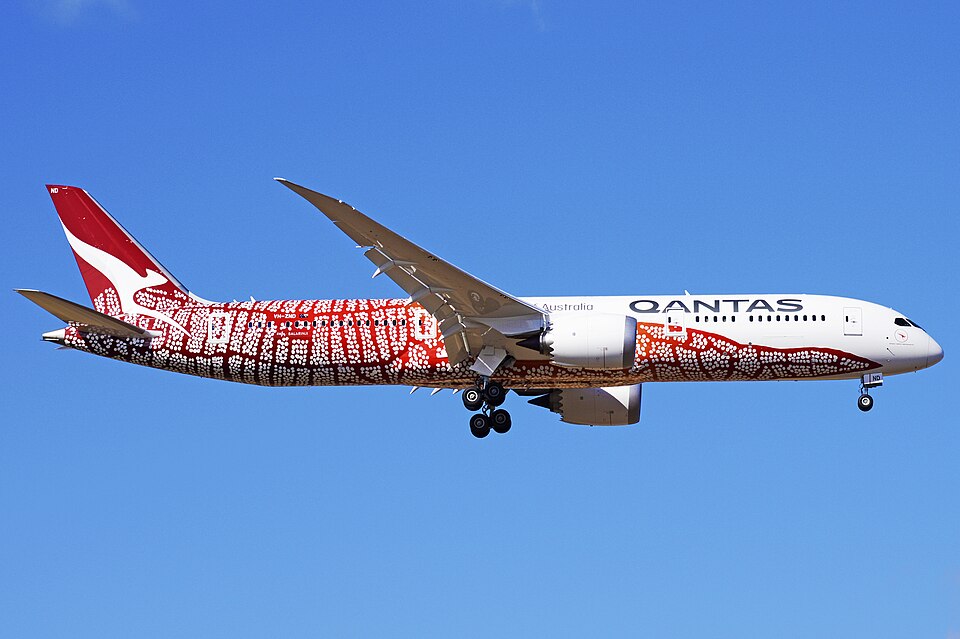
On 9 February 2020, a Boeing 787-900, registration VH-ZND, was on a scheduled flight from London Heathrow Airport to Perth, Australia. During takeoff from Runway 27R, the surface wind was reported as 220° at 28 kt gusting 44 kt. The acceleration was normal, and at VR of 172 KIAS, the pilot flying initiated rotation coincident with a strong gust. Shortly after becoming airborne, the EICAS tail strike message was displayed. The crew held southwest of Heathrow at 6,000 ft, carried out the Quick Reference Handbook (QRH) actions, which prevented aircraft pressurisation, and prepared to return to Heathrow. They were radar-vectored for an approach to Runway 27L, where an overweight landing was made.
Aircraft Information
The Boeing 787 is equipped with a tail strike protection system that automatically adjusts elevator position to reduce tail contact potential during takeoff and landing. A tail strike detection sensor, a 2-inch blade on the rear lower fuselage, provides a caution message on EICAS if its electrical circuit is compromised by ground contact, accompanied by an aural warning and master caution light.
Aircraft Examination
After landing, the tip of the tail strike detection sensor showed abrasion due to runway contact. No other damage was found.
Recorded Information
Flight data from the Continuous Parameter Logging (CPL) system and FDR showed the aircraft was correctly configured for takeoff with flaps set to five and VR at 172 kt. During the takeoff run, airspeed fluctuations occurred due to gusty winds. At 160 KIAS, airspeed rapidly increased to 175 KIAS, at which point rotation began. As the aircraft pitched up, airspeed reduced to 172 KIAS and stagnated briefly. The pilot flying moved the control column aft to 4°, then slightly forward to 3°, but pitch rate increased to 3.2°/s. Airspeed then increased, and the pilot pulled back on the control column while moving the control wheel from 20° counter-clockwise to 33° counter-clockwise, causing left spoilers to deploy from 5° to 20°. At a pitch attitude of 6.3° nose-up, pitch rate reached nearly 4°/s with tail height 4.5 ft. The tail strike prevention system activated, reducing pitch rate to 2°/s. The pitch attitude at takeoff was about 9.7°, with tail height less than 2 ft. The aircraft manufacturer stated that the near tail contact resulted from a combination of factors including high pitch rate close to lift-off, airspeed stagnation, and control wheel usage deploying spoilers on the left wing.
Weight and Balance
The aircraft takeoff weight was 253,400 kg, below the maximum takeoff weight of 254,011 kg, with a center of gravity at 22.1% MAC (forward limit 20.25% MAC, aft limit 24.3% MAC).
Meteorological Conditions
Storm Ciara brought strong winds and heavy rain across the UK. An active occluded front crossed the London Terminal Manoeuvring Area, with intense rainfall and strong south-westerly winds. METAR observations showed wind from 220° with mean speeds 26-29 kt and gusts 37-45 kt. The observation closest to the incident (1250 UTC) recorded mean wind 27 kt gusting 44 kt. Visibility lowered to 3,900 m with cumulonimbus cloud.
Analysis
Although the aircraft operated within its weight, CG, and wind limitations, the gusty conditions caused rapid airspeed increase just before rotation. The initial pitch rate of 2°/s increased to 3.2°/s and then 4°/s, when the tail strike prevention system reduced it to 2°/s. Lateral control wheel inputs deployed left spoilers, decreasing lift. The combined effect led to a pitch angle reaching the tail contact angle of 9.7°, triggering the EICAS message.
Conclusion
During strong, gusty winds, a high pitch rate near lift-off activated the tail strike prevention system. The tail contact angle was reached, and the crew received the EICAS tail strike message.