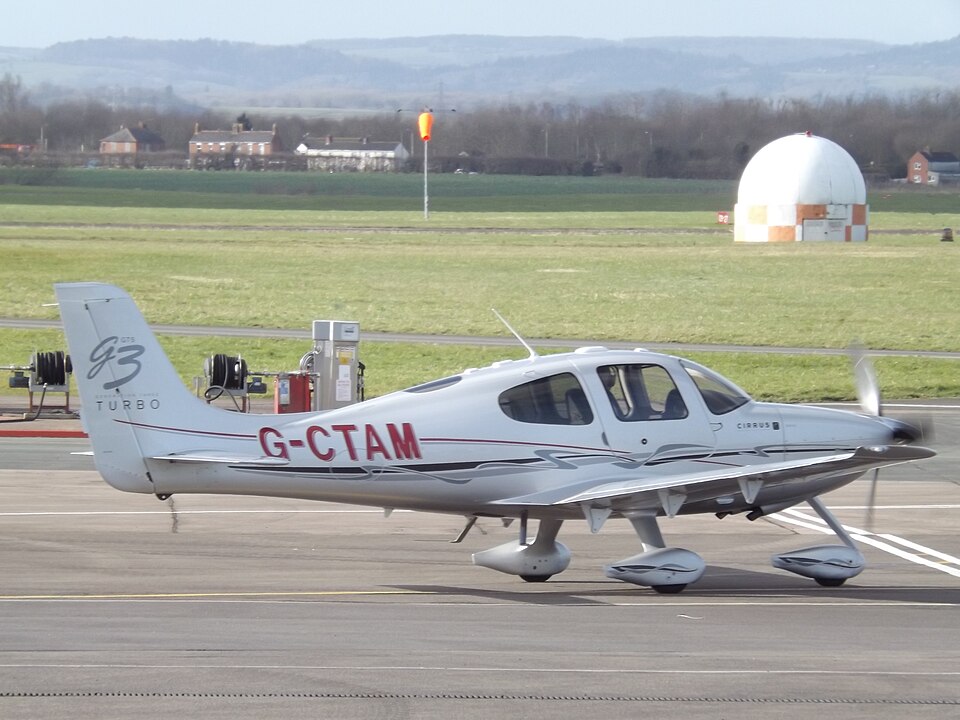
Summary
On 31 May 2020, a Cirrus SR22 (registration G-CTAM) experienced a loss of engine power while descending near Calshot Spit, Hampshire. The pilot deployed the aircraft's Ballistic Parachute Recovery System (BPRS), and both occupants exited the aircraft uninjured after a ditching. The aircraft was damaged beyond economical repair.
History of the Flight
The aircraft had been refueled to tab level on 28 May 2020 at Lee-on-Solent, adding 126 litres to achieve a total of 227 litres. The pilot set the MFD initial fuel to 220 litres as a contingency margin. The aircraft flew a return trip to Turweston Aerodrome, recording 1 hour 13 minutes airborne.
On 31 May, the pre-flight checks at Lee-on-Solent showed 127 litres usable fuel on the MFD. The aircraft departed at 1054 UTC for Dunkeswell, landing at 1130 UTC. After lunch, the pilot noted 84 litres usable fuel at 1245 UTC, calculating 43 litres used for the outbound leg.
The return flight took off at 1305 UTC, climbing to 3,400 ft. The pilot used fuel leaning for 75% cruise power. He altered the route to pass over Bournemouth Airport, then descended to 1,700 ft at reporting point OLGUD. The MFD showed 12 USG at OLGUD and 11 USG at Lee-on-Solent.
During a slow descent toward Lee-on-Solent, at about 1,400 ft, the pilot felt the engine cough. Initially suspecting a mixture lever error, he confirmed the lever correct. The fuel caution light illuminated, and the engine ran roughly. The pilot called Lee-on-Solent, reporting fuel exhaustion. He changed fuel tank selection, causing a brief recovery, then failure. He did not use the fuel pump boost. At 800 ft, he changed tank selection again with no improvement. At 600 ft, he turned parallel to shore, briefed the passenger, and deployed the BPRS.
Ditching and Recovery
The aircraft touched down in the sea 3.4 nm west of Runway 05 at Lee-on-Solent and 0.5 nm southeast of Calshot Spit beach. The nose went briefly underwater, then the aircraft floated upright with wings slightly submerged. Both occupants exited through the right door onto the wing. The parachute remained inflated, inverting the aircraft as they swam clear. A windsurfer assisted, and the Hamble Lifeboat rescued both occupants uninjured. The parachute dragged the inverted aircraft to shore.
Post-Accident Examination
A rescuer, also a pilot, turned off the fuel selector, battery master, and magnetos. Police reported no fuel leaks. The next day, an insurance loss adjuster observed the throttle fully forward, mixture near fully forward, fuel pump off, and fuel selector in right-off. The recovery team opened the fuel tanks; both main tanks contained no more than two or three pints of fuel with a small amount of sea water. The collector tanks had a trace of fuel and some sea water. No visible fuel leakage was noted. The aircraft sustained significant damage to the upper fuselage and windscreen from being dragged upside down across the beach.
Probable Cause
The loss of power was probably caused by fuel starvation to the engine, but the cause of the starvation could not be determined.