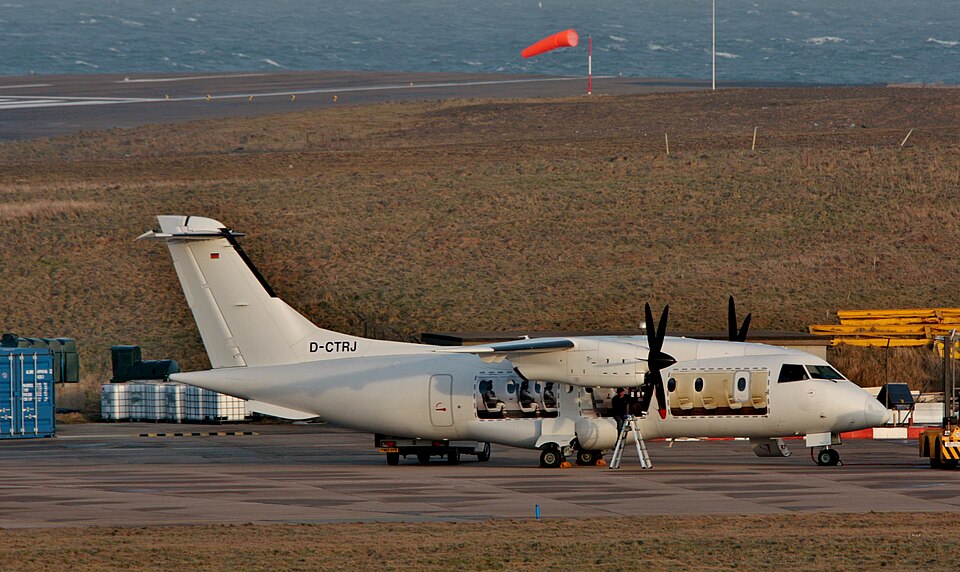
History of the Flight
The flight was an EASA certification test flight aimed at increasing the maximum demonstrated crosswind of the Dornier 328 from 21 kt to 30 kt. The commander, aged 64 with an Airline Transport Pilot’s Licence and 10,379 total flying hours (4,035 on type), occupied the right seat as pilot monitoring. The pilot flying, an EASA test pilot with only 30 minutes on type, sat in the left seat. Three full-stop landings on Runway 09 were accomplished using 20° of flap before the final approach with 32° of flap.
Weather at Sumburgh Airport was reported as wind from 160° at 24 kt gusting 36 kt, visibility 8,000 m, and scattered cloud at 1,100 ft. ATC provided a two-minute average wind of 160° at 26 kt to the crew during final approach.
The Incident
On the final landing, the aircraft touched down slightly to the left of the runway centreline. The pilot flying selected ground idle power. The aircraft moved right toward the centreline, but when left rudder was applied to maintain runway heading, it had no effect, and the aircraft began drifting right. In an attempt to regain directional control and prevent a runway excursion, the pilot applied left brake. At the same time, he inadvertently relaxed his aileron input, causing aileron deflection to reverse from a ‘roll right’ to a ‘roll left’ sense. This resulted in the right wing lifting and the right main landing gear rising off the runway.
Believing this was due to his brake application, the pilot ceased differential braking and re-applied right aileron. The bank angle reduced, and the right mainwheel touched down again. Thinking he had applied reverse thrust and that this might have reduced rudder effectiveness, the pilot moved the power levers forward to what he thought was ground idle. In reality, he had moved them to flight idle, increasing power. The commander immediately returned the levers to ground idle and applied maximum reverse thrust.
The aircraft yawed left, but despite full left rudder and the commander’s intervention, control could not be regained. The aircraft exited the runway onto grass at approximately 25 kt. The soft ground brought the aircraft to an abrupt halt.
Flight Data
Recorded flight data indicated that during the first 1.5 seconds after touchdown, aileron deflection increased to approximately 14° in a ‘roll right’ sense. Over the next 5.5 seconds, deflection reversed to about 11° in a ‘roll left’ sense as the right main landing gear lifted. Left rudder was applied progressively, reaching maximum travel three seconds after main gear touchdown and 1.5 seconds after nose gear touchdown. Maximum left rudder input was maintained until after the aircraft left the runway.
Data from the nose landing gear weight-on-wheels switch suggested that the nosewheel steering did not engage after touchdown except for brief periods, as the switch disengages steering when weight is off the wheels.
Assessment
The pilot flying stated that he attempted to regain control through asymmetric braking and cancellation of reverse thrust, but inadvertently relaxed left aileron input, lifting the right wing and main gear. The commander considered that when the right main gear lifted, the aircraft began to weather-cock into wind, leaving insufficient directional control in the strong crosswind to prevent the runway excursion.
It is likely that the nosewheel steering was only engaged intermittently during the landing roll, which would have contributed to the handling difficulties.