History of the Flight
The pilot was flying his second flight of the day, having flown from Turweston to Little Gransden earlier. For the return leg, he was accompanied by a friend, also a PPL holder. The weather was benign with forecast wind from 050° at 10 kt. The flight was uneventful, and after observing an aircraft landing at Skegness, the pilot prepared for a straight-in approach to Runway 03.
The aircraft touched down just before the runway intersection. After approximately 100 m, it began to veer to the left, leaving the mown grass runway into long grass and continuing toward a drainage ditch that ran perpendicular to the runway. The aircraft entered the ditch and struck the far side at approximately 45°, causing fuselage deformation and collapse of the right main landing gear and nose landing gear before coming to rest next to the ditch.
Both the pilot and passenger were unconscious after the accident. The passenger regained consciousness with his torso on the upper surface of the wing and his head on the grass, with the aircraft door open. He then found the pilot in his seat with his head resting on the passenger side instrument panel. The pilot was later airlifted to hospital, where he was treated for head injuries, bruising, and fractured vertebrae. Both occupants had been wearing three-point seatbelts during the flight; the pilot's seatbelt was still fastened after the accident, but the passenger does not know whether his seatbelt was fastened.
The pilot recalled the flight up to final approach but does not remember the landing or subsequent departure from the runway. He does not know whether he lost consciousness due to the accident or during the landing roll. No recording devices were on board. The passenger recollected a smooth landing and initial central roll, but then noticed the aircraft veering left. He called to the pilot about trees rapidly approaching to the left. He then remembers a violent left turn as the aircraft entered the ditch, but nothing else until waking after the accident. He does not recall the pilot speaking during the sequence.
Aircraft Information
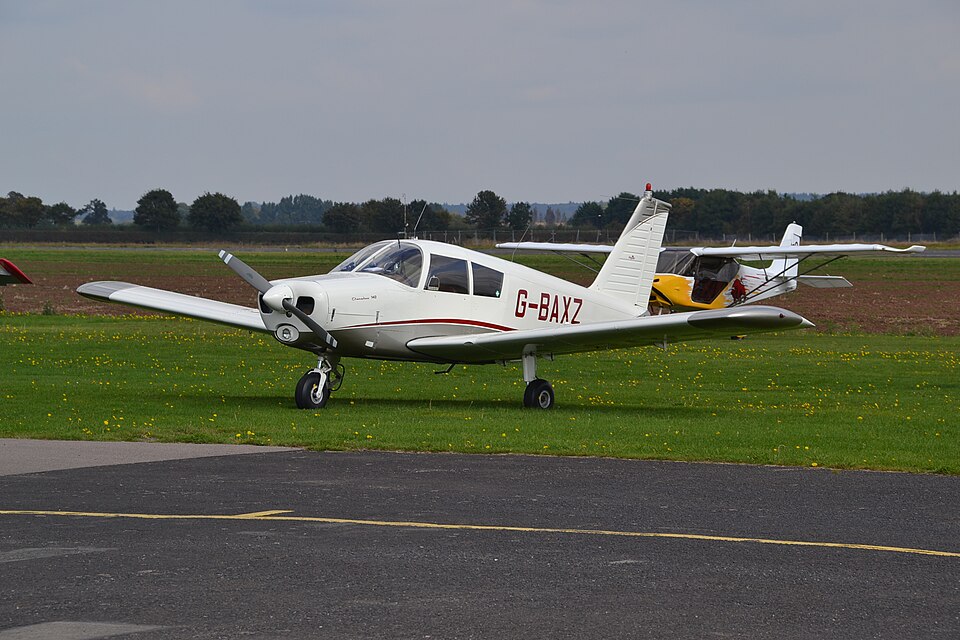
The Piper PA-28-140 is a four-seat light aircraft with fixed tricycle landing gear. The cabin is accessed by a single overwing door, hinged at the front and secured by a sprung latch below window level and a pin and hook mechanism at the top. The front seats are fitted with adjustable lap belts and inertia-reel shoulder straps.
Examination
AAIB assessment found that the aircraft fuselage was deformed such that the door would not fit the frame. The sprung latch functioned normally, but the pin in the top of the door frame onto which the hook engages had been pulled out. The door stay was broken, allowing the door to open beyond its normal range.
Both seatbelt inertia reels activated normally. The seatbelt buckles functioned normally, but the passenger latch plate required slightly more force to be correctly seated in its buckle.
A subsequent assessment by a salvage organization found no obvious technical issue with the aircraft that could account for the loss of directional control.
Analysis
With the pilot unable to recall the end of the flight, no recording devices on board, and no findings from the aircraft examination, it is not possible to determine why the aircraft veered off the runway. Both occupants wore three-point seatbelts, but the seatbelts would not have restrained them laterally during the left turn into the ditch and the abrupt stop when striking the far side, which explains the pilot's head striking the instrument panel and the passenger's movement forcing the door open and pulling out the upper door locking pin. It is not possible to determine how the passenger ended up partially outside the aircraft; the seatbelt clasp may not have been fully engaged and parted under load, or the impact may have dazed him such that he unfastened his seatbelt before losing consciousness while attempting to exit.