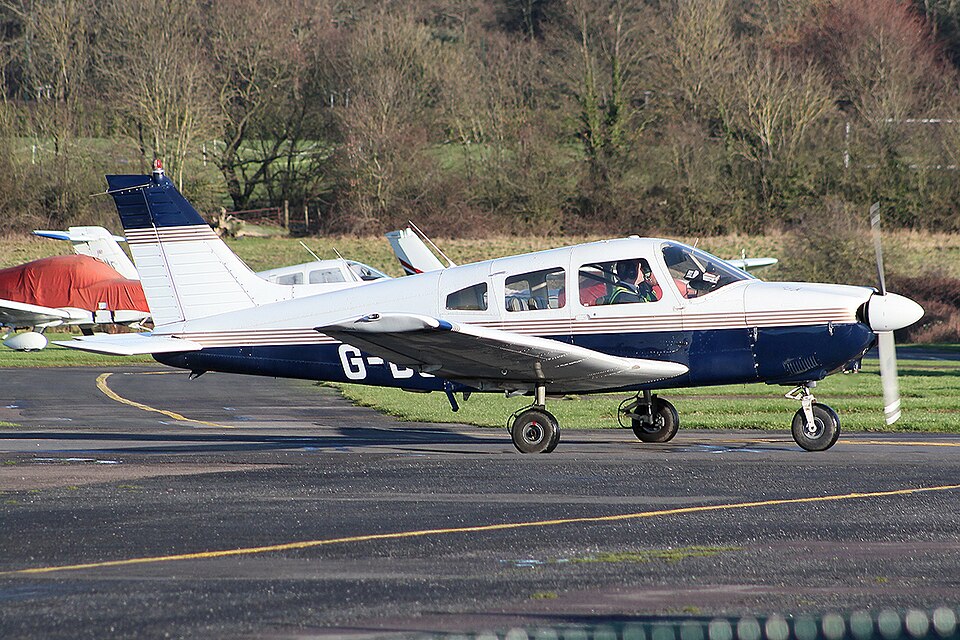
Flight History
On 7 January 2018, a Piper PA-28-181 Cherokee Archer II (registration G-BSIZ) departed Elstree Aerodrome at 1010 hrs for a training flight. The student pilot practiced forced landing procedures in an area about 15 nm northwest of the airfield at altitudes up to 3,500 ft. Both pilots stated that carburettor heat was applied regularly during the exercise. During the transit back to Elstree, carburettor heat was de-selected when the aircraft was approximately 7 nm from the airfield at 1,700 ft above airfield level (aal). It was reselected before the throttle was reduced to idle for a descent to 1,000 ft aal, the circuit altitude. The aircraft routed overhead the airfield from north to south to join the right-hand circuit for Runway 08.
Landing and Damage
After inadvertently descending to 900 ft aal, the student advanced the throttle, but the engine power did not increase. He immediately checked that all fuel and electrical indications were normal, and both pilots made further unsuccessful attempts to restore power. The instructor then took control, manoeuvred the aircraft toward a field one mile south of Elstree, and actioned the engine failure checklist. No power increase was apparent, so at approximately 500 ft agl he transmitted a MAYDAY call and completed the forced landing checklist.
The aircraft touched down in a wet, muddy grass field on all three wheels. The nosewheel then lifted off briefly before contacting the ground a second time and detaching. The propeller and nose dug in, causing the aircraft to turn left through about 90°, while the right wing struck the ground and incurred severe damage. The two occupants, both uninjured, exited the aircraft and called the airfield to report the incident.
Aircraft Examination
Following examination, the aircraft owner reported that no engine fault was found and that both fuel tanks contained fuel before the aircraft was recovered. Carburettor icing was suggested as a possible cause for the engine problem, even though the instructor reported that carburettor heat was used in accordance with the manufacturer’s procedures.
Environmental Conditions
Met Office records indicate that the outside air temperature during the return to Elstree was approximately 0°C, with a dew point about 0.5°C lower. According to guidance documents referenced in the AAIB comment, these conditions placed the aircraft at risk of serious icing at any power setting.
The AAIB noted that loss of engine power has been attributed to carburettor icing in several previous reports, even when carburettor heat was used as recommended.