Summary
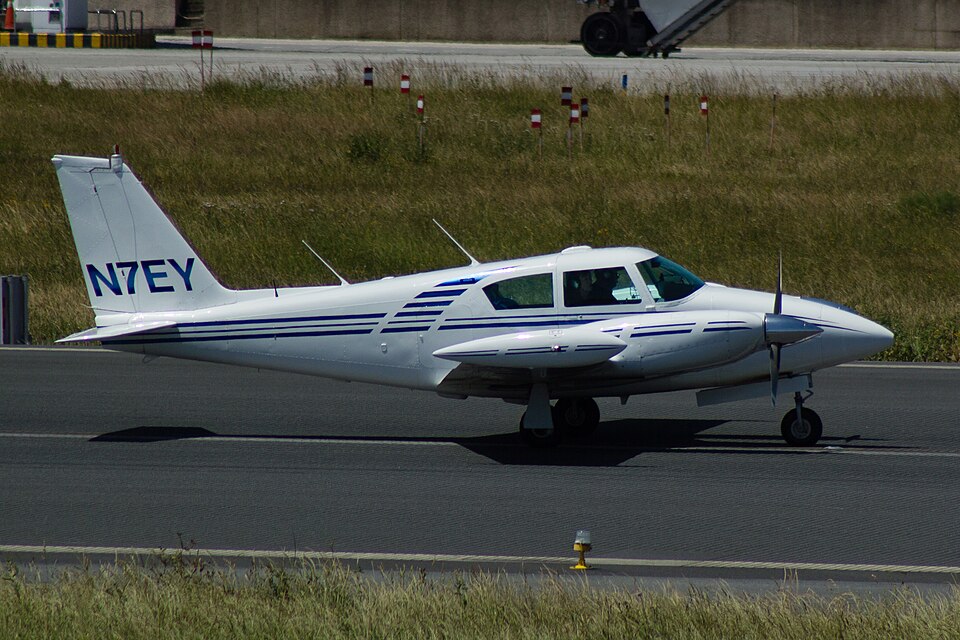
On 10 September 2017, a Piper PA-30A Twin Comanche, registration N7EY, was landing on Runway 06 at Farley Farm Airstrip, Hampshire, when it overran the runway and entered a hedge. The aircraft sustained damage to the right landing gear leg and minor damage to the right aileron and flap. The pilot and the single passenger were uninjured and vacated the aircraft unassisted.
Aircraft and Flight Information
The aircraft was a 1969 Piper PA-30A Twin Comanche powered by two Lycoming IO-320-B1A piston engines. The flight was a private flight, originating from White Waltham. The pilot, aged 60, held a Private Pilot’s Licence with 1,793 total flight hours, including 864 hours on type. The aircraft was being flown to Farley Farm Airstrip for a scheduled maintenance inspection.
Runway and Weather Conditions
Farley Farm Airstrip has a single grass runway oriented 06/24, 760 meters in length, at an elevation of 460 ft. The western end is bounded by trees, and the eastern end by a hedgerow. Runway 06 has an upslope; takeoffs are typically conducted on Runway 24 and landings on Runway 06. The windsock is located near the midpoint of the runway. The pilot reported that the runway surface was damp and soft following several days of wet weather.
Accident Sequence
The pilot flew from White Waltham, circled the Isle of Wight, and then proceeded to Farley Farm. Upon arrival, he performed a low pass overhead to check for model aircraft and ensure the runway was clear. He then joined the circuit for Runway 06. The approach experienced some turbulence over the trees. The pilot touched down approximately 200 meters into the runway. After applying the brakes, the aircraft did not decelerate as expected. Approximately 100 meters before the end of the runway, the pilot realized he would not stop. He attempted a ground loop, but the aircraft continued forward and slid sideways into the hedge. The right landing gear leg folded inward.
Meteorological Information
The pilot had received a surface wind report from Southampton Airport (6 nautical miles southeast) of 230° at 11 knots. The 1120 hours METAR from Southampton reported surface wind from 230° at 15 knots, varying between 200° and 260°, with visibility greater than 10 km and few clouds at 1,800 ft. The 1220 hours METAR reported gusts up to 26 knots.
Pilot’s Assessment
The pilot assessed the cause of the accident as a possibly stronger-than-anticipated tailwind combined with the damp condition of the grass, both of which contributed to reduced braking performance. A similar overrun accident occurred on Runway 06 at Farley Farm in May 2005, where a tailwind was considered a factor.