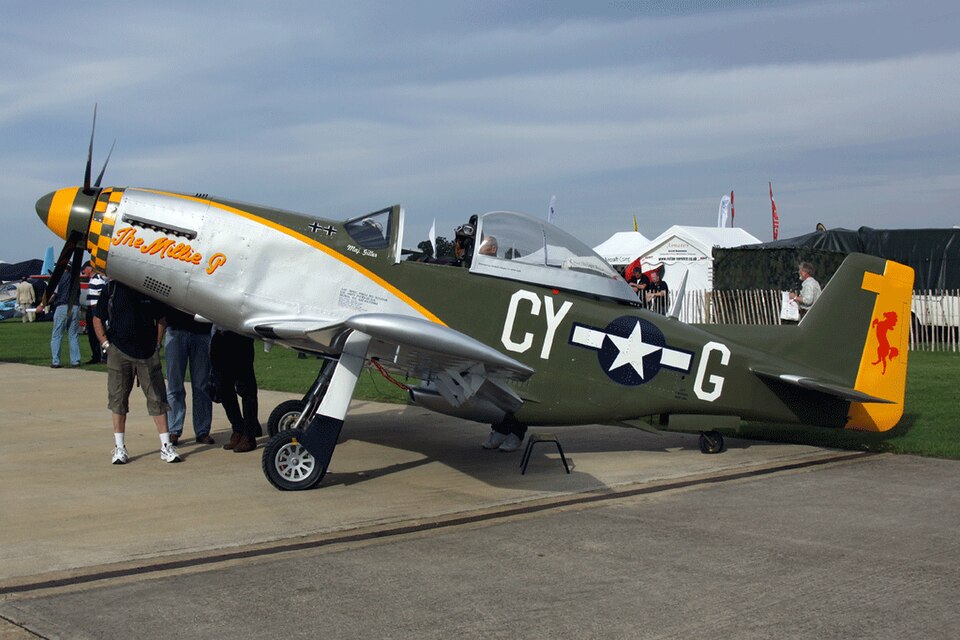
Accident
On 21 May 2020, at approximately 1235 UTC, a Titan T-51 Mustang (registration G-TSIM) suffered an engine failure while maneuvering near Shobdon Airfield, Leominster, Herefordshire. The aircraft was conducting a private flight with a single pilot on board. The pilot was uninjured, but the aircraft sustained extensive damage, particularly to the underside.
History of the Flight
The pilot was performing a check flight for a Light Aircraft Association (LAA) permit renewal. After completing the planned flight, he returned to the airfield for the final item: a VNE (velocity never exceed) run over the runway. As he turned onto the base leg for Runway 26, the engine suddenly lost power and began to wind down. Initially, the pilot continued toward the runway and made a MAYDAY call while lowering the landing gear. He selected the alternate engine ignition/injection computer, but the engine did not recover.
Realizing he would not reach the airfield, the pilot rapidly changed his plan for an off-field landing. He retracted the landing gear, selected full flap, and identified a suitable field at 250–300 ft above ground level. He maneuvered for a landing, leveling the wings just above the ground. After touchdown, the aircraft skated across the ground, yawed rapidly to the left, and slid sideways until stopping. The pilot described the landing as a “very rough ride.”
Engine Examination
Post-accident examination revealed that the propeller had windmilled down to touchdown, suggesting a mechanical fault was unlikely. The engine contained normal oil and coolant levels. Both fuel pumps functioned, and both fuel filters were free of debris. The engine’s fuel injection system is electronically controlled by a programmable unit, with a dual ignition/injection system switchable via a relay unit for redundancy. Although the pilot switched units after the power loss, the engine did not recover. The pilot considered an electrical failure in the ignition/injection system likely, but the exact fault could not be readily identified.
Survivability
Despite his head striking the canopy several times during the landing, the pilot was not injured. He commented that wearing a helmet almost certainly saved him from what could have been a serious head injury.
Conclusion
The pilot successfully performed a forced landing after the engine failed on approach. Although time was limited, he continued to assess options and adjusted his plan when the initial attempt became unviable. Despite extensive damage to the aircraft, the pilot was uninjured, likely due to wearing a helmet. The cause of the power loss was not established.