Preliminary Information
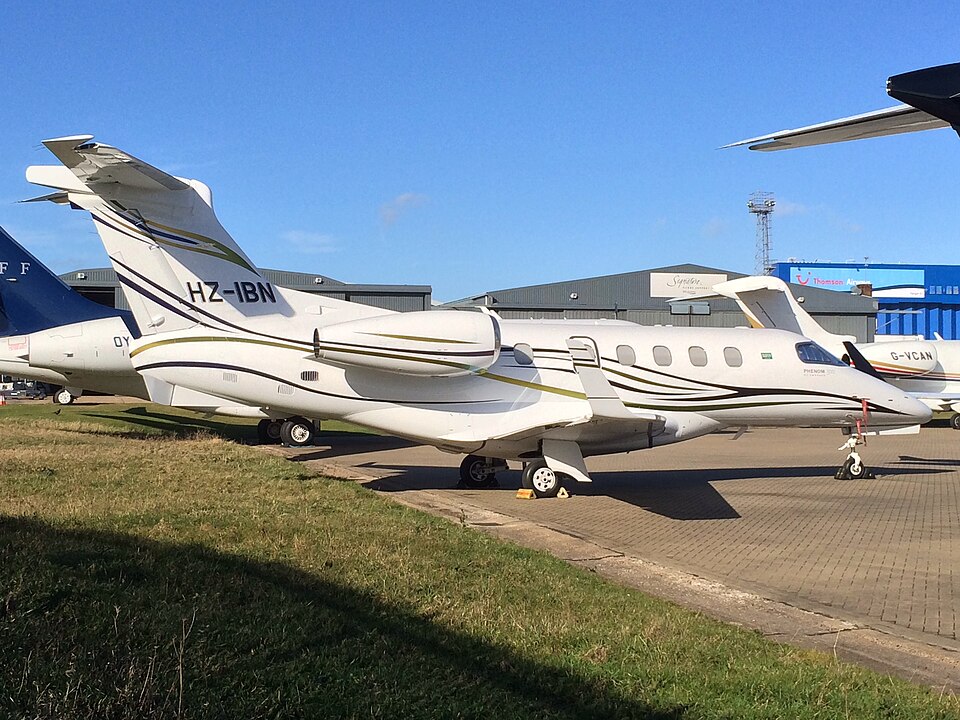
The aircraft, an Embraer EMB-505 Phenom 300 (registration HZ-IBN), was manufactured in 2010 and powered by two Pratt & Whitney Canada PW535E turbofan engines. It was operating a private IFR flight from Milan, Italy, to Blackbushe Airport, Hampshire, with one pilot and three passengers on board. The commander held an Airline Transport Pilot's Licence and was 57 years old, with 11,000 total flying hours, including 1,180 hours on the Phenom 300. His recent flying experience was 23 hours in the last 90 days and 5 hours in the last 28 days.
Approach and Descent
The flight was routine until the approach to Blackbushe. Weather conditions were fine with light and variable winds, visibility exceeding ten kilometres, and no low cloud. After being handed off to Farnborough Approach and then to Blackbushe Information, the aircraft entered a left-hand circuit for Runway 25 via the crosswind leg. On the downwind leg, it overtook a microlight aircraft and climbed slightly to pass ahead and above it. At approximately 1,000 ft above aerodrome level, a TCAS 'descend' Resolution Advisory was issued to resolve the conflict with the microlight. The TCAS advisory then changed to 'maintain vertical speed' and later 'adjust vertical speed', possibly for a second conflict with an aircraft above to the east. The aircraft then descended at up to 3,000 ft/min toward the runway threshold. The TCAS annunciated 'clear of conflict' when the aircraft was 1.1 nm from the threshold, at 1,200 ft aal and 146 KIAS, with landing gear down and flap 3 selected.
The operator estimated the landing weight at 6,522 kg, and the manufacturer calculated a target threshold speed of 108 KIAS. However, the approach continued at approximately 150 KIAS. Between 1,200 and 500 ft aal, the average rate of descent was about 3,000 ft/min, and at 500 ft aal it was 2,500 ft/min. The aircraft's Terrain Awareness and Warning System (TAWS) generated six 'pull up' warnings during the final approach.
Touchdown and Accident Sequence
The aircraft crossed the Runway 25 threshold at about 50 ft aal at 150 KIAS. Tyre marks on the runway indicated the aircraft touched down approximately 710 m beyond the threshold. Runway 25 has a declared Landing Distance Available (LDA) of 1,059 m, so the touchdown point was 349 m before the end of the LDA and 438 m before the end of the paved surface. Data from the Combined Voice and Flight Data Recorder showed a groundspeed of 135 kt and an airspeed of 134 KIAS at touchdown. The manufacturer estimated that at this speed, the landing ground roll required to stop the aircraft would be at least 616 m.
The aircraft departed the paved surface at the end of Runway 25, approximately three metres left of the extended centreline. It struck a one-metre-high earth bank, causing the lower section of the nose landing gear and nose gear doors to detach. The aircraft became airborne briefly before colliding with several parked cars at an adjacent business and coming to rest about 70 m beyond the bank. The wing detached from the fuselage during the impact sequence, and an intense fire developed shortly thereafter, consuming most of the aircraft. The aerodrome rescue and firefighting service attended, followed by local emergency services. All four occupants suffered fatal injuries.
Investigation
The Air Accidents Investigation Branch (AAIB) initiated a field investigation on the day of the accident. The aircraft wreckage was transported to the AAIB facility at Farnborough. The investigation is continuing with assistance from representatives of the State of Manufacturer and the State of Operator. A final report is expected to be published in due course.