Paraglider Crash in Puente Alto Injures Pilot and Passenger
A SkyWalk Join't 3 paraglider crashed into the ground near Las Vizcachas, Chile, on September 1, 2024. The pilot and passenger sustained serious spinal…
On May 2, 1980, a Douglas DC-9-80 (registration N980DC) was involved in an aviation accident near Edwards Air Force Base, California. Investigators recorded the probable cause as: The National Transportation Safety Board determined that the probable cause of this accident was "the pilot's failure to stabilize the approach as prescribed by the manufacturer's flight test procedures. This summary draws on records from the U.S. National Transportation Safety Board (NTSB) Aircraft Accident Reports.
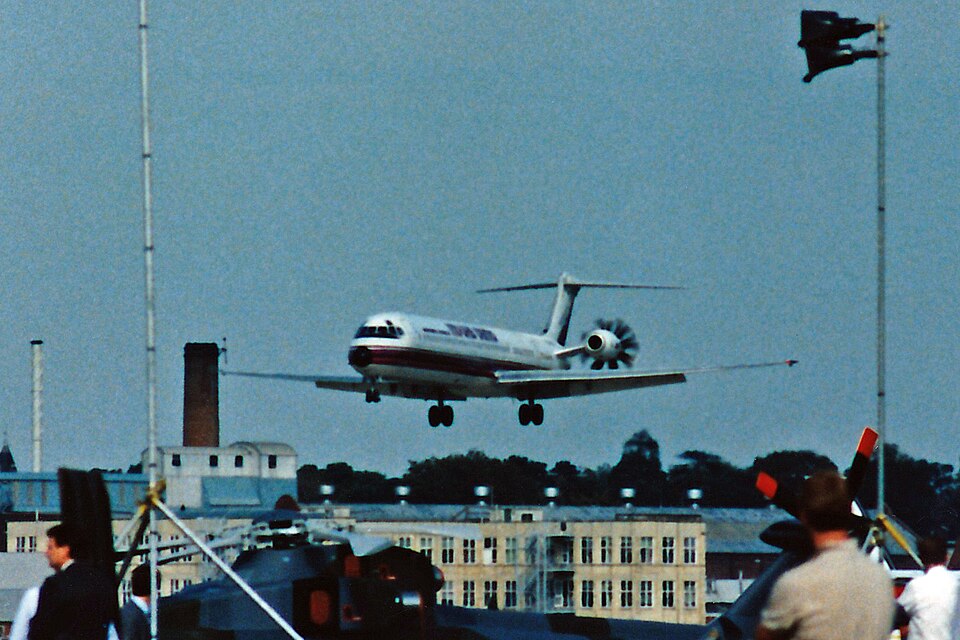
The National Transportation Safety Board determined that the probable cause of this accident was "the pilot's failure to stabilize the approach as prescribed by the manufacturer's flight test procedures. Contributing to the cause of the accident was the lack of a requirement in the flight test procedures for other flight crewmembers to monitor and call out the critical flight parameters. Also contributing to this accident were the flight test procedures prescribed by the manufacturer for demonstrating the aircraft's landing performance which involved vertical descent rates approaching the design load limits of the aircraft."
— NTSB Determination
About 0634 P.d.t. on May 2, 1980, a McDonnell-Douglas DC-9-80, registration N980DC, crashed while attempting to land on runway 22 at Edwards Air Force Base, California. The aircraft touched down with a descent rate that exceeded its structural limitations, causing the empennage to separate from the fuselage. The aircraft came to rest 5,634 feet beyond the landing threshold. One of the seven crewmembers on board sustained a serious injury; the others were uninjured.
### The flight
The aircraft had flown to Edwards Air Force Base from Yuma, Arizona. It was conducting a certification test flight to determine the horizontal distance required to land and bring the aircraft to a full stop, as required by 14 CFR 25.125.
The crew consisted of a McDonnell-Douglas engineering test pilot in command, an FAA engineering test pilot acting as copilot, three flight test engineers, and two technicians. The pilot in command had about 6,000 flight hours, including 265 in the DC-9-80. The copilot had 6,500 flight hours, with 40 hours in DC-9 aircraft, 95 of which were in the DC-9-80. The aircraft was the first DC-9-80 built and had accumulated 364.1 total flight hours. The weather was clear with 45 miles of visibility and calm winds.
### The sequence of events
The flight card procedures for the test landing required an approach speed (Vref) of 133 knots indicated airspeed (KIAS) to be held until 50 feet above the ground. At 50 feet, the target descent rate was 700 to 800 feet per minute (fpm), and engine thrust was to be reduced to idle. The landing flare was to begin at 25 feet, with full wheel brakes applied 0.5 to 0.75 seconds after main landing gear touchdown.
At about 452 feet, the pilot aligned the aircraft on the final approach course. He stated that he used the Head-Up Display (HUD) exclusively during the approach. The pilot said that at 100 feet, his decision height to continue, his maximum acceptable descent rate was 720 fpm and his airspeed was Vref plus 2 KIAS. According to the pilot, his sink rate at 100 feet was between 710 and 720 fpm and his airspeed was 132 KIAS, so he decided to continue the approach and land.
The pilot stated that at about 55 feet, he perceived a slight increase in the descent rate and decided to delay the thrust reduction. He thought he reduced thrust to idle at about 37 feet and began the landing flare at about 20 feet. Because he still perceived a slightly higher sink speed, he applied more back elevator force. The aircraft landed very hard, the nose fell through, and the nose wheel tires blew out. The pilot applied reverse thrust and wheel brakes, stopping the aircraft. After exiting, he saw that the empennage had separated and was lying on the runway.
The copilot stated that he thought the approach was reasonably stable to 100 feet, at which point he remembered seeing about an 800 fpm rate of descent and 135 KIAS. He then looked outside and stopped watching the airspeed and descent rates. A flight test engineer standing behind the observer's seat remembered that at 50 feet, the airspeed was about 130 KIAS and the rate of descent was about 300 fpm. He stated that immediately after passing 50 feet, the descent rate increased and the airspeed began to decrease rapidly, recalling a final descent rate of about 1,000 fpm just before touchdown.
### What the investigation found
The aircraft touched down about 2,298 feet beyond the runway threshold. The empennage separated from the aircraft at fuselage station 1429, fell to the runway, and came to rest about 3,690 feet beyond the threshold. The top and side of the fuselage were buckled substantially. One flight test engineer, whose foot was resting on an angled instrument console flange, broke his left ankle on touchdown.
Flight data recorder information showed that the aircraft was not stabilized during the final approach. At 450 feet, the rate of descent was about 910 fpm and the airspeed was 131 KIAS. The pilot increased thrust, and by 250 feet, the airspeed reached a maximum of 137 KIAS and the descent rate decreased to 400 fpm. Thrust was then reduced. At 100 feet, the descent rate was about 840 fpm and the airspeed was 132 KIAS. At 50 feet, the descent rate was about 950 fpm and the airspeed was 128 KIAS.
Calculations indicated that at 100 feet, the net thrust was about 5,000 pounds below what was required to maintain a stabilized 720 fpm descent at Vref. At touchdown, the airspeed was 125 KIAS and the descent rate was 990 fpm (16.5 feet per second), which exceeded the aircraft's ultimate vertical speed limitation for landing of 12.25 fps. Data showed the pilot deflected the elevators to their maximum trailing edge up position about 2 seconds before touchdown, which rotated the aircraft but did not decrease the rate of descent.
Post-accident engineering analysis requested by the Board indicated that a successful go-around could have been made if the pilot had initiated it at 50 feet. The analysis also showed that a flare initiated at 45 feet with full up-elevator could have reduced the descent rate to less than 10 fps at touchdown, though it exposed the aircraft to a potential tail strike. Additional abused landing controllability tests demonstrated that the aircraft had adequate elevator effectiveness and met FAA certification requirements.
The Board noted that the manufacturer's procedures for this test did not assign any crewmember the responsibility of monitoring airspeed and descent rate as a backup to the pilot. The Board also observed that the procedures used to demonstrate minimum landing distances require the pilot to land at sink rates close to the aircraft's limit loads, which is not representative of the way the aircraft is landed during routine line operations.
### Probable cause
The National Transportation Safety Board determined that the probable cause of this accident was "the pilot's failure to stabilize the approach as prescribed by the manufacturer's flight test procedures. Contributing to the cause of the accident was the lack of a requirement in the flight test procedures for other flight crewmembers to monitor and call out the critical flight parameters. Also contributing to this accident were the flight test procedures prescribed by the manufacturer for demonstrating the aircraft's landing performance which involved vertical descent rates approaching the design load limits of the aircraft."
A SkyWalk Join't 3 paraglider crashed into the ground near Las Vizcachas, Chile, on September 1, 2024. The pilot and passenger sustained serious spinal…
A Cessna 172N struck electrical cables while on final approach to land at Aucó Aerodrome in Chile. The pilot was uninjured, but the aircraft sustained damage…
A Bombardier DHC-8-402 suffered a tail strike during landing at Puerto Williams on September 9, 2024. All 76 occupants were unharmed, but the aircraft…
A MYD JS-MD 3 glider veered off the runway and struck a wall at Vitacura Aerodrome on January 6, 2025. The pilot was uninjured, but the aircraft sustained…
A recreational paraglider flight in Puchuncaví, Chile, ended with the pilot sustaining serious injuries after a rapid descent and impact with a hillside on…
A Tecnam P2006T landed on its belly at an aerodrome in Poland after the crew failed to confirm landing gear deployment. The incident resulted in no injuries…