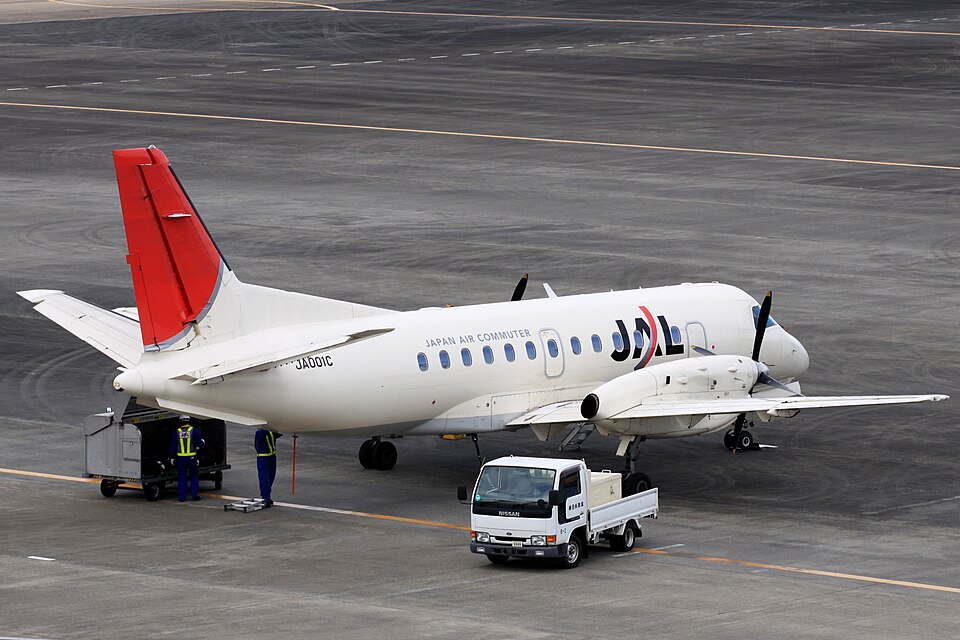
Incident Overview
A serious incident involving a SAAB-Scania SAAB 340B, registration JA001C, operated by Japan Air Commuter Co., Ltd., occurred on December 18, 2007, at approximately 11:26 JST. The aircraft, operating as scheduled Flight 2345 from Osaka International Airport, was landing on Runway 25 at Izumo Airport when it departed the runway to the right (north) during the landing roll. The aircraft continued veering right and came to a stop on the apron. There were 37 persons on board, including the captain, two other crewmembers, and 34 passengers. No injuries were sustained, and the aircraft suffered slight damage with no fire.
Flight History
The flight from Osaka to Izumo proceeded under instrument flight rules. During the approach, the crew communicated with the Izumo Airport Mobile Communication Station, receiving wind information from 300° at 14 to 17 knots. The landing gear was extended, flaps set to 15°, and later 20°. At 11:25:18, a "five hundred feet" aural callout was heard. At 11:26:03, with the aircraft at about 125 knots indicated airspeed and heading 256°, the pilot in command (PIC) called "Yaw damper OFF." Shortly after, both power levers were retarded, initially at similar rates but then the left lever moved faster than the right, steepening the approach path. At 11:26:11, both power levers were advanced, with the right lever moving faster, and the aircraft's pitch angle began to increase. The radio altimeter indicated about 8 feet. The angular difference between the left and right power levers reached about 10°.
At 11:26:13, the pitch angle peaked at 2.1°. One second later, the left propeller speed dropped sharply from 1,387 rpm to 957 rpm, accompanied by a sound change. At 11:26:17, a triple chime (master warning) sounded, and the first officer (FO) called "FI (Flight Idle)." The left oil-pressure annunciator light illuminated. The PIC instructed "You have" to the FO, transferring control. The rudder angle, which had peaked at 12.1° left, began decreasing, and the aircraft's heading started veering right. The left power lever was moved to reverse at 11:26:20, followed by the right three seconds later. From 11:26:24, the roll angle changed to 1.8° right, and vertical acceleration fluctuated. At 11:26:29, both power levers were returned to ground idle, then moved to reverse at 11:26:31. The aircraft came to a stop at 11:26:41 with a heading of about 281°.
Investigation
The Japan Transport Safety Board (JTSB) investigated the incident, examining the aircraft, runway, and engines, and conducting simulator verifications. The investigation focused on the factual sequence of events, including asymmetrical power lever movements and the left propeller speed reduction.