Summary
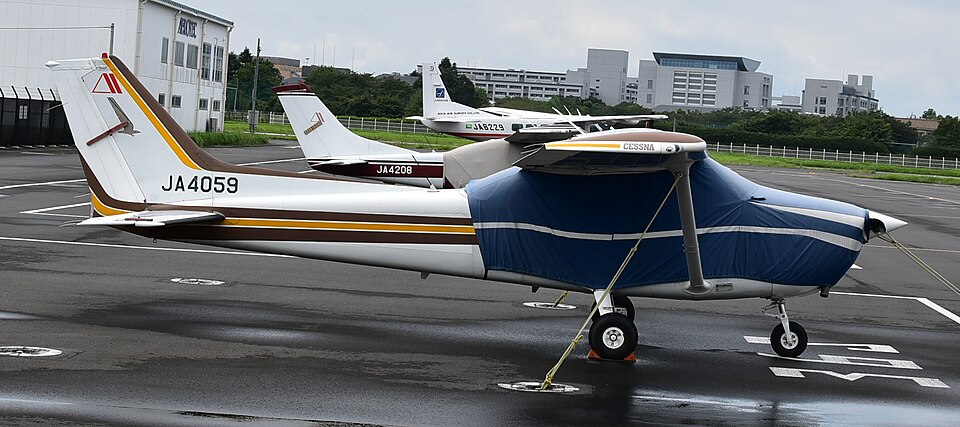
On September 17, 2023, at approximately 13:54 Japan Standard Time, a Cessna 172P (registration JA4059) operated by a private pilot made a landing at Bibai City Farm Road Airfield in Hokkaido Prefecture. During the landing, the aircraft's aft lower fuselage contacted the runway surface. The pilot and three passengers on board were not injured. The aircraft sustained damage including scratch marks and damage to the aft lower fuselage skin, scratch marks on the tail cone bulkhead, breakage of the tail tie-down ring, scratch marks and partial damage to the lower rudder fairing, and damage to the fixed tab of the rudder.
Factual Information
Aircraft and Personnel
The aircraft was a Cessna 172P, serial number 17275777, manufactured on June 8, 1982. Its airworthiness certificate (No. Tou-2023-017) was valid until April 18, 2024. At the time of the incident, the estimated weight was 2,338 lb and the center of gravity location was 45.66 inches, both within allowable limits (maximum landing weight 2,400 lb; CG range 39.5–47.3 inches).
The pilot in command was a 64-year-old male holding private pilot certificates for airplane (since May 16, 1988) and glider (since November 10, 1986). He held a class 2 aviation medical certificate valid until August 24, 2024, and his pilot competency assessment was valid until September 10, 2025. His total flight time was 136 hours 18 minutes, including 54 hours in airplanes. In the last 30 days he had flown 5 hours 58 minutes, all on the Cessna 172P. He had not flown for about 11 years prior to August 2023, when he resumed flying in the owner's aircraft. He made three flights totaling 4 hours 40 minutes under the guidance of Passenger A (the aircraft owner). On September 10, 2023, he passed a pilot competency assessment, but the examiner (Passenger A) noted in the practical skills assessment that the pilot needed more proficiency in short runway take-offs and landings.
Meteorological Conditions
Observations from the Bibai Automated Meteorological Data Acquisition System (about 3.9 km southwest of the airfield) at 14:00 showed wind from the south-southwest at 4.9 m/s, temperature 25.8°C, and no precipitation. At 15:00, wind was similar at 4.9 m/s and temperature 24.8°C. The designated manager of Bibai Airfield recorded wind velocity of 7 kt or less with no gusts, and QNH 29.93 inHg.
History of the Flight
The aircraft departed from Sapporo Airfield at approximately 13:06 bound for Bibai Airfield for the pilot’s familiarization flight. On board were the pilot in the left pilot seat, Passenger A (aircraft owner) in the right aft seat, Passenger B in the right pilot seat, and Passenger C in the left aft seat. It was the first time the pilot had flown the aircraft with four persons on board. During the flight, the pilot did not notice any difference in controllability.
At about 13:51, the aircraft received information from Bibai Flight Service that the runway was clear. During the final approach to Runway 20, the pilot extended the flaps to 20°. The approach experienced a headwind component, no strong winds, and a smooth flight path. The pilot recalled that the airspeed over the threshold was 55 to 60 kt and did not recall hearing a stall warning. Some passengers recalled hearing a stall warning.
An eyewitness observing the final approach from the administrative building reported that the aircraft approached in an unstable condition, descending in a staircase pattern, touched down hard on the runway, and bounced. The pilot stated that on the first touchdown the nose was raised higher than on the second touchdown after the bounce, and the impact on the first touchdown was clearly greater. The pilot recalled the throttle was in the idle position at touchdown. After landing, the aircraft slowed on the runway, made a 180° turn about 100 m from the runway end, taxied to the apron, and parked.
Damage and Discovery
After parking, the pilot and passengers inspected the aircraft but concentrated on the nose gear because of the strong impact felt there, so they did not notice damage to the tail components. The pilot subsequently conducted touch-and-go training: three times with Passengers B and C, and four times with Passengers A and B, all at Bibai Airfield, before returning to Sapporo Airfield. During those flights, the pilot felt no abnormality. Only when mooring the aircraft at Sapporo Airfield did they notice the tail tie-down ring was missing and recognized the damage to the aft lower fuselage.
The next morning, the designated manager of Bibai Airfield did not find the tie-down ring during a regular runway check. However, Passengers B and C visited Bibai Airfield that morning and found the tie-down ring on the runway, along with scratch marks nearby (about 100 m from the Runway 20 threshold).
Speed Information
The aircraft’s Flight Manual specifies a normal landing airspeed of 60–70 KIAS with flaps down. The pilot’s recalled approach speed of 55–60 kt was below this range. The manual states that the specified landing speeds are generally minimum safe speeds; landing below them may lead to stall, difficulty in control, or high descent rates.
The design and manufacture company of the Cessna 172P estimated that, at mean sea level, standard atmosphere, flaps retracted, and a gross weight of 2,400 lb, the airspeed at which the region of reversed command is first encountered is approximately 60 kt. This estimate applies to a Cessna 172P with basic optional equipment.
Center of Gravity Information
The Federal Aviation Administration's Pilot’s Handbook of Aeronautical Knowledge notes that a CG location aft of the allowable range reduces static and dynamic longitudinal stability, reduces stall and spin recovery capability, and produces light control forces that make inadvertent overstressing more likely. In this incident, the CG was within the allowable range.
GPS Data
An aviation GPS device brought by Passenger A recorded latitude, longitude, altitude, date, and time every 6 to 11 seconds during the flight, but did not record aircraft attitude. The data was used to examine ground speed during the final approach and compare it with speeds during subsequent touch-and-go training.