Incident Overview
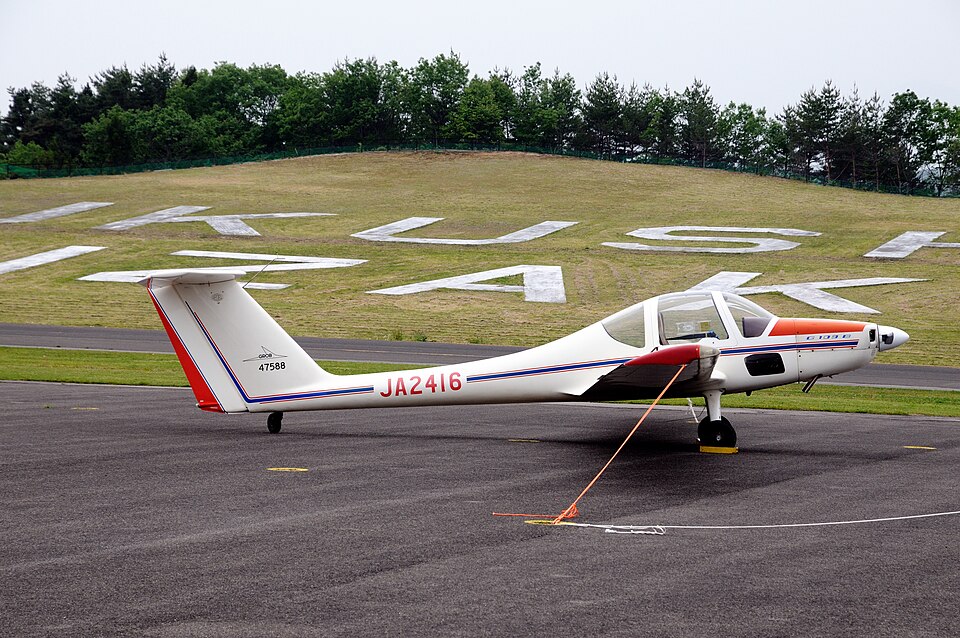
On May 5, 2024, at approximately 14:04 Japan Standard Time, a Grob G109B motor glider (registration JA2416) was landing on Runway 14 at Fukushima Sky Park, a temporary operation site in Fukushima City, Fukushima Prefecture. During the landing roll, the glider's propeller blades, propeller spinner, and lower section of the engine cowl struck the ground, and the aircraft came to a stop. The incident was classified as a serious incident under Item (iii), Article 166-4 of the Regulation for Enforcement of the Civil Aeronautics Act of Japan.
Flight History
The glider, with a captain in the left seat and a passenger in the right seat, departed Hanamaki Airport at about 12:36 for a familiarization flight. It entered the east traffic pattern at 2,300 ft for landing on Runway 14. The FUKUSHIMA FLIGHT SERVICE issued a wind warning: "Wind 140° at 6 kt, occasionally 180° at 8 kt. Be careful." The captain maintained altitude until turning onto final, then reduced engine power to idle, deployed airbrakes, and approached at 70 kt (8 kt faster than usual) due to potential wind gusts. During final approach, the glider lost altitude due to wind; the captain retracted airbrakes, increased power, and regained altitude, then redeployed airbrakes after recapturing the desired descent path. The captain fully opened airbrakes after passing the runway threshold.
Landing Sequence
The captain recalled that during the flare, the glider was blown by wind, resulting in a hard touchdown (first touchdown) and significant bouncing. The captain did not execute a go-around and attempted to maintain level flight, but the glider floated again due to wind. A second touchdown occurred left of the runway centerline, followed by another bounce and a third touchdown. After the third touchdown, the glider continued to bounce slightly during the landing roll. The captain reported that the airbrakes remained fully open. When the slight bouncing subsided, the glider was suddenly blown by wind, causing the right wing to lift and the glider to yaw left. The captain applied brakes hard and used right rudder to correct direction. The aft fuselage lifted and tilted forward, causing the propeller blades, spinner, and engine cowl to strike the runway before the glider stopped. The engine stopped at that point. The captain turned off the ignition switch and fuel shutoff valve. The glider came to rest about 540 m southeast of the Runway 14 threshold and 5 m northeast of the runway centerline. The glider was moved to the apron by club members with the captain and passenger still on board.
Damage
The glider sustained minor damage: scratch marks on the right main landing gear brake disk and tire interior, missing tips of both propeller blades (approximately 11 cm and 10 cm), and scratch marks on the propeller spinner and engine cowl.
Runway Evidence
Scratch marks on the runway indicated the landing sequence: second touchdown (brake disk scratch, ~435 cm), third touchdown (brake disk scratch, ~520 cm), seven propeller blade scratches (~40–80 cm apart, ~300 cm long) after a small bounce, and final scratches from propeller blades, spinner, and engine cowl.
Analysis
The Japan Transport Safety Board (JTSB) analyzed that the glider likely touched down in an unstable attitude due to variable winds, with the captain unable to fully correct the attitude. The significant bounce likely resulted from an insufficient flare, failing to reduce approach speed and descent rate adequately. The glider may have floated due to increased lift from wind. During the second touchdown, the right landing gear contacted the runway at a high sink rate, likely because airbrakes were fully open and the glider's right tilt was not corrected. The glider then bounced and continued with slight bounces. The JTSB noted that after a significant bounce, a go-around should be considered. Regarding the nose-over, the JTSB concluded that the glider likely had not reduced speed sufficiently after several bounces, and hard braking at relatively high speed on a tailwheel aircraft (nose-over tendency) caused the aft fuselage to lift and the nose to strike the ground.