History of the Flight
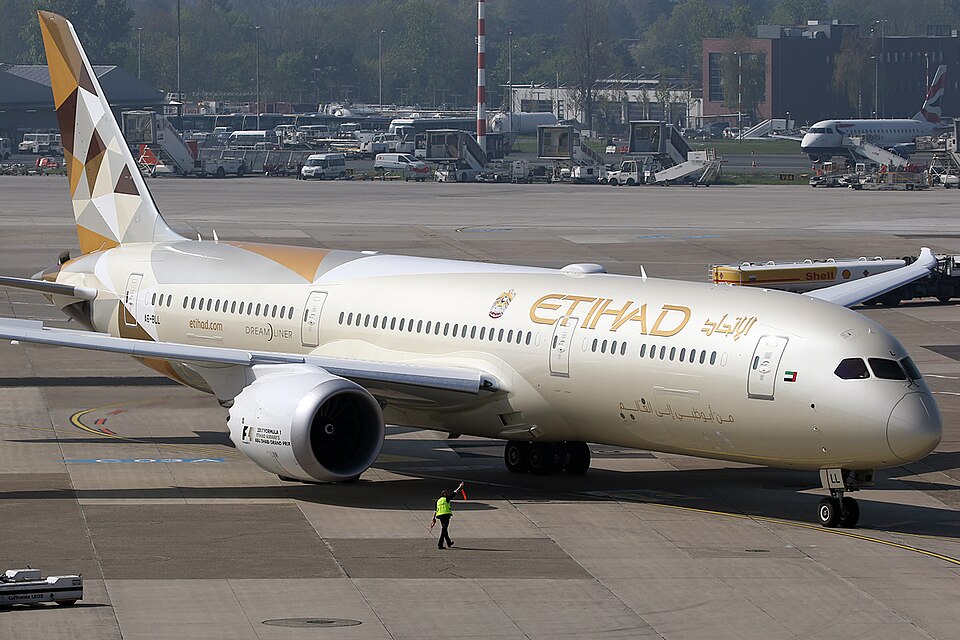
On 28 September 2021, at 0758:22 UTC, Etihad Airways Boeing 787-9, registration A6-BLL, began taxiing for instrument flight rules passenger flight ETD2333 from Abu Dhabi International Airport to King Abdulaziz International Airport, Jeddah. Onboard were 224 passengers, 2 flight crewmembers, and 9 cabin crewmembers. The Commander was the pilot flying and the Copilot was the pilot monitoring.
At 0757:23, Tower Aerodrome Control North requested a hold on all departures due to ongoing runway calibration operations. At 0800:33, the military aircraft UAF2299 was released for departure from runway 31L. At 0803:00, the ETD2333 crew contacted Aerodrome Control South and were instructed to hold short of runway 31L at taxiway Echo 15.
At 0803:20, Aerodrome Controller South requested release of ETD2333 from Approach, but Approach stated no release was needed. At 0803:42, the crew was instructed to line up and wait. At 0804:25, the controller queried readiness, and the crew confirmed. At 0804:30, take-off clearance was issued, including traffic information. Simultaneously, Aerodrome Controller North called to stop the clearance.
At 0805:05, Aerodrome Controller South instructed the crew to cancel take-off and vacate via Echo 14, but used an incorrect callsign (UAF2333). The crew did not acknowledge and began the take-off roll. The controller repeated instructions with the wrong callsign and asked "Did you copy?" The crew continued. At 0805:38, the controller used the correct callsign "Etihad two three three three stop"; the crew read back and executed a rejected takeoff at 127 knots ground speed, passing abeam taxiway Echo 13.
The aircraft vacated the runway at 0807:18 after confirming no abnormalities. The aircraft had stopped on the runway abeam taxiway Echo 10, approximately 1,850 meters from the threshold.
Personnel Information
The Commander held an Air Transport Pilot License issued by the GCAA, valid until 7 September 2024, with a Class 1 medical certificate valid until 28 February 2023. The Copilot held an ATPL valid until 16 December 2022, with a Class 1 medical certificate valid until 31 January 2023. Both had attended the Operator's required training and stated they were well-rested and fit for the flight.
Aerodrome Controller South held an ATC license valid until 30 September 2022, with an OMAA Aerodrome Control rating expiring 30 June 2022, and an OJTI endorsement. The Controller had a Class 3 medical certificate valid until 15 May 2022 with VNL2 limitation.
Aerodrome Controller North held an ATC license valid until 31 December 2021, with an OMAA Aerodrome Control rating expiring 30 October 2021, and endorsements for OJTI, LCE, and EXM. He had a Class 3 medical certificate valid until 31 May 2022 with VNL limitation.
Aerodrome Information
Abu Dhabi International Airport is located 16.5 km east of Abu Dhabi city at elevation 83 feet. It has two asphalt runways: 13R/31L and 13L/31R. Runway 31L has a landing distance available of 4,106 meters; the distance between runway centerlines is 2,000 meters. Runway 31L is equipped with ILS CAT II/III precision approach lighting and PAPI lights for a 3.0-degree glide path.
Aircraft and Meteorological Information
The aircraft's technical logs showed no pre-incident defects, and no post-flight maintenance fault messages were reported. The weather was normal.