Incident Overview
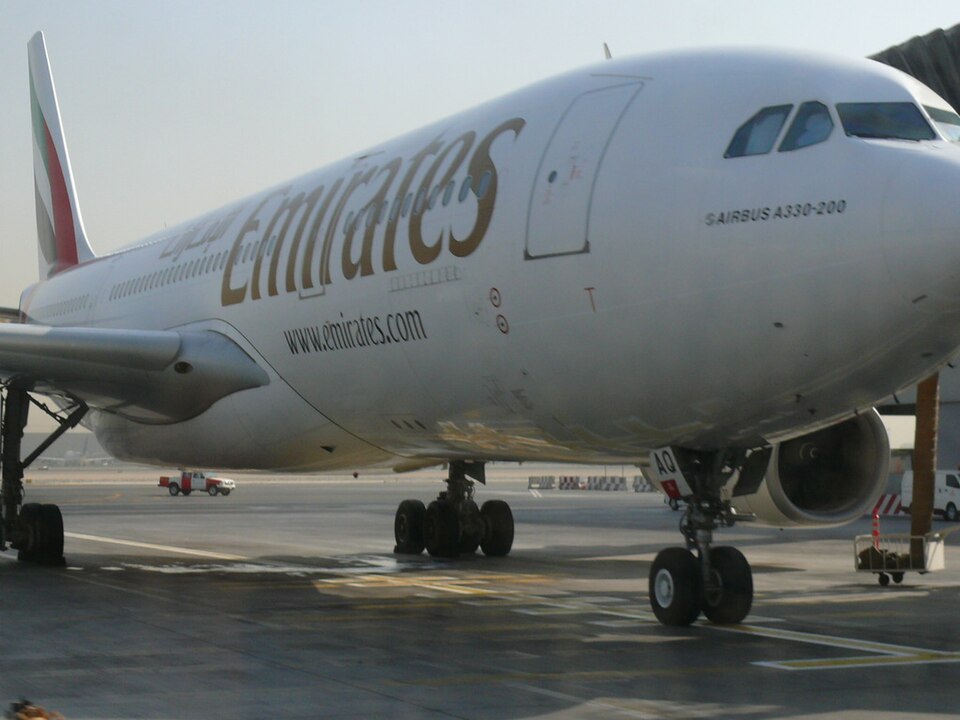
On 4 October 2014, Emirates flight EK609, an Airbus A330-243 registered A6-EAQ, was preparing for departure from Jinnah International Airport, Karachi, Pakistan, to Dubai International Airport, United Arab Emirates. The aircraft carried 14 crew and 68 passengers.
Hydraulic Fluid Mist
As departure preparations were completed, the flight crew detected an odor and a yellow hydraulic system low pressure indication on the Electronic Centralized Aircraft Monitoring (ECAM) system. Hydraulic fluid mist had entered the cabin and cockpit through the air conditioning system. The source was a fractured hose supplying hydraulic pressure to the rudder yellow system actuator. Leaking hydraulic fluid entered the auxiliary power unit (APU) and then the air conditioning system, creating a dense mist that caused breathing difficulty, throat discomfort, and eye irritation.
Protective Breathing Equipment Fire
In response to the mist, perceived as smoke, a cabin crew member at door L3 handed a fire extinguisher and protective breathing equipment (PBE) to the crew member at door L1A. After donning the PBE and pulling the lanyard to activate the oxygen generator, the PBE caught fire. The crew member immediately removed and discarded it on the floor near door L3, causing a localized fire that was suppressed by other crew members.
Evacuation and Aftermath
The commander initially decided to return to the stand and disembark using steps. After being informed that cabin visibility was limited to four rows, the commander ordered an evacuation while the aircraft was at its final pushback position. The evacuation was well-managed. Following evacuation, passengers remained near the aircraft without further direction. Air traffic control did not halt airside operations, and several aircraft and vehicles continued moving.
Investigation Findings
The investigation determined that the dense mist resulted from failure of a yellow hydraulic system rudder servo hose, allowing hydraulic fluid to enter the APU, where it was heated and atomized, then fed into the aircraft's air conditioning. The cause of the hose failure was not determined. The investigation found that it was probable that manufacturing defects in the PBE candle caused abnormal ignition when the activation lanyard was pulled.