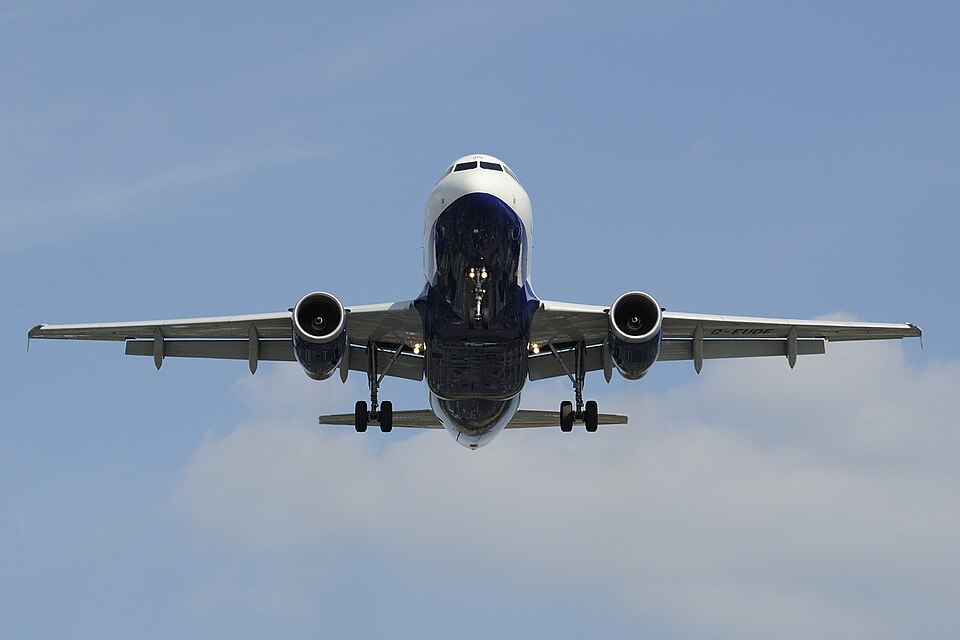
Aircraft and Incident Overview
On 12 February 2007 at 0750 UTC, an Airbus A319-131 (registration G-EUOF) operated by a commercial airline was taxiing onto Stand 415 at London Heathrow Airport's Terminal Four. The aircraft had two IAE V2522-A5 turbofan engines and was manufactured in 2001. There were seven crew and 57 passengers on board; no injuries were reported. The only damage was to a cushion on the airbridge shroud; the aircraft itself was undamaged.
History of the Flight
The aircraft had arrived at the airport and was guided by the Stand Entry Guidance (SEG) system. The turn round manager (TRM) had previously switched on the SEG. Before taxiing, the flight crew confirmed the SEG was operational and indicated their aircraft type. The commander and co-pilot each checked their respective sides for obstacles. The commander noticed red and white barrier markers around the base of the airbridge on the left but, unaware of any work in progress, considered the airbridge sufficiently clear. He taxied the aircraft forward following the SEG indications. When the system indicated five metres remaining to the stop position, the commander saw the TRM giving a stop signal with crossed arms, and the SEG changed to a 'stop' message. He braked, and the aircraft halted four metres short of the intended stop line.
Meanwhile, the crew of another aircraft that had just pushed back from Stand 415 observed the wing tip contact and informed air traffic control (ATC). This was the first indication to G-EUOF's flight crew that contact had occurred. ATC initiated a ground incident; the Aerodrome Fire and Rescue Service and police attended. The left wing tip was in contact with the flexible curtain at the end of the airbridge. No fluid leakage or fire hazard was found. A tug pushed the aircraft back two to three feet, creating a gap, and passengers disembarked using airstairs. There were some marks on the wing tip fairing but no aircraft damage.
Airport and Operator Information
Stand 415 was subject to an Airside Works Instruction (AWI) for floor replacement in jetties at Terminal Four. The AWI covered 11 to 17 February 2007 and specified that between 12 and 15 February the stand would be restricted to a maximum aircraft size of Airbus A321, with no jetty service. It also required a marshaller for all live arrivals while the jetty was positioned parallel to the clearway. A marshaller was initially nominated for G-EUOF's arrival but was recalled for a shift changeover before providing the service. No information about the marshaller requirement was published in Notices to Airmen (NOTAMs) or in the airline operator's flight crew briefing material. The UK Aeronautical Information Publication (AIP) for Heathrow advised that pilots should not enter a stand unless the SEG was illuminated or a marshaller signalled clearance.
The airline operator had been advised of the work on 9 February. In a conference call at 0730 on 12 February, the operator's Terminal Four Turn Round Shift Manager (TRSM) stated she was told the stand was restricted to A319 and A320/A321 aircraft but did not recall being informed that aircraft would be marshalled.
Recorded Information
The Flight Data Recorder (FDR) and Cockpit Voice Recorder (CVR) were recovered. The CVR captured a transmission from the previous aircraft on Stand 415 indicating they were clear. The FDR showed G-EUOF approached the stand at about 5 knots groundspeed, slowly decelerating until it stopped. After stopping, the co-pilot remarked on the SEG countdown distance.
Personnel Actions
The TRM had walked to Stand 415, checked for obstacles, entered the aircraft type into the SEG, and switched it on. Noticing the jetty extended, she returned to the terminal to check the computer for a marshaller requirement. A colleague said the computer only indicated the jetty was unserviceable. That colleague had previously dispatched another A320 series aircraft and had noticed its left wing was close to the airbridge when pushed back. Realizing a marshaller might be needed, they returned to the stand but found no marshaller; G-EUOF was already taxiing. The TRM gave the stop signal, and her colleague activated the emergency stop button on the SEG. The commander brought the aircraft to a halt.