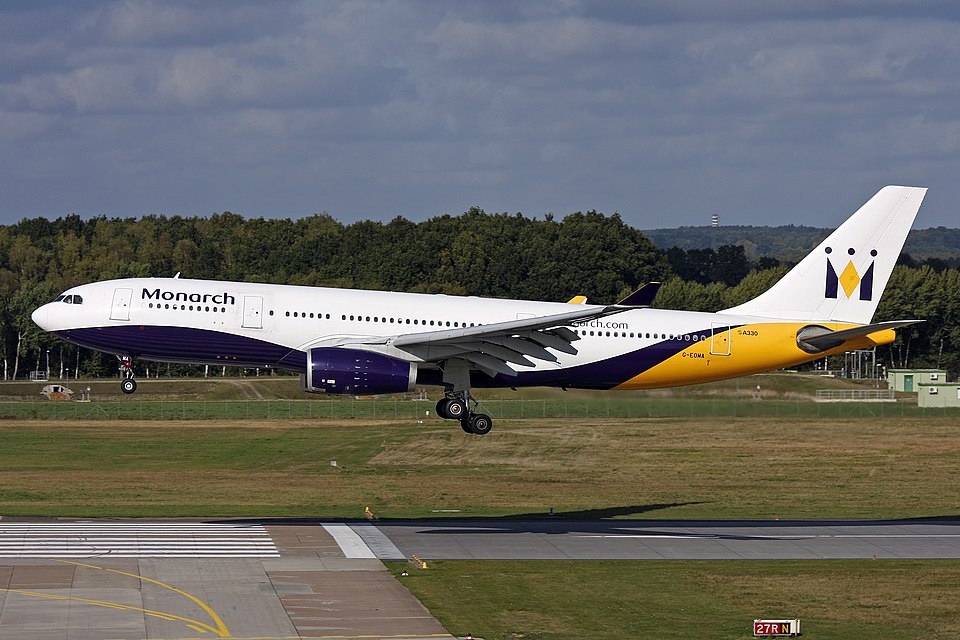
History of the Flight
On 24 May 2002 at 1624 UTC, an Airbus A330-243 (registration G-EOMA) was completing a scheduled passenger flight from Naples, Italy, to London Gatwick Airport. The aircraft executed an ILS approach to Runway 26L, with the first officer handling. The ATIS weather for Gatwick indicated wind 230°/17 kt gusting 30 kt, with light to moderate turbulence and possible windshear on approach; visibility exceeded 10 km with no precipitation. The aircraft was flown manually with autothrust engaged and Managed Speed mode selected throughout the final approach and landing. Despite gusty conditions and high autothrust activity, neither the commander nor the instructor pilot in the jump seat (who was conducting a line check) noticed anything unusual about the approach or landing. The touchdown was not considered unusually firm given the conditions, and de-rotation was smooth. Braking was applied with the autobrake set to 'low'.
As the aircraft vacated the runway, ATC advised that a tyre appeared to have burst on landing. The aircraft was stopped on the parallel emergency runway, where the Airport Fire Service attended and reported that the No.8 tyre had deflated and lost its tread. A high No.7 brake temperature indication on the ECAM screen confirmed to the crew that the loss of braking from the No.8 wheel had likely been compensated by the No.7 wheel. Following an inspection by a company engineer, the aircraft taxied to the nearest suitable stand without further incident.
Further inspection revealed scuff marks from thrown tyre tread on the inboard side of the right engine nacelle, along with four areas of impact damage on the right inboard flap. This damage exceeded maintenance manual limits and required an engineering concession for inspection every time the aircraft returned to the UK until the next scheduled hangar visit. The No.4 brake aft wear pin was also found damaged. The No.7 and No.8 wheels and brakes were replaced; their tyres and tread fragments were returned to the manufacturer for investigation.
Engineering Investigation
The failed No.8 tyre (serial number 9052B134) had been re-treaded twice. Its records showed 234 landings as a new tyre before being worn to limits. As a first retread, it accomplished 160 landings before suffering a deflation and being removed as unserviceable in March 2000. The tyre was eventually fitted to G-EOMA on 15 May 2002 after being retreaded again, and had completed 22 landings since fitment at the time of failure.
The manufacturer's tyre failure report indicated that the No.8 tyre had completely lost its tread around the entire circumference and across the entire width of the crown. A 3 mm perforation through the casing was found in the shoulder, opposite the serial number location, but there was no corresponding perforation in the tread section from this location. Evidence was also found of a separation pocket between the tread and casing having formed in the area of the perforation.
The tyre manufacturer concluded that the perforation had not been detected during the previous retreading operation. When the newly retreaded tyre was inflated, nitrogen leaked through the perforation and gradually worked its way between the tread and casing, causing local separation of the tread, which ultimately led to the whole tread peeling off under the landing loads.