History of the Flight
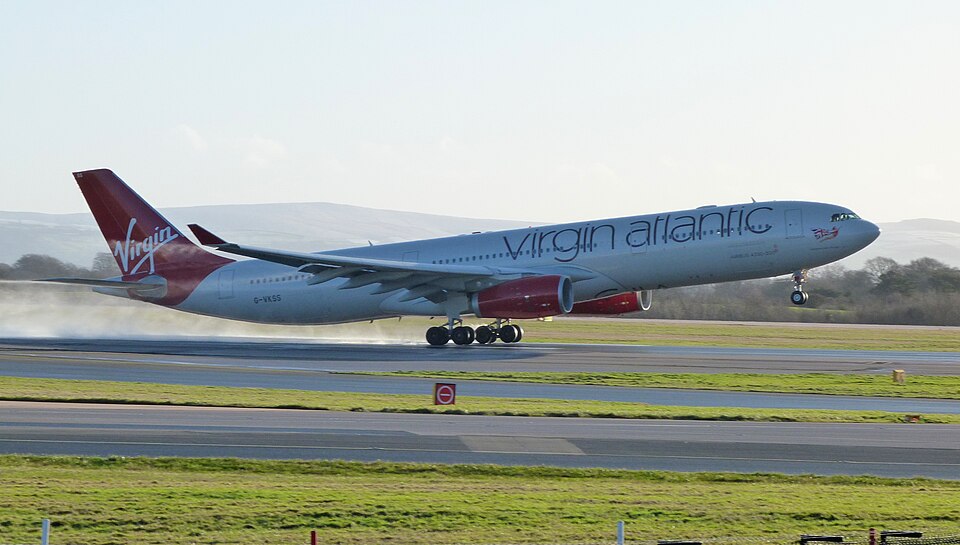
The aircraft, an Airbus A330-343 registered G-VKSS, was operating a scheduled passenger flight from Orlando International Airport, USA, to Manchester International Airport, UK. The flight crew consisted of three pilots: the commander (Airline Transport Pilot's Licence holder, age 48, with 13,850 total flying hours including 128 on type), a co-pilot, and a second senior first officer. The co-pilot was the Pilot Flying (PF) and the commander the Pilot Monitoring (PM). The departure was at night with benign weather conditions: visibility of 10 km and few clouds at 3,600 ft. The crew completed normal pre-flight checks and briefed actions for abandoned or continued takeoff and overweight landing procedures. Using a flexible takeoff thrust temperature of +46°C, the aircraft lined up on Runway 35L and commenced the takeoff roll.
At approximately 2333 UTC on 19 January 2013, during the initial climb at 530 ft above ground level, the aircraft suffered multiple bird strikes. A loud bang was heard as a bird struck the nose, causing alarm to the crew. Almost simultaneously, an Electronic Centralized Aircraft Monitoring (ECAM) message indicated a malfunction of the left engine. The crew engaged autopilots in heading mode, selecting a heading of 060° as per their departure clearance. Significant vibration was felt through the airframe, identified as coming from the left engine. The ECAM displayed an "eng 1 oil lo pr" caption with oil pressure indicating zero. Following standard operating procedures, the commander retarded the left engine thrust lever to idle. As the warning persisted, the engine master control was selected to OFF and the engine shut down procedure was carried out. The commander informed the tower with a "pan standby climbing runway heading" call, later upgrading to "mayday" when contacting radar. The crew reviewed the ECAM actions, called the Flight Service Manager for a NITS briefing, and the commander used the public address system to reassure passengers. The mayday was downgraded to "pan" and the commander assumed control as PF. The aircraft levelled at 3,000 ft while the crew calculated landing distances for an overweight single-engine landing. ATC offered an ILS approach to Runway 36R, but a single orbit was required for additional time to complete pre-landing checks. The approach and landing were uneventful; after landing, the aircraft taxied clear of the runway for inspection by the airport Rescue and Fire Fighting Service. Due to hot brakes, a tug was used to reach the parking stand. The total flight time was 30 minutes.
Airport Information
Orlando International Airport covers 1,604 hectares and includes four parallel runways, associated taxiways, parking areas, and terminal buildings. The habitat is predominantly artificial prairie with dry sandy soils, grasses, sedges, and asters, with about 5% comprising retention ponds, lakes, and drainage canals. The area is ecologically diverse with many resident and migratory bird species. The Greater Orlando Aviation Authority maintains a comprehensive wildlife management plan; a biologist and two wildlife specialists patrol the airfield daily. In 2011, there were 317,020 aircraft movements, with 115 aircraft struck by birds. Notably, 72% of strikes occurred on arrival, and 44% on Runway 17L/35R, 22% on 17R/35L, 22% on 18L/36R, and 12% on 18R/36L. Approximately 66% of strikes happened on the less developed eastern airport complex.
Flight Recorder Data
The aircraft was equipped with a 25-hour Flight Data Recorder (FDR), a 120-minute Cockpit Voice Recorder (CVR), and a Digital ACMS Recorder (DAR). Recordings from the incident flight showed that during the climb at 530 ft, the left engine N1 shaft vibration increased from 0.4 to 10 units (the maximum range), EGT increased by 10°C to 771°C, and all three shaft speeds increased slightly. Rapid and erroneous fluctuations in left engine untrim oil pressure were also recorded. The right engine N1 shaft vibration increased from 0.2 to 1.8 units. The commander confirmed ECAM indications and retarded the left engine thrust lever to idle. The right engine thrust was increased to the TOGA position before the shutdown procedure for the left engine was completed. The total time from initial warning to engine shutdown was 1 minute 46 seconds.