History of the Flight
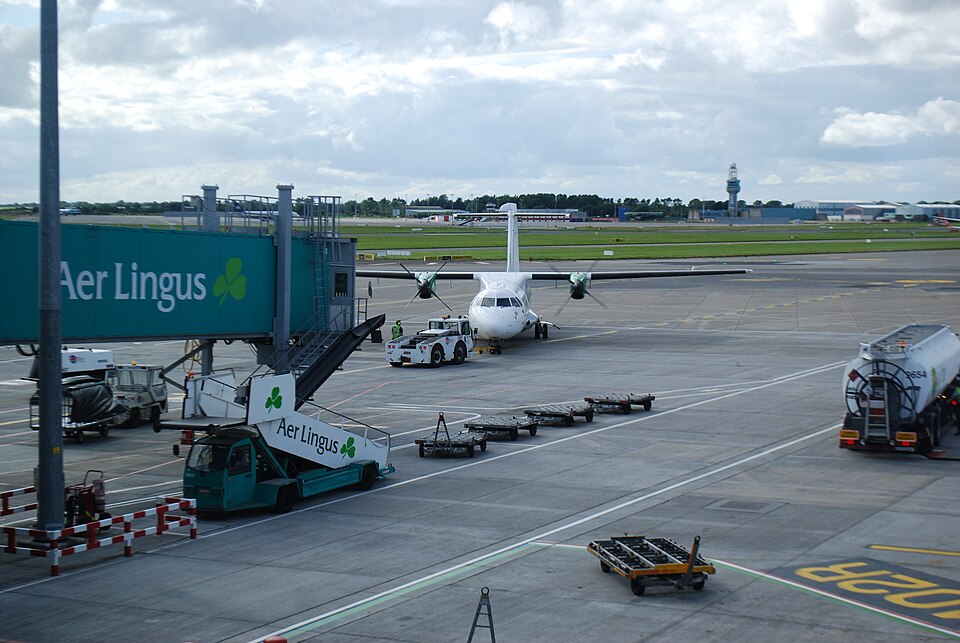
The aircraft operated a commercial passenger flight from Galway, Ireland, to Manchester, UK. After an uneventful flight, the commander taxied the aircraft towards Stand 7. Before turning onto the stand centreline, the flight crew checked that all brake pressures indicated normally. Upon reaching the correct stopping position, the commander set the parking brake and feathered both propellers. Ground crew approached while anti-collision lights were flashing and attached the fixed electrical power cable. Their procedures required them to insert chocks immediately on approaching, but they did not do so.
The aircraft then began moving slowly forward, causing the ground crew to run clear. Both pilots attempted to stop the aircraft by applying toe brakes, without success, after which the commander activated the parking/emergency brake lever. Recognising the aircraft was not under control, the commander gave an alert call to the cabin crew and instructed the co-pilot to shut the engines down. The co-pilot shut the engines down, transmitted to ATC that the aircraft was in difficulties, and requested fire and rescue service attendance.
The aircraft rolled forward until the No 2 engine propeller struck a stand guidance mirror assembly. Both the mirror and propeller were damaged, with one propeller blade becoming lodged in the mirror assembly as the aircraft stopped. The fire and rescue service responded after a short delay due to concurrent training exercises.
Recorded Information
The Flight Data Recorder (FDR) and Cockpit Voice Recorder (CVR) were successfully downloaded. The FDR recording did not include parameters relating to hydraulics, brakes, or ground speed, limiting its use. The CVR provided good quality audio of crew communications and ambient noise. Recordings showed that 3 minutes 20 seconds after touchdown, propeller pitch changed from low to normal, and engine torque and propeller speeds dropped to 0% (propeller speeds are not computed below 25% of nominal rpm). Approximately 35 seconds later, impact sounds consistent with propeller blades striking the mirror were recorded, with an initial propeller speed of 75 rpm. This was followed by a short period without impacts and then rumbles consistent with blades striking and rubbing the mirror mounting pole. During this time, fuel flow for both engines reduced to zero.
Description of the Aircraft Hydraulic Systems
The ATR 72 has two hydraulic systems, Green and Blue, supplying services including braking. Each system is pressurised to 3,000 psi by an AC electric pump powered by a frequency-wild AC generator on each propeller reduction gearbox. A single reservoir with a partition separates the two systems. The Blue system has an auxiliary DC pump that operates automatically under certain conditions, including when main system pressure falls below 1,500 psi with landing gear down and at least one engine running. Frequency-wild generators drop offline when propeller rpm falls below 70%. Each hydraulic system has a 0.2 litre accumulator; an additional 1.2 litre parking/emergency braking accumulator maintains brake pressure when parked. Each brake line contains a hydraulic fuse to limit fluid loss in a leak downstream. These six fuses are mounted near the anti-skid manifold in the hydraulic bay.
Examination of the Aircraft
The aircraft was examined briefly on the evening of the accident and in detail the following day. The aircraft had moved between 10 and 14 metres beyond the usual stop position, with a trail of hydraulic fluid under the fuselage extending a similar distance behind, indicating significant leakage after the initial stop. The right propeller struck the first of two poles holding stand guidance mirrors. Significant damage occurred to the composite propeller blades. The impact caused the mirror to rotate around its pole, and the aircraft came to rest with the propeller blades trapped between the pole and the mirror.
The left main landing gear aft fairing was removed to access hydraulic components. The bay floor was wet with hydraulic fluid, and no fluid was visible in the reservoir sight glass. After removing the filler cap, the Blue system side of the reservoir was empty. Approximately 5 litres of fluid were required to reach the 'Full' indication. The park brake lever was set to off, and the DC pump operated for a few seconds, pressurising the Blue system to approximately 3,000 psi. However, pressure decayed rapidly as fluid leaked from the rearmost of two hydraulic fuse assemblies attached to the anti-skid manifold.
The defective hydraulic fuse was removed and exhibited a crack in its valve body. The crack ran along the wall between two internal chambers. Metallurgical examination confirmed the crack, and the valve body was broken open for fracture surface analysis. The crack originated from fatigue initiated at multiple points in the bore, influenced by shrinkage porosity from the casting process. The fatigue crack grew to about 4.5 mm before final brittle overload failure, which accounted for approximately 50% of the cross-sectional area. There was no evidence of lifed maintenance; the fuse had been on the aircraft since initial build, accumulating 30,854 hours and 54,385 cycles.