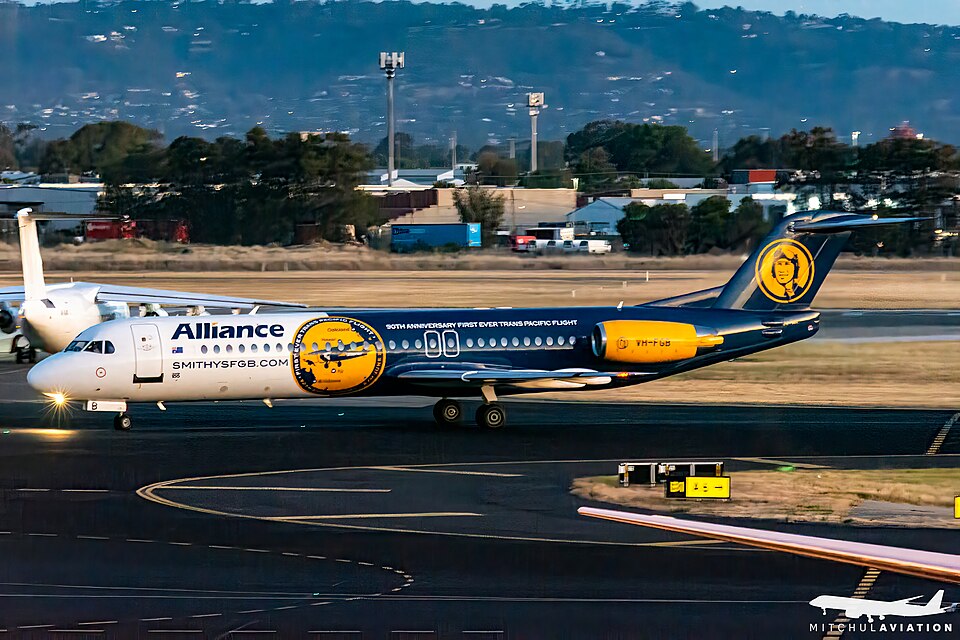
Incident Overview
On 30 August 2023, an Alliance Airlines Fokker 100, registered VH-FGB, was operating scheduled passenger flight VA1388 from Brisbane, Queensland to Adelaide, South Australia. At approximately 1048 local time, the aircraft commenced the standard instrument arrival into Adelaide.
Flight Sequence
During the arrival with the auto-flight system engaged, the aircraft descended below a segment minimum safe altitude of 3,800 ft. The captain commanded the aircraft to hold its current altitude, but the first officer observed that the descent continued. In response, the first officer disconnected the autopilot and initiated a climb. The auto-flight system later captured the lateral track of the localiser and intercepted the instrument landing system (ILS) glideslope when the autopilot was reconnected. The aircraft continued the ILS approach and landed at about 1100.
Approaching waypoint KERRS, although the automatic flight system entered altitude hold mode, the aircraft continued to descend but met the 5,000 ft minimum altitude restriction at KERRS. The automatic flight system then returned to the descent mode and did not capture the selected 3,800 ft altitude, which was the segment minimum safe altitude between KERRS and waypoint GULLY. By the time the flight crew had completed resolution actions and reinstated the automatic flight system, the aircraft had passed GULLY and intercepted the lateral localiser track. During that period, the aircraft was in and out of cloud, and the flight crew visually assessed terrain clearance.
Investigation Findings
The Australian Transport Safety Bureau (ATSB) investigated the incident. The ATSB found that, for an undetermined reason, the flight management system (FMS) did not capture the selected altitude. This resulted in the aircraft descending about 480 ft below the segment minimum safe altitude. Despite consulting with the aircraft manufacturer, Fokker, and the flight management computer manufacturer, Honeywell, the reason the aircraft did not level at the selected altitude could not be determined.
Safety Message
The incident highlights the importance of flight crew continuously monitoring auto-flight systems and reacting quickly when the aircraft is not on the expected flight path to ensure that limits are not exceeded.