Approach and Landing
At 0724 hours, Flesland approach cleared flight FLI670 to descend to 4,000 feet. Three minutes later, it was cleared to leave controlled airspace and transfer to Sørstokken's frequency. Meanwhile, the AFIS duty officer at Stord Airport had visual contact with the aircraft and confirmed its position with Flesland approach. The crew, using aerodrome data, found it acceptable to plan a visual approach and landing on runway 33, which would shorten the approach despite a small tailwind component. The AFIS duty officer was informed and confirmed the wind as 110° 6 kt. The crew reported 12 passengers on board.
The approach proceeded normally. Landing gear was extended, and flaps were extended stepwise. At 07:31:12, the aircraft was 2 NM from the threshold at 800 ft with a ground speed of 150 kt. Flaps were extended to 33°, reducing ground speed to 130 kt. At 07:31:27, the AFIS duty officer repeated 'runway free' and reported wind 120° 6 kt. The cockpit voice recorder (CVR) recorded the first officer confirming the aircraft was stabilised at plus 5 kt at 07:31:43, then plus 3 kt six seconds later. At 07:31:51, an audible warning (ping) was recorded. The commander later stated he aimed for three red and one white on the PAPI. The first officer announced the speed was correct (bug speed). The crew maintained a speed over threshold at Vref (112 kt). Ground radar showed ground speed 120 kt at the threshold. The commander lowered the thrust levers to Flight Idle at approximately 50 ft above the runway. At 07:32:14, wheel contact was recorded. Both pilots described a soft landing a few metres beyond the standard landing point.
Runway Excursion
After touchdown, the first officer announced 'and spoilers' at 1 second, followed by a sound of the spoiler lever being moved to LIFT SPLR at 1.5 seconds. At 4 seconds, he announced 'no spoilers' when the indicator lights did not illuminate. At 6.6 seconds, the brake selector switch was turned; a single chime sounded at 7.9 seconds. Tyre screeching began at 12.8 seconds and continued variably until 22.8 seconds, when the aircraft left the runway. The AFIS duty officer activated the crash alarm at the same time. The CVR stopped at 26 seconds.
The first officer reported that after landing, he saw the commander move the thrust levers to Ground Idle and the spoiler lever to LIFT SPLR. He expected the spoiler indicator lights within three seconds and was surprised they did not appear. He verified hydraulic pressure and other instruments were normal. The commander explained that when speed dropped to approximately 80 kt, he kept his left hand on nose wheel steering and right hand on thrust levers, while the first officer took the control wheel. He felt the brakes working until about halfway down the runway, after which retardation ceased. He applied full force on both brake pedals without normal braking. He moved the brake selector from Green to Yellow, then to Emergency Brake (disconnecting anti-skid), but the aircraft could not stop. He steered towards the end of the runway, then attempted a sideways skid to increase friction. The aircraft left the runway left of the centreline. The commander believed he could have stopped with 50–100 metres more runway; the first officer estimated 10–15 metres more would have been sufficient.
Observations
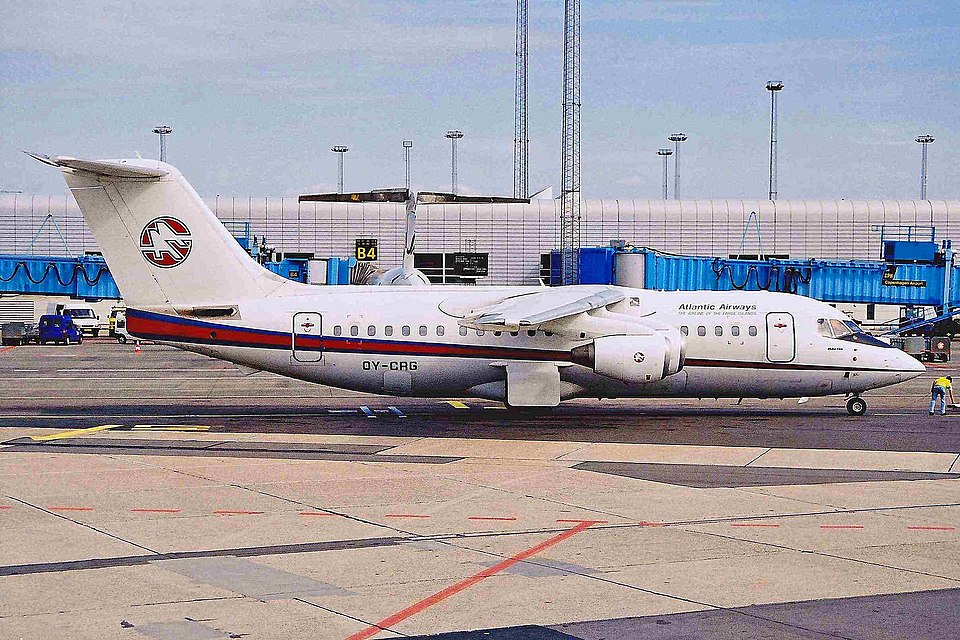
The AFIS duty officer visually followed OY-CRG during approach and landing, noting it may have been higher and faster than normal. He estimated touchdown within the first third of the runway. During rollout, the aircraft was briefly obscured by a parked aircraft of the same type (OY-RCW) from Atlantic Airways. When visible again, the aircraft had greater speed than normal. He saw the aircraft turn right then left, leaving the runway in a skid at approximately 45° to the runway direction. He triggered the crash alarm. He noted the speed was moderate enough that he hoped the aircraft would stop before the runway end, and suggested that 50 metres more runway might have been adequate. He observed dampness and smoke emanating from the back of the main wheels during rollout.