Accident Overview
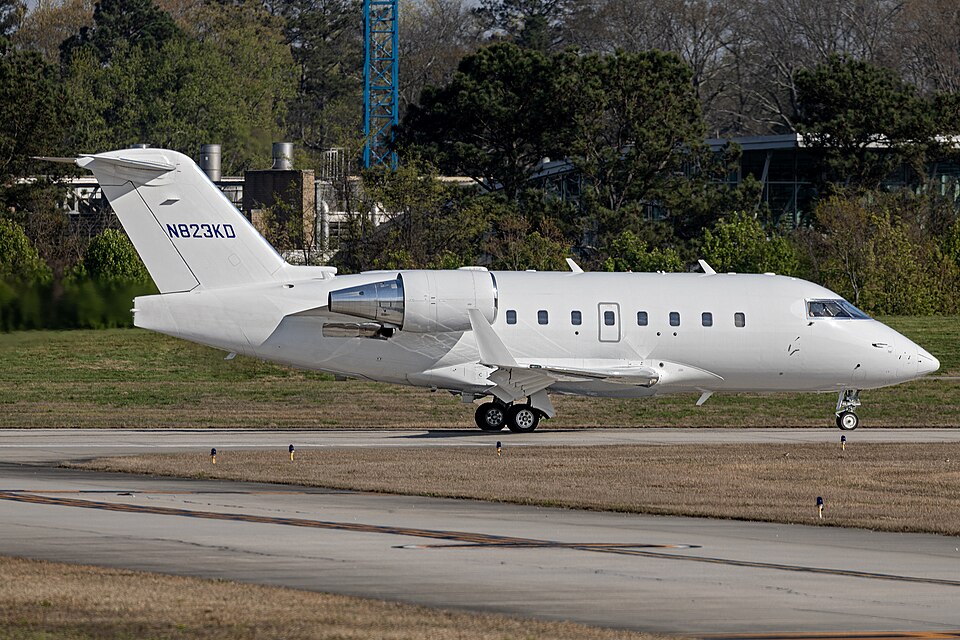
On February 9, 2024, at about 1517 eastern standard time, a Bombardier Inc CL-600-2B16, registration N823KD, was destroyed in an accident near Naples, Florida. The two airline transport pilots on board sustained fatal injuries. The cabin attendant and the two passengers suffered minor injuries, and one person on the ground also received minor injuries. The aircraft was operated by Ace Aviation Services, doing business as Hop-A-Jet, under Title 14 Code of Federal Regulations Part 135 as an on-demand passenger flight.
Flight History
The flight was returning to Naples Municipal Airport (APF) from Ohio State University Airport (OSU) in Columbus, Ohio, where it had flown earlier that day. Prior to departure from OSU, the aircraft was serviced with 350 gallons of fuel. Preliminary data from Automatic Dependent Surveillance–Broadcast (ADS-B) and air traffic control (ATC) records indicate that the flight crew contacted the ATC tower at APF while on a right downwind leg of the approach to the airport, maneuvering for a 5-mile final approach to runway 23. At 1508, the tower controller cleared the flight to land. At that time, the aircraft was about 6.5 miles north of APF at approximately 2,000 ft geometric altitude and 166 knots ground speed, turning for the base leg of the traffic pattern.
Engine Failure
A preliminary review of data from the aircraft’s flight data recorder revealed the first of three Master Warnings at 1509:33, indicating "L ENGINE OIL PRESSURE," followed immediately by a second warning for "R ENGINE OIL PRESSURE" at 1509:34, and a third warning for "ENGINE" at 1509:40. The system alerted pilots via a "Master Warning" light on the glareshield, a corresponding red message on the crew alerting system page, and a triple chime voice advisory saying "Engine oil." Twenty seconds later, at 1510:05, at about 1,000 ft msl and 122 knots, while on a shallow intercept angle for the final approach course, the crew announced, "…lost both engines… emergency… making an emergency landing." The tower controller acknowledged and cleared the aircraft to land.
Emergency Landing
At 1510:12, at about 900 ft and 115 knots, the crew replied, "We are cleared to land but we are not going to make the runway… ah… we have lost both engines." No further transmissions were received from the flight crew, and ADS-B track data ended at 1510:47, directly over Interstate 75 in Naples. Dashcam video submitted to the National Transportation Safety Board captured the final seconds of the flight. The aircraft descended into view in a shallow left turn before leveling its wings and touching down aligned with southbound traffic on Interstate 75. The left main landing gear contacted the ground first in the center lane, followed by the right main landing gear in the right lane. The aircraft then continued through the breakdown lane and into the grass shoulder, impacting a concrete sound barrier. Dust, fire, smoke, and debris obscured the aircraft after impact.
Investigation
The cabin attendant stated that after the aircraft came to rest, she identified that the cabin and emergency exits were blocked by fire and coordinated the successful egress of herself and the passengers through the baggage compartment door in the tail section. The official probable cause, as stated in the investigation, is: "Corrosion of both engines’ variable geometry (VG) system components, which led to their operation in an off-schedule position and resulted in near-simultaneous sub-idle rotating compressor stalls on approach, subsequent loss of thrust in both engines, and an off-airport landing. Contributing to the accident was inadequate fault isolation guidance from the engine manufacturer, which prevented the identification of corrosion buildup in VG system components during troubleshooting of hung start events of both engines about 1 month before the accident."
This information is preliminary and subject to change.