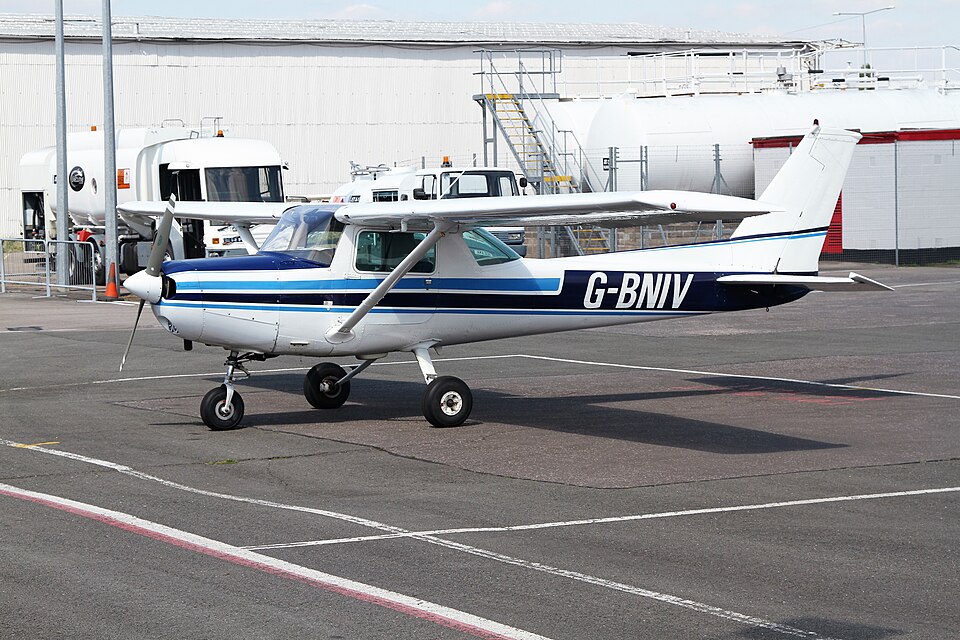
Accident Overview
On 19 March 2012 at 1208 UTC, a Cessna 152 (registration G-BNIV) sustained extensive damage when it overturned during a solo touch-and-go landing at Rochester Airport, Kent. The single-engine aircraft, powered by a Lycoming O-235-L2C piston engine and manufactured in 1981, was being flown by a 49-year-old student pilot with 34 hours total flying experience (31 hours on type). The pilot, who was the sole occupant, suffered only superficial grazing and exited through the left window after the left door hinge was damaged and initially difficult to open.
Flight History
The pilot was conducting solo visual circuits under the supervision of an instructor. The weather was fine with a surface wind from approximately 300° at 5 to 10 kt. Runway 34, a grass runway 963 m long with a landing distance available of 773 m, was in use. The pilot had previously completed 2 hours of solo circuit flying and had flown both dual and solo on Runway 34.
Before the solo flight, the pilot completed three dual touch-and-go circuits with the instructor, during which minor technique points—including smooth flap resetting after landing—were addressed. The instructor was satisfied with the student's ability to complete the solo exercise safely and observed the first two solo approaches from the clubhouse. Both were made at the correct angle, and the pilot appeared to correct a slightly fast first approach. Both landings were satisfactory.
The Accident Sequence
The third approach and landing were similar to the second, but as the aircraft rolled along the runway after landing and the pilot reset the flaps for takeoff, it encountered a surface undulation—a known runway characteristic that the pilot had previously managed but that caught him unaware on this occasion. The aircraft bounced a number of times; eventually, the nose leg dug into the grass runway, causing the aircraft to flip forward onto its back at fairly low speed. Flying school personnel examining witness marks on the grass runway concluded that the aircraft had bounced at least twice, possibly more, and that at least one bounce landing was primarily on the nosewheel.
Pilot and Aircraft Status
The pilot's last 90 days included 5 hours of flying, all within the last 28 days. The aircraft's nature of damage was described as extensive. No injuries were reported for the crew, and no passengers were on board.