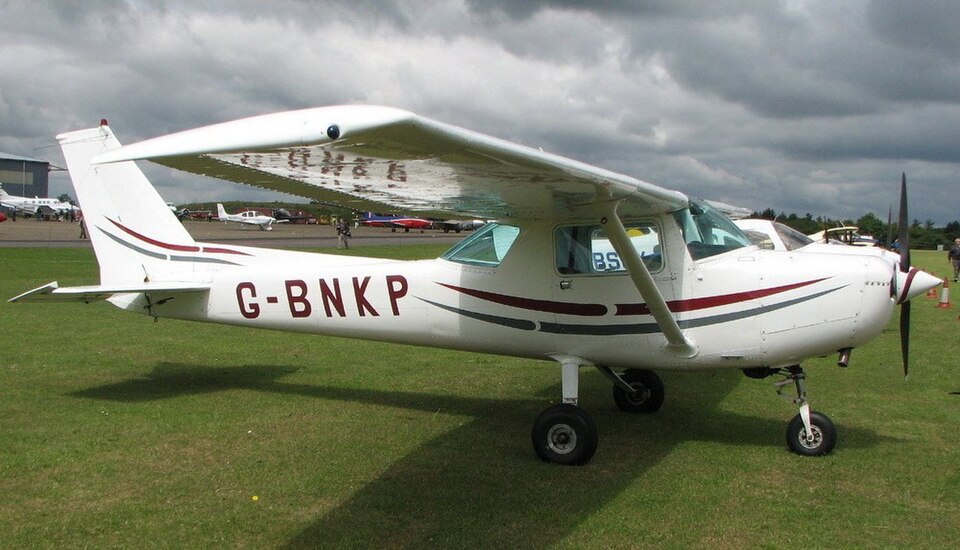
Incident Overview
On 27 May 1999, at approximately 1530 UTC, a Cessna 152 (registration G-BNKP) departed Clacton Airfield in Essex for a private training flight with an instructor and student on board. After a normal takeoff handled by the student, the aircraft turned crosswind and was climbing left at 850 feet, intending to level at 1,000 feet for the downwind leg. At that point, the engine 'coughed'. The instructor immediately took control, and within two seconds the propeller stopped in a horizontal position. He completed the engine failure drill and attempted a restart without success. He then contacted Clacton, declared an engine failure, turned into wind, and selected a wheatfield of suitable length for a forced landing. Flap was selected and a successful landing was conducted in the field. The instructor informed Clacton that the forced landing was successful and there were no injuries.
Examination Findings
The aircraft was recovered to the operator's engineering facility. Examination of the engine revealed substantial damage to the No 4 cylinder and piston, apparently caused by the No 4 inlet valve having fallen into the cylinder. A metallurgical examination of the No 4 cylinder, piston, and related components determined that the event was initiated by fatigue failure of the inlet valve spring cap. This failure allowed the valve's keys (collets) to disengage from the key-way in the top of the valve stem, after which the valve dropped into the combustion head of the cylinder.
Microscopic examination of the fractures showed two cracks that had initiated at the lower inboard edge of the spring cap, almost diametrically opposite each other and in line with the split between the valve's keys. These cracks propagated by a tensile fatigue mechanism until final failure of the spring cap occurred. It was not possible to determine the number of cycles over which the cracks had propagated. No defects were found in the material of the spring cap or its manufacture that may have initiated the cracks.
All other spring caps from the engine were examined, but no other cracks were found. Various mechanisms for initiating the cracks were considered, including the possibility that the No 4 inlet valve tappet may have been maladjusted, at some time, to an extent that would have put the valve spring into a 'coil-bound' situation, resulting in a direct mechanical force from the cam shaft being applied to the top of the spring cap via the two keys. An engine overhaul organisation was requested to check if such adjustment was possible; they found it was possible, but the degree of maladjustment would have been extremely obvious and the tappet adjustment thread would have been clearly 'out of safety'.
A cylinder repair and overhaul facility was consulted. They confirmed that they had encountered cracked valve spring caps associated with engines returned for inspection following instances of overspeeding. In such cases, more than one spring cap had been found cracked, and these were found on one side, with the front cylinder spring cap showing more damage than the rear cylinder. The engine in this incident had been overhauled 'to zero hours' in May 1998 and had accumulated 447 hours up to the time of the incident. During that overhaul, all spring caps had been inspected and found serviceable before being refitted.