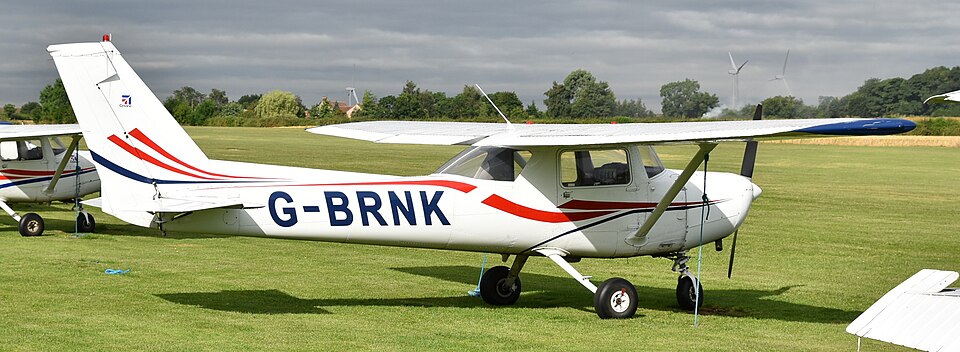
Aircraft and Flight Details
The accident involved a Cessna 152, registration G-BRNK, powered by a single Lycoming O-235-L2C piston engine. The aircraft was manufactured in 1977 and was being used for a training flight from Netherthorpe Airfield in Yorkshire. The commander held a Commercial Pilot’s Licence with a Flying Instructor Rating, was 55 years old, and had accumulated 798 total flying hours, including 420 hours on type. In the previous 90 days, he had flown 55 hours, and 19 hours in the last 28 days. The flight was the commander's sixth of the day and his third in G-BRNK. The aircraft's fuel tanks were below half-full.
Operations and Weather Conditions
Operations were conducted on Runway 06, which had a grass surface, a declared Landing Distance Available of 407 metres, and a 1.9% downslope. The grass had been mown during the afternoon before the accident. The commander described the runway surface as firm. Earlier, a rain squall had crossed the airfield while the commander was away on a previous flight, but he had landed normally on the short wet grass of Runway 06, using approximately 80% of the runway length to stop. After that landing, he departed for a one-hour training flight with a student without refuelling.
Sequence of Events Leading to the Excursion
When the commander and student returned to the airfield, another rain shower was passing through. The commander loitered to the west for 10 minutes to allow the rain to pass and for visibility to improve. He then set up for a short-field approach, using full flap and reducing the airspeed to 55 kt at the airfield boundary. He anticipated that the short wet grass would provide reduced braking action. The wind was estimated at 5–10 kt from 100°(M), and the ambient temperature was 20°C.
Landing and Runway Excursion
The approach and landing were reportedly normal, with the aircraft touching down at the start of the runway. During the first half of the ground roll, the aircraft decelerated, but after that deceleration became minimal. The aircraft then ran off the end of the runway at a speed of around 10–15 mph, striking a wire boundary fence. The impact caused damage to the propeller, spinner, and the leading edge of the right wing. The commander suggested that the major loss of braking effectiveness was attributable to wet grass clippings remaining on the runway surface. There were no injuries to the two crew members.