Introduction
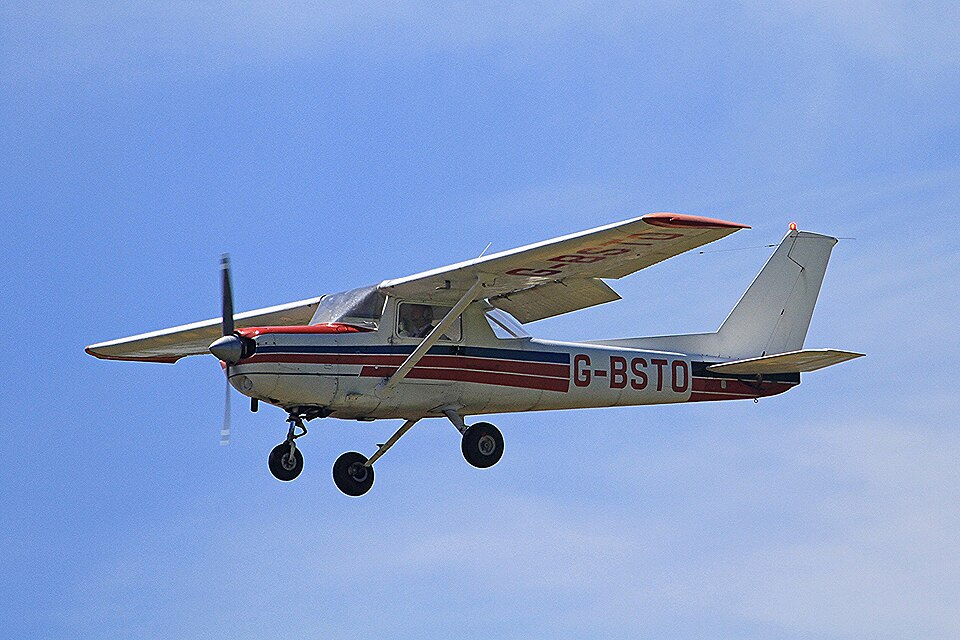
On 29 November 2002 at 1815 UTC, a Cessna 152 (registration G-BSTO, serial number 152-????, year of manufacture 1978) operated by a private pilot experienced an incident during a night approach to Runway 31 at Plymouth Airport, Devon. The aircraft was powered by a single Lycoming O-235-L2C piston engine. The flight was private, with one pilot and one passenger on board. No injuries were reported to either occupant. The aircraft sustained minor damage to the left wheel brake assembly.
History of Flight
The pilot, aged 58, held a Commercial Pilot's Licence and had 676 hours of flying experience, of which approximately 290 were on type. His recent flying included 9 hours in the last 90 days and 4 hours in the last 28 days. Although not holding an instructor rating, he was cleared by his flying club to conduct check flights on members whose club currency requirements had lapsed. On the day of the incident, he had conducted a daylight check flight on a club member. The same member, who had no night flying experience, wished to accompany the pilot on a night flight as a passenger. That evening, the check pilot completed a solo night circuit to renew his night currency before taking the passenger on board (seated in the right-hand seat) and departing for the local area.
Approach and Landing
After an uneventful flight, the pilot commenced an approach to Runway 31 using the Precision Approach Path Indicator (PAPI) lights for glidepath guidance. The PAPI lights, set to a glidepath of 3.5°, were installed on the left side of the runway, 172 metres beyond the threshold. However, on short final, the pilot altered his approach path to aim for the runway threshold lights instead. The remainder of the approach appeared normal to the pilot. Upon landing, it became apparent that the aircraft had touched down short of the runway, in the grass undershoot area. The aircraft traversed the grass and quickly regained the paved runway surface, where it was slowed and taxied back to the parking area.
Damage and Examination
Inspection that night revealed damage to one centreline approach light and one runway end light, consistent with marks found on the aircraft's left tyre and wheel brake assembly. A further inspection the next day found that the aircraft had touched down in the Runway End Safety Area (RESA), approximately 14 metres short of the turning circle at the approach end of Runway 31, midway between the end of the circle and a 3-metre-high fence. Plymouth's Runway 31 is 1,170 metres long and 30 metres wide, with a displaced threshold providing a landing distance available of 1,045 metres. The approach end turning circle is marked by a tangential row of red lights, and the displaced threshold is marked by high intensity green lights, with about 40 metres between these transverse light sets.
Weather and Pilot Considerations
The weather was fine, with surface wind essentially down the runway at 4 kt. However, wind at circuit height was much stronger, between 15 and 20 kt. There was no turbulence or thermal mixing of layers. The aerodrome chart for Plymouth contains a warning that significant differences may occur between surface wind velocity reported by ATC and the actual wind at approximately 100 feet above aerodrome level. The pilot wondered if he had lost airspeed very late on finals due to wind shear, but he was able to flare the aircraft and the touchdown was soft, so this explanation was considered unlikely. The pilot stated that during daylight flying, he habitually aimed to touchdown at the threshold, especially when using short strips. He intended to use the same aiming point that night, but may have, during a brief instrument check, looked up again without realizing that he had transposed the runway end lights for the threshold lights.