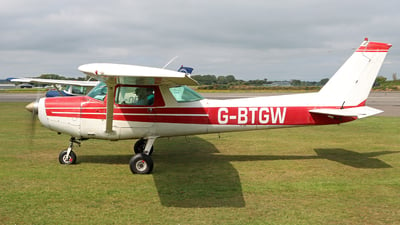
Incident Overview
On 12 November 2001 at 1537 UTC, a Cessna 152, registration G-BTGW, was involved in an accident near Detling Show Ground, close to Detling VOR. The aircraft sustained substantial damage after striking a tree and subsequently making a forced landing in a field. Both crew members, an instructor and a student, were uninjured.
Flight Details
The aircraft, a 1979 Cessna 152 with a single Lycoming O-235-L2C piston engine, was conducting a training flight under the supervision of the Chief Flying Instructor (CFI). The instructor, aged 35, held a UK Airline Transport Pilots Licence with an Assistant Flying Instructor Rating and had 6,200 hours total flying experience (103 on type). The flight was planned as a navigation exercise, which according to the JAR-FCL PPL syllabus included navigation at less than 1,000 feet above ground level (agl). The weather forecast indicated visibility of 8 km and scattered to broken stratus between 1,000 and 1,500 feet above mean sea level (amsl).
Events Leading to the Accident
The flight proceeded uneventfully for the first leg, with a landing at Lydd Airfield. After departure for Shoreham Airport, the instructor became concerned about lowering cloud base and turned toward the coast. He informed 'London Information' of the route change and obtained suitable weather for landing at Shoreham. Prior to departure for the final leg to Stapleford, the instructor checked weather at Stapleford, which was broken at 800 feet agl. He refuelled and decided to fly visually along the coast toward Hastings instead of the original route. During this leg, the instructor took control and asked the student to prepare a simulated diversion from Fairlight Cove to north of Chatham. The instructor was flying clear of cloud at approximately 600 feet agl, instructing on low-level navigation and emphasising the importance of maintaining height above 500 feet agl to comply with Rule 5 of the ANO. He intended to maintain visual flight rules (VFR) as long as possible, but would climb to instrument flight rules (IFR) if conditions deteriorated. After the student briefly took control, the instructor reassumed control north-west of Lashenden (Headcorn) Aerodrome. He turned east to avoid Maidstone, then back north-west toward Detling VOR using visual references. While pointing out the M20 motorway as a landmark, the instructor suddenly realised he had flown into hill fog. He applied full power and transitioned to instruments for a climb, but then felt a loud 'thud'. He noted a reduction in engine power and saw tree branches below the aircraft. The pitch control felt unusual. The hill fog cleared, and he spotted a large field nearby. He transmitted a 'Mayday' call to 'London', which was acknowledged, then executed a forced landing using limited power. The touchdown was smooth, but the aircraft did not stop before contacting a perimeter fence at approximately 5 knots. Both occupants vacated the aircraft after making all switches safe.
Post-Accident Assessment
The aircraft was initially assessed at the crash site, then dismantled and transported by road to Stapleford Airfield. The initial main impact with the tree appeared to have been on the main landing gear; foliage was also found around the engine cowling. The instructor later stated he was flying at about 650 feet amsl (based on QNH 1014 hPa) when the aircraft hit the tree. The highest ground in the immediate area was 673 feet amsl, with an aerial at 935 feet amsl nearby.
Pilot's Acknowledgment
The instructor acknowledged that he had become overloaded and distracted while trying to provide instruction in addition to flying and navigating. He noted that while hill fog was not specifically forecast, the weather was unsuitable for the flight, and he considered that he had made an error in judgement in not abandoning the exercise well before the accident.