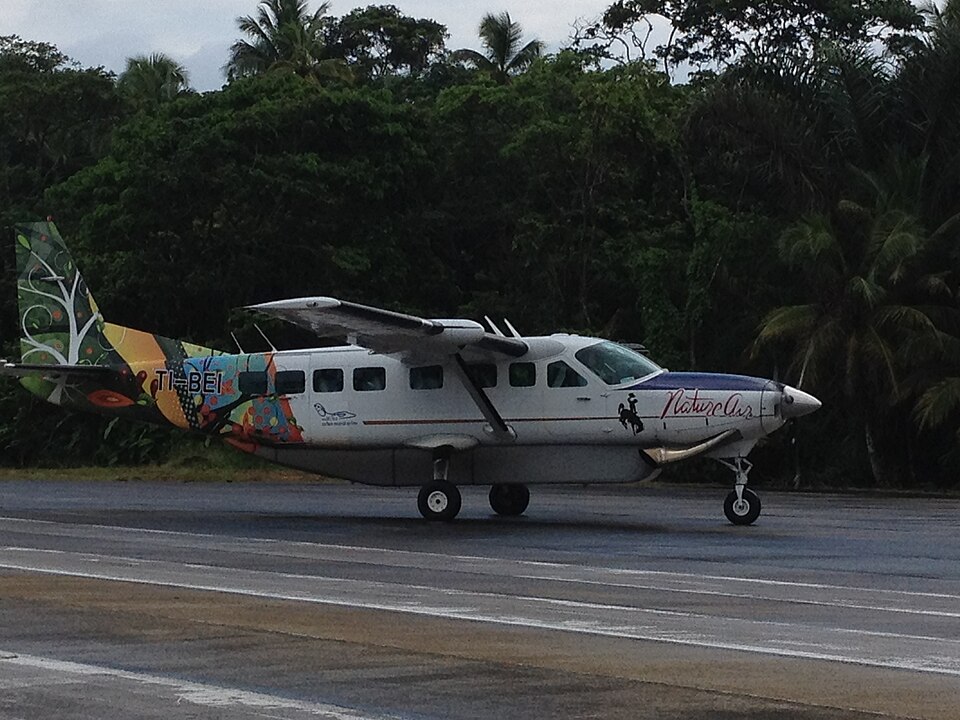
Background
The aircraft was operating a commercial charter flight with two pilots and 10 passengers, intending to transport them to an international airport for connecting flights. The departure airport was located in a valley surrounded by rising terrain, except to the southwest where runway 21 led toward the Pacific Ocean. The airport had no control tower and no windsocks installed at the time of the accident, though two frames were present. No weather reporting facilities were available in the vicinity.
Flight Details
The accident aircraft was the second of two flights. The first aircraft departed runway 3 about 15 minutes earlier and made an immediate right turn to the east/southeast after takeoff, following a pass in the hills over lower terrain to gain altitude. The accident aircraft also departed from runway 3. According to a witness and surveillance video, it continued on runway heading, then entered a left turn and descended into terrain.
Investigation Findings
Video analysis showed the aircraft reached a maximum bank angle of about 75° and an airspeed below the published aerodynamic stall speed before impact. Examination of the wreckage was limited due to impact and postcrash fire, but no preimpact failures or malfunctions were found, and the engine showed signatures of producing power at impact.
The captain held appropriate ratings and had extensive experience in the accident aircraft model. He had been previously employed by the operator in 2006 and was recently rehired, but records did not show completion of all required training and check flights per the operator's General Operations Manual (GOM). The first officer was appropriately rated but had little experience in the accident aircraft. The GOM required additional airport-specific training for airports with special characteristics, but the operator provided no listing of such airports, including the departure airport. The pilots' experience at that airport could not be determined.
Regarding the captain's medical history, psychiatric diagnoses from 2011 were noted, but limited information prevented determination of his symptoms, treatment, or mental state at the time of the accident. Therefore, the role of his medical or psychological conditions could not be determined.
Performance and Terrain Analysis
Performance calculations indicated the aircraft would have been able to take off with up to a 10-kt tailwind (the manufacturer's limit). The witness reported that both flight crews acknowledged the need to use the eastern pass to clear terrain when departing runway 3. The reason the accident crew failed to use this path could not be determined. It is likely that after entering the valley ahead of the runway, with rising terrain exceeding the aircraft's climb capability, they attempted a left turn to exit toward lower terrain. During the steep turn, they failed to maintain adequate airspeed, exceeded the critical angle of attack, and stalled.
Calculations showed that with weights within manufacturer limits, the aircraft was unlikely to have sufficient climb performance to clear terrain north of the airport, but would likely have cleared terrain east of the airport if a right turn had been made immediately after takeoff, like the preceding aircraft.
Probable Cause
The flight crew's failure to maintain airspeed while maneuvering to exit an area of rising terrain, which resulted in an exceedance of the airplane's critical angle of attack and an aerodynamic stall. Contributing to the accident was the flight crew's decision to continue the takeoff toward rising terrain that likely exceeded the airplane's climb capability, the lack of adequate weather reporting available for wind determination, and the lack of documented training for an airport requiring a non-standard departure.