Introduction
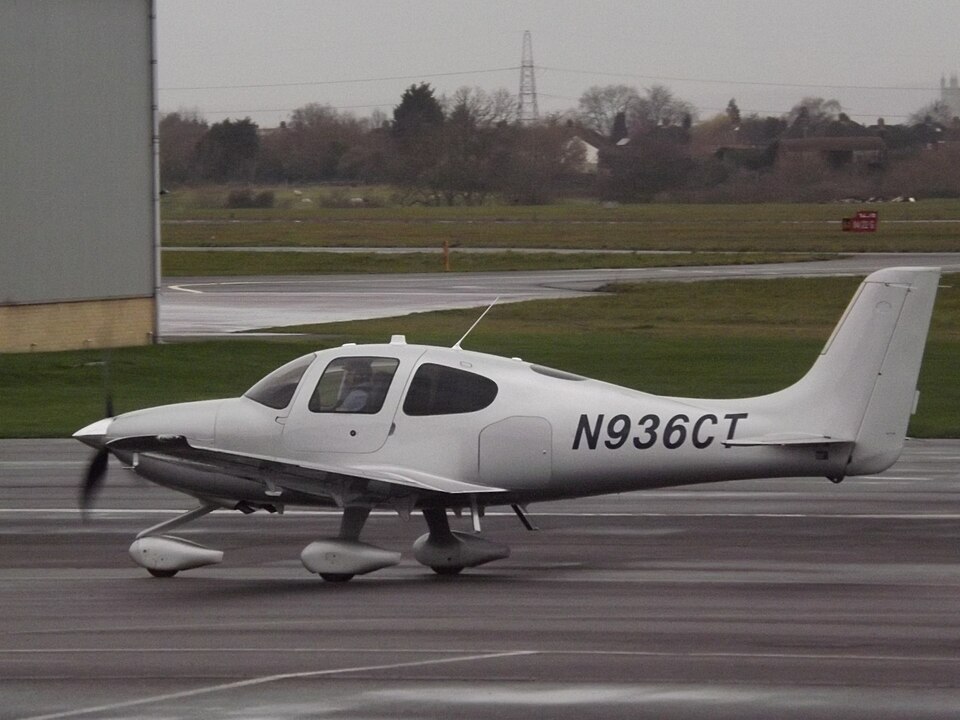
On 6 June 2013 at approximately 0947 UTC, a Cirrus SR22, registration N936CT, experienced an in-flight event while on approach to Gloucestershire Airport. The aircraft sustained substantial damage to its wings and fuselage; the pilot was uninjured.
History of the Flight
The pilot was conducting a private flight from Denham Aerodrome to Gloucestershire Airport. Pre-flight preparation included contacting Gloucestershire Airport by telephone, where he was informed that Runway 09 was in use. The first part of the flight was uneventful and conducted in visual meteorological conditions (VMC). The pilot initially contacted Farnborough ATC, who instructed him to contact Brize Norton ATC. Brize Norton ATC instructed the pilot to climb first to 3,300 ft, then to 4,000 ft. When the aircraft was approximately 16 nm from Gloucestershire Airport, Brize Norton ATC instructed the pilot to contact Gloster (Gloucestershire Airport ATC) but refused his request for a descent. Upon contacting Gloster, the pilot was offered an approach to Runway 27, which he accepted. At this stage, the pilot was approximately 7 nm from the initial approach fix, located 10 nm on the extended centreline.
The pilot established the aircraft on the final approach track for an RNAV approach to Runway 27 with the autopilot engaged in GPS approach and vertical speed modes. At approximately 1,800 ft amsl, the autopilot was disconnected for about 5 seconds, during which the aircraft rolled to approximately 30° left bank. When the pilot reinstated the autopilot, it engaged in PITCH HOLD and ROLL HOLD modes, which are the default modes. The pilot did not notice the mode change and, observing a banked turn, attempted to override the autopilot to regain wings level. After 18 seconds, he disconnected the autopilot again, but the aircraft had deviated from the approach centreline. The pilot reported “over-controlling” in roll and pitch. Over the next 80 seconds, the aircraft exhibited large variations in pitch, roll, speed, and altitude. Warnings including overspeed and terrain proximity occurred. While still in cloud, the pilot assessed he was too close to the ground to recover from what he described as an out-of-control situation and deployed the ballistic recovery system. The pilot reported becoming VMC at about the same time as parachute deployment. The aircraft came to rest in the garden of a suburban house.
Recorded Data
The aircraft was fitted with a Cirrus Perspective avionic system (based on Garmin G1000) with an SD card recording flight data. At 0942 hrs, the aircraft was at 2,000 ft amsl, heading 269°M, IAS 84 kt, with AFCS engaged in GPS roll and ALT pitch modes. The pitch mode changed to vertical speed as the aircraft started to descend. At 0942:57 hrs, the AFCS was manually disconnected (status value 5). At 0943:05 hrs, the AFCS engaged again in PITCH HOLD and ROLL HOLD modes; the aircraft had a pitch of -9.4° and left roll of 23.4°. At 0943:23 hrs, the AFCS was disconnected again, and the aircraft levelled at approximately 1,400 ft amsl. At 0943:40 hrs, a right roll reached 81.9°, with rapid descent and speed increase, levelling at 1,000 ft amsl. The aircraft then climbed at up to 2,988 ft/min to 1,771 ft amsl, speed dropping to 54.6 kt, then rapidly rolled left and nose dropped. Descent stopped at 880 ft amsl, IAS 144 kt after exceeding 10,000 ft/min descent rate. High pitch climbs and accelerating descents repeated until recording stopped due to BRS deployment.
Weather
The 0950 hrs weather report from Gloucestershire Airport indicated surface wind from 040° at 8 kt, visibility 8,000 m, scattered cloud at 500 ft, broken cloud at 800 ft, temperature 11°C, dewpoint 8°C, pressure 1023 hPa.
Pilot Training
The pilot held a UK Private Pilot’s Licence and FAA Instrument rating; he had 673 hours total flight experience, 443 on type. He had received training in a Cirrus simulator practicing BRS deployment for various emergencies, which he stated was beneficial. He had not received training involving the use of the automatic levelling (LVL) function.
Automatic Flight Control System (AFCS)
The AFCS has four main functions: autopilot, flight director, yaw damper, and electric pitch trim. The autopilot controls pitch and roll via servos with slip-clutches allowing override. The autopilot includes an automatic levelling function activated by pressing the LVL key, which commands zero bank and zero vertical speed and cancels all modes. Activation of the stall warning system disconnects the autopilot, including LVL mode.
Ballistic Recovery System (BRS)
The BRS consists of a parachute, a solid fuel rocket, an activation handle, and a harness. A three-point harness connects the fuselage to the parachute. The pilot can activate the system by pulling the handle on the cockpit ceiling, which deploys the rocket from a hatch behind the cockpit. The rocket pulls the parachute out, and forward harness straps pull through the fuselage skin; the aircraft descends in a nearly level attitude.
Conclusion
The initial disengagement and re-engagement of the autopilot caused the system to engage in default modes that the pilot was not expecting and, due to high workload, did not notice. The distraction and confusion caused by the unexpected aircraft response caused him to over-control in pitch and roll, which further increased workload and led to him becoming disorientated to the extent that he felt he was unable to control the aircraft safely.