Incident Overview
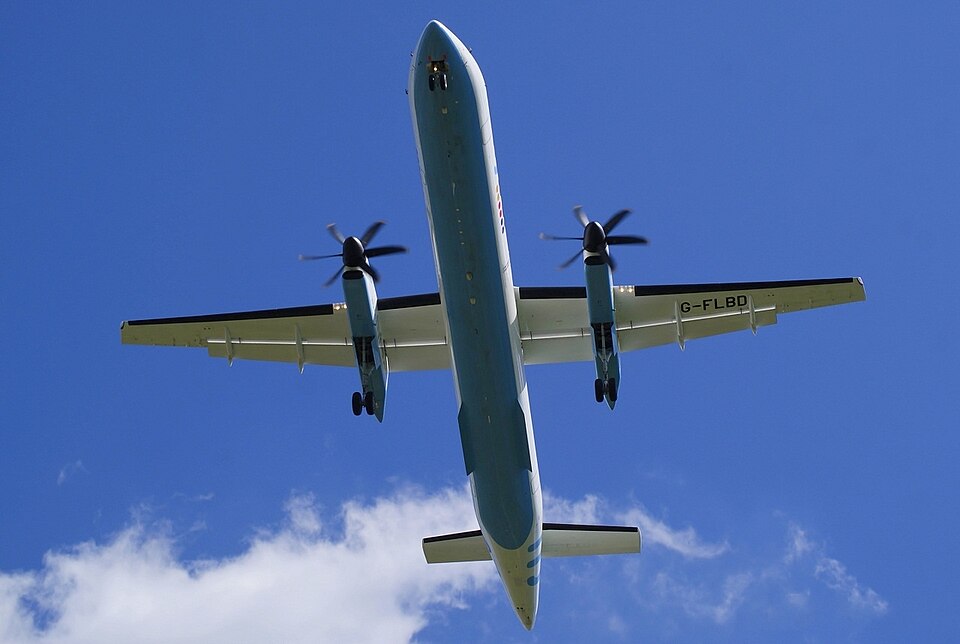
On 1 June 2013, a DHC-8-402 Dash 8, registration G-FLBD, was operating a commercial passenger flight from the Isle of Man to Liverpool Airport. The aircraft, powered by two Pratt & Whitney Canada PW150A turboprop engines, had 4 crew and 61 passengers on board. No injuries or damage were reported.
Flight History
The approach to Runway 27 at Liverpool was initially conducted under ATC radar vectors. Given good weather and no other traffic, the co-pilot, who was the handling pilot, requested to convert to a visual approach. The commander agreed and ATC approval was obtained.
During the visual approach, the co-pilot began configuring the aircraft for landing. The commander prompted the co-pilot to turn right onto a base leg. The co-pilot, concerned about flying above the ideal glide path if he turned too early, continued on the base leg while descending. He recalled seeing a radio height of 1,200 ft. However, the aircraft descended below the recommended profile.
At approximately 0907 UTC, while tracking near the Runcorn Bridge, the Enhanced Ground Proximity Warning System (EGPWS) generated a "CAUTION OBSTACLE" alert at a radio height of 894 ft. The flight crew adjusted the aircraft's flight path and confirmed it was safe to continue the approach to a safe landing.
Discussion
The EGPWS uses internal terrain and obstacle databases to predict conflicts between the aircraft's flight path and terrain or obstacles. The obstacle in this case was possibly the Runcorn Bridge, but was not positively identified. Recorded flight data showed the aircraft reached a rate of descent of about 2,000 ft/min on base leg. The Dash 8 Q400 operating manual states the correct crew response to a "CAUTION OBSTACLE" alert is to 'take appropriate action to correct the unsafe condition.'
The commander reported that the co-pilot had allowed the aircraft's rate of descent to increase while on base leg, and the commander became distracted from monitoring the vertical profile.
No probable cause was determined by the investigation.