History of the Flight
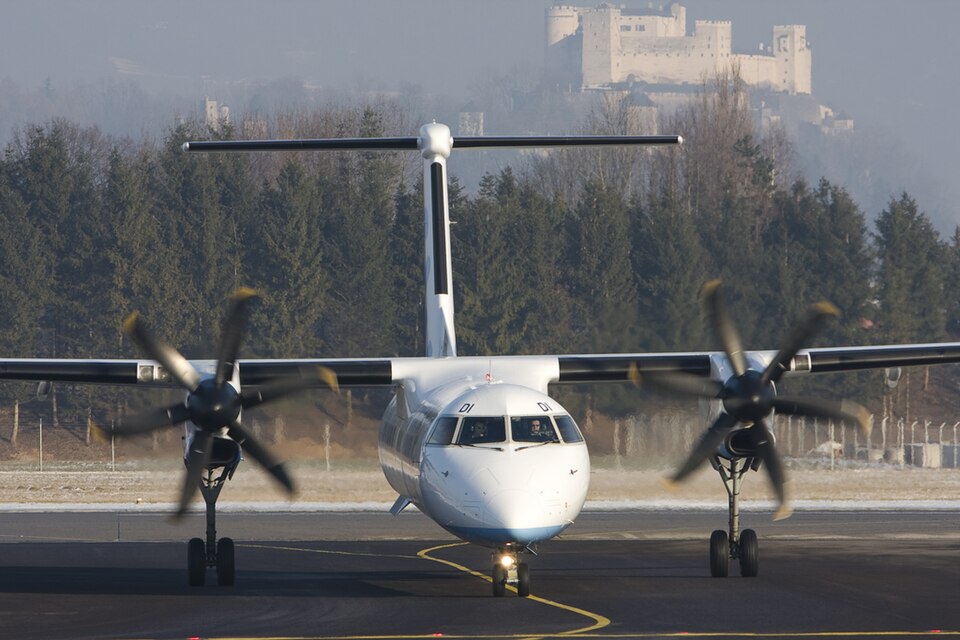
The aircraft, a DHC-8-402 Dash 8 registered G-JEDI, departed London Gatwick Airport on a scheduled passenger flight to Düsseldorf on 21 December 2009. As it climbed through 6,000 ft, caution lights illuminated: left AC bus, right AC bus, left TRU, right TRU, #1 AC generator, and #2 AC generator. The commander, acting as pilot monitoring, handed radio communications to the co-pilot and performed emergency checklist procedures for loss of both AC generators with propeller de-icing on. The aircraft continued climbing but the pilots requested descent to avoid icing conditions. ATC cleared descent to FL110 but, as icing persisted with limited ice protection, the pilots issued a PAN PAN urgency call and requested further descent and diversion to Gatwick. They exited icing conditions at approximately FL100. The commander briefed the senior cabin crew and informed passengers. Although the airframe appeared clear of ice, the crew elected to approach with flap 35 at increased speed per company icing procedures. The landing was uneventful; fire service attendance was not required.
Engineering Examination
Post-flight troubleshooting revealed that the left AC generator input drive shaft had sheared. Engineers then exchanged generators and found that the right generator input shaft had also sheared. Inspections of the wiring loom in the left centre-wing section trailing edge area showed significant damage. The loom was supported by plastic tie straps attached to a bracket riveted to the lower wing skin. The tie strap and protective tape had detached; the plastic bracket had melted. There was evidence of arcing between wires and between wiring and the aircraft structure near the bracket, as well as between wiring and the head of a cadmium-plated blind rivet securing the bracket. The wiring loom contained 22 wires, including power feeds for left propeller de-icing, right generator power to contactor K1, left generator power to contactor K2, right AC bus to standby power unit, left AC bus to EPCU volt sense, and external power bus to contactor K1. The loom and bracket were sent to a forensic laboratory. Analysis showed localised mechanical damage on wires, with abrasion by a sharp object; particles of cadmium and iron were found. One tie strap had a notch with cadmium particles. The AC generators and contactors K1 and K2 were tested and found serviceable apart from the fractured spline shafts.
Analysis
The wiring loom failure resulted from chafing by the head of the blind rivet securing the loom support bracket. The action of inserting a blind rivet creates a shear lip on the inner stem. Relative movement of the loom against the rivet head caused abrasion, leading to arcing and subsequent system failures. The arcing likely shorted the left generator supply, causing its GCU to isolate it and connect the left AC bus to the right generator via contactor K1. However, the affected loom also contained wires from the left AC bus, which led to faults detected by the right GCU, shutting down the right generator. Both AC buses then lost power, causing the associated system failures.
Flight Recorder Data
The cockpit voice recorder (CVR) had recorded over the incident due to post-flight maintenance activity. The flight data recorder (FDR) retained data from the incident and subsequent fault-finding. The FDR showed that as the aircraft climbed through 5,900 ft, standby hydraulic pressure dropped from 3,000 psi to about 100 psi over four seconds, accompanied by a master caution and offline status of both AC generators and buses. The aircraft levelled at 6,500 ft, then climbed to FL130 before descending. During descent, both AC buses and generators came back online briefly, then went offline again at 4,100 ft. The landing and taxi were uneventful.
Modification Issued
The aircraft manufacturer issued a modification to replace blind rivets with solid rivets and to inspect wiring for damage.