Background
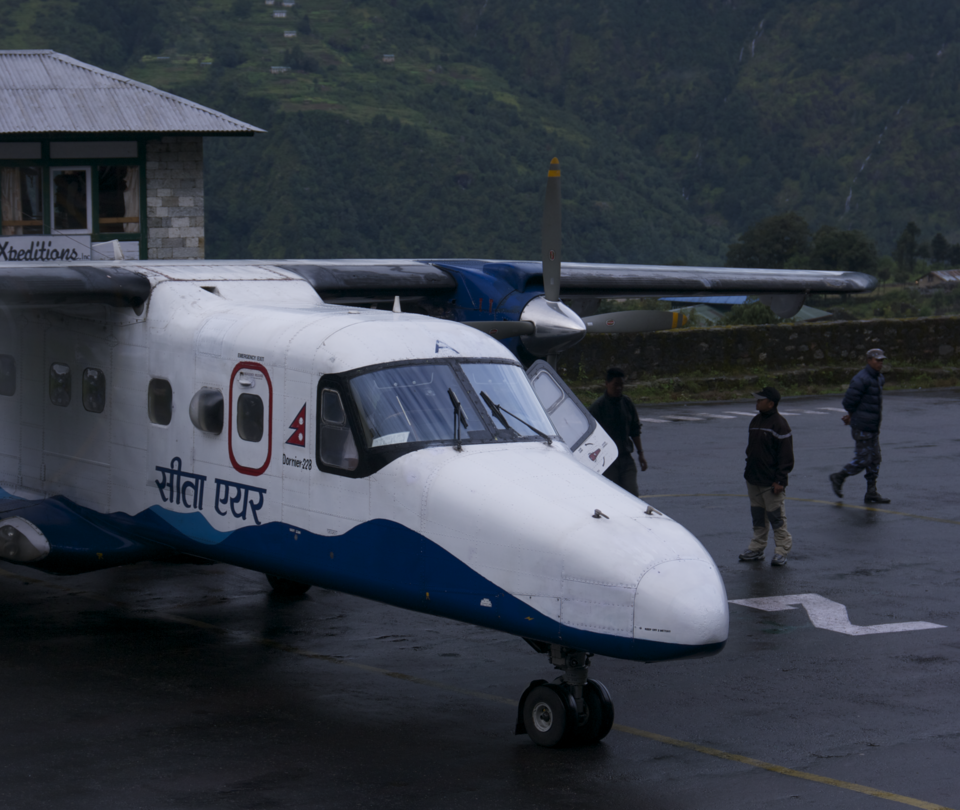
On a scheduled flight from Tribhuvan International Airport (TIA), Kathmandu, to Tensing/Hillary Airport, Lukla, a Dornier 228 aircraft, registration 9N-AHA, was planned to carry 16 passengers and 3 crew members. The commander served as pilot flying, following common practice for the route.
Flight Preparation
At the time of departure, the 0020Z METAR for TIA reported calm wind, visibility of 3,000 meters in mist, scattered clouds at 2,000 ft above aerodrome level (AAL), broken clouds at 10,000 ft AAL, temperature 19°C, and QNH 1017 hPa. Air traffic control (ATC) updated the QNH to 1018 hPa at 0029 hours.
At 0028 hours (0613 am local), the co-pilot requested taxi clearance, and 9N-AHA taxied toward Intersection 2 for Runway 20. During taxi, the crew completed the before-takeoff checklist; the commander confirmed flaps set to 1 and all four booster pumps on. No emergency brief or discussion of reference speeds for takeoff was held. The crew switched frequency to the tower controller, who cleared them to enter Runway 20 from the intersection and await takeoff clearance. The commander requested line-up checks, during which the speed lever was selected to HIGH.
Takeoff and Initial Climb
After lining up, the commander stated, "THERE IS A BIRD," and three seconds later, "I WILL TAKE FLAPS TWO," acknowledged by the co-pilot. The aircraft received takeoff clearance and began its takeoff run at 0032 hours. Two seconds into the roll, the commander said, "WATCH OUT THE BIRD." At 50 knots indicated airspeed (KIAS), the co-pilot called "50 KNOTS," and the commander replied "CHECK." Two seconds later, passing 58 KIAS, the co-pilot reported "BIRD CLEAR SIR." Approaching 70 KIAS, approximately 13 knots below V1 and Vr, the first officer called "VEE ONE ROTATE." The aircraft began to rotate but did not lift off; the nose was briefly lowered. At 86 KIAS, the aircraft became airborne and the landing gear was immediately raised. Climbing, it accelerated to 89 KIAS over about two seconds, then continued to 100 ft above the runway over the next 11 seconds, but speed decreased to 77 KIAS.
Loss of Control
The aircraft then flew level for 14 seconds, during which speed further decreased to 69 KIAS. The air traffic controller asked, "ANY TECHNICAL?" The pilot replied, "[uncertain]….DUE BIRD HIT." The heading changed slowly from 200°M to approximately 173°M. The stall warning activated for three seconds as the aircraft decelerated through 71 KIAS. Two seconds after the warning ceased, it sounded again for about six seconds at 69 KIAS. The aircraft began a gentle descent at that speed, with the stall warning ongoing; the rate of left turn increased rapidly. It departed controlled flight, most probably left wing low, and crashed into a small open area 420 meters southeast of the end of Runway 20.
Post-Accident Findings
A runway inspection revealed the remains of a bird, identified as a "Black Kite," at a position 408 meters from Intersection 2. No other bird strikes were reported for other departures.
Probable Cause
The investigation identified the following causal factors: 1. During level flight, drag exceeded power available, causing deceleration and excessive drag in a critical ascent phase; the reason for reduced thrust could not be determined. 2. The flight crew did not maintain airspeed above stall speed, and insufficient height was available to recover when controlled flight was lost. Contributory factors: 1. The flight crew did not maintain V2 during climb, increasing power required for level flight. 2. The flight crew did not maintain the runway centerline, removing the option to land on the remaining runway.