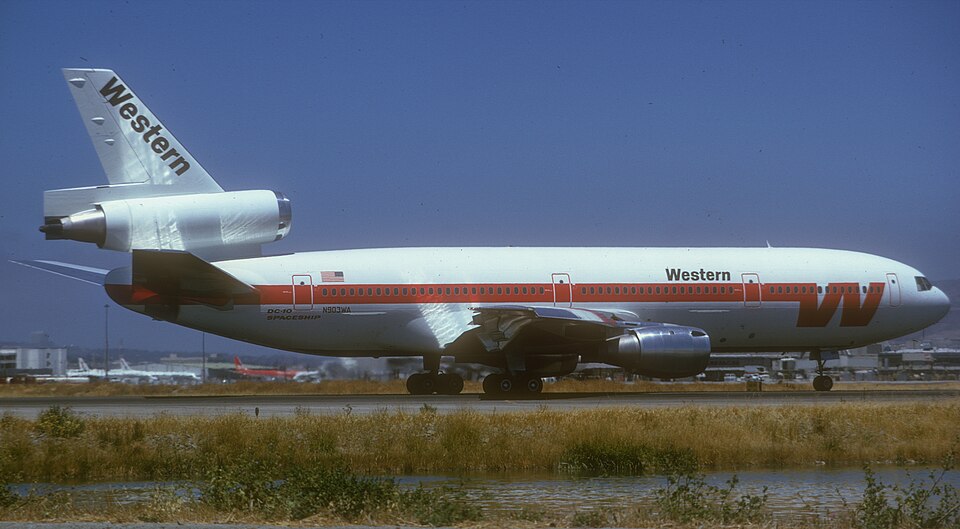
On October 31, 1979, a Douglas DC-10 (registration N903WA) operated by Western Airlines was involved in an aviation accident near Mexico City-Benito Juarez, Mexico during landing or approach. 73 people were killed. Investigators recorded the probable cause as: The accident was the consequence of the combination of the following factors: non-compliance with the meteorological minima for the approach procedure, as cleared, and failure to comply with the aircraft's operating procedures. This summary draws on records from the Bureau of Aircraft Accidents Archives (B3A); 3 related events involving the same aircraft type or operator are linked below.
On 31 October 1979, N-903WA departed Los Angeles for Mexico City. During an instrument approach, the crew continued below decision altitude and landed on closed Runway 23 Left, striking a truck and causing a fatal crash.
Departure and Approach Clearance The aircraft, registered N-903WA, departed Los Angeles International Airport at 0140 local time on 31 October 1979, bound for Mexico City. Mexico centre cleared the crew to approach Mexico City via Tepexpan and later instructed them to change frequency to the control tower. The tower reported Runway 23 Right in use and provided weather and landing data. ## Approach and Runway Selection While on final approach, the tower operator repeated that Runway 23 Right was in use and advised the pilot that the aircraft was left of the intended flight path. The pilot acknowledged being slightly left. Communications recorded on magnetic tape show the tower operator asked whether the pilot could see the approach lights on his left; the pilot replied “negative.” Flight recorder data indicated the crew was conducting an instrument approach. The instrument landing procedure authorized in the aeronautical information publication for Runway 23 Left with transition to 23 Right required the pilot to break off the approach and climb to 8,500 ft if the runway was not in sight at 600 ft. The crew continued the landing procedure, ignoring the requirement to call out altitude values and the decision minimum, and descended until the landing gear touched down off-centre on Runway 23 Left, which was closed to all operations. ## Initial Ground Contact and Truck Collision Cockpit voice recorder transcription recorded the pilot-in-command saying he was on the flight path to Runway 23 Left just before the left landing gear wheels touched grass to the left of the runway and the right landing gear wheels touched the runway shoulder. The aircraft did not enter the runway until it had travelled about 100 m. Flight recorder data and wheel traces showed the crew re-applied power for a go-around and lifted the nose by 100–210. Once airborne, the right landing gear struck a truck on the left shoulder of the closed runway. The impact left a mark on the truck’s bonnet matching the aircraft wheel. The truck, loaded with 10 tonnes of earth, lost its right landing gear leg with part of the main gear beam, and three of four tires burst. Two front tires came off the wheels, whose hubs disintegrated. The horizontal shaft carrying the front wheels and brake units broke off and was projected more than 400 m. The severed right landing gear leg struck the right tailplane and elevator, severing them almost completely and throwing the gear assembly about 70 m beyond the collision point. ## Damage to Truck and Aircraft The truck’s left dumper body panel broke off and was thrown left of the runway, bearing tire traces along its top edge. The inner right-hand section of the wing flaps struck the dumper body and was removed; it was found about 40 m beyond the truck’s final location, with earth on the underside and in the fractures. The truck broke up completely, with parts scattered over an area about 400 m long by 100 m wide. Three seconds before the truck collision, the engine throttles were opened. Despite the impact, the aircraft remained airborne, though lift was precarious due to loss of the right tailplane with elevator and the inner wing flap section. The aircraft banked right, and the bank increased until the outer section of the right wing flap struck the cab of an excavator parked parallel to the right edge of Runway 23 Left, about 1,500 m from the threshold. The impact destroyed the cab, and flap trailing-edge parts were found embedded in the excavator’s twisted framework. ## Continued Flight and Final Impact The aircraft continued veering right, increasing its bank until the right wing tip scraped Taxiway “A,” leaving a deep score, damaging a telephone manhole, and destroying some taxiway edge lights. A severed section of the right wing was found embedded in the ground there, and early fire signs appeared in the nearby grass. The distance from the landing gear marks 167 m from the threshold to the Taxiway “A” score was about 2,500 m, with no ground marks except a few metres beyond the excavator. A constant-depth score about 70 m long was made in the grass, possibly by something suspended under the aircraft, with glass-fibre fragments found along it. After the right wing tip traces on Taxiway “A,” scores of varying depths were made in Taxiway “Ptt” by the aileron and outer right flap. A few metres later, the right wing struck the corner of the PCV repair hangar, knocking down a pillar, a cross tie, and part of the roof corner. Aircraft components, including flap guides and hinges and sections of the right aileron leading edge, were found inside the hangar, along with fuel spilled from the fractured wing onto a PCV under repair and parked vehicles. The hangar collision barely interrupted the aircraft’s path. It finally crashed into the front of a building, demolishing it. In the main impact, the tail fin with rudder, engine No. 2, the tail unit, the left tailplane with elevator, and the remaining right tailplane and elevator broke off. The left wing was severed at its attachment to the centre section and thrown more than 200 m, turning over and falling on a house outside the airport, part of which burned. Engines No. 1 and 3 broke away from the wings and were destroyed by impact and fire. ## Casualties Seventy-two occupants, including nine crew members, were killed, along with one person in the building. Sixteen people were injured.
Probable cause
The accident was the consequence of the combination of the following factors: non-compliance with the meteorological minima for the approach procedure, as cleared, and failure to comply with the aircraft's operating procedures.