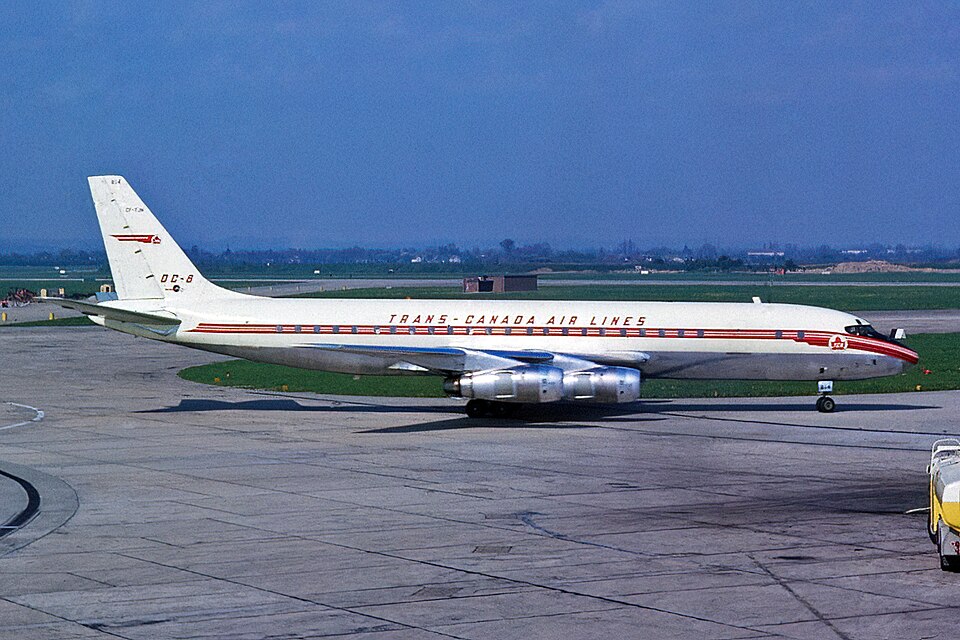
On November 29, 1963, a Douglas DC-8 (registration CF-TJN) operated by Trans-Canada Air Lines - TCAL was involved in an aviation accident near Sainte-Thérèse-de-Blainville, Canada during takeoff. 118 people were killed. Investigators recorded the probable cause as: An unprogrammed extension of the Pitch Trim Compensator was the most probable cause for the pilot having applied Aircraft Nose Down Trim, which initiated the chain of events that culminated in the crash. This summary draws on records from the Bureau of Aircraft Accidents Archives (B3A); 8 related events involving the same aircraft type or operator are linked below.
A Douglas DC-8 crashed shortly after takeoff from Montreal-Dorval Airport, killing all 118 occupants. The official investigation could not determine the exact cause but identified probable contributing factors.
Flight Details and Accident Sequence A Douglas DC-8 was operating a regular scheduled flight from Montreal-Dorval Airport (YUL) to Toronto (YYZ), Canada. The flight was scheduled to depart Montreal at 18:10, but boarding delays caused the aircraft to begin its takeoff roll on runway 06R at approximately 18:28. Weather conditions at the time were reported as overcast with light rain and fog, visibility of 4 miles, and surface winds from the northeast at 12 mph. The flight was instructed to report passing 3,000 feet and 7,000 feet during the climb-out. The aircraft took off normally and reported at 3,000 feet, after which it acknowledged a clearance for a left turn to St. Eustache. This was the final radio contact with the flight. The aircraft then deviated approximately 55 degrees to the right from its normal flight path and entered a rapid descent. At 18:33, 16.9 miles from the airport, the DC-8 struck the ground at a speed of 470-485 knots while descending at an angle of approximately 55 degrees (±7 degrees). The aircraft disintegrated completely upon impact, and there were no survivors among the 118 occupants. ## Probable Cause Analysis The official investigation concluded that the actual cause of the accident could not be determined with certainty. However, the most probable chain of events was identified as follows: the pilot applied near-maximum available Aircraft Nose Down (AND) trim to the horizontal stabilizer, causing the aircraft to enter a diving descent that built up speed so rapidly that any attempted recovery was ineffective. The stabilizer hydraulic motor had stalled, making it impossible to trim the aircraft out of the extreme AND position within the available altitude. Three possible reasons for the pilot's application of AND trim were identified: 1. Pitot System Icing: Icing of the Pitot system could have indicated to the pilot the necessity for applying nose-down trim. While the crew's experience and competency would likely have led them to recognize the fault in time for corrective action, this possibility could not be dismissed. 2. Vertical Gyro Failure: A failure of a vertical gyro without an associated warning flag could have misled the pilot if the aircraft was being flown with reference to the associated artificial horizon instrument. The aircraft was equipped with a standby artificial horizon on the Captain's instrument panel, and cross-referencing this instrument, combined with the crew's experience, would likely have led to timely recognition of the fault. However, this possibility also could not be dismissed. 3. Unprogrammed Pitch Trim Compensator Extension: An unprogrammed and unnoticed extension of the Pitch Trim Compensator (PTC) would have moved the control column back, the elevators up, and the aircraft into a nose-up condition. The pilot would likely have counteracted this by trimming the horizontal stabilizer to or near the limit of the AND setting. Evidence showed that the simultaneous application of up elevator from the PTC and even 0.5 degrees of AND trim had an adverse effect on aircraft stability, creating difficult control problems that worsened as further AND trim was applied. In the aircraft, 2.0 degrees of AND trim was available, and the pilot applied at least 1.6 degrees. The flight crew were unlikely to have been aware of the serious stability and control problems resulting from the combination of extended PTC and AND trim. The aircraft would have been in a condition where slight displacement from its trim point led to divergent oscillations, with minor attitude changes easily caused by existing turbulence building into large displacements. The inadequate control available to the pilot and the lack of an external horizon reference likely resulted in the aircraft eventually assuming a dive attitude. The investigation concluded that an unprogrammed extension of the Pitch Trim Compensator was the most probable cause for the pilot having applied Aircraft Nose Down Trim, which initiated the chain of events that culminated in the crash.