Background
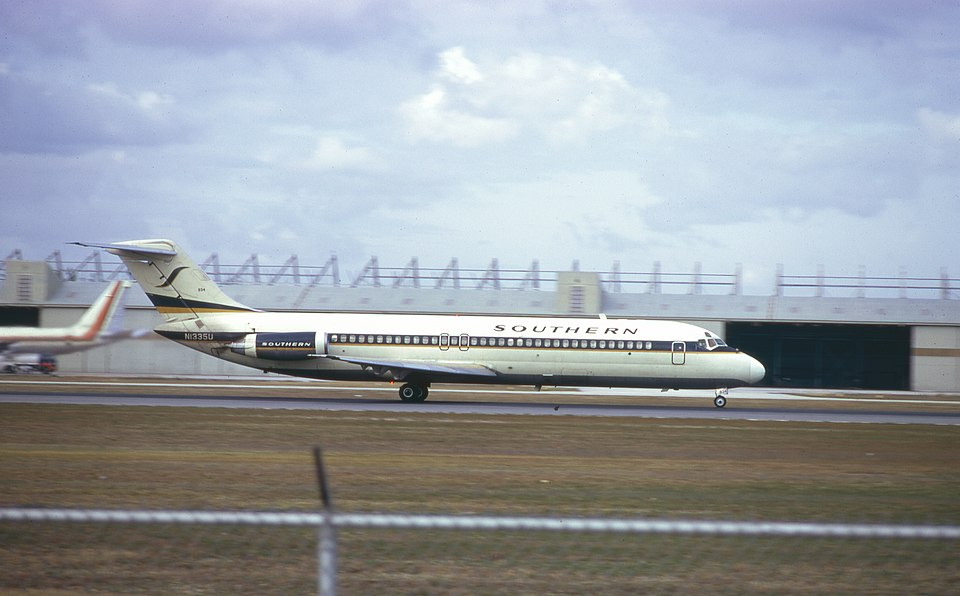
Southern Airways Flight 242 was a scheduled passenger flight from Muscle Shoals, Alabama, to Atlanta, Georgia, with an intermediate stop at Huntsville, Alabama. The aircraft was a DC-9-31. It departed Muscle Shoals at 15:21 and landed at Huntsville about 15:44. At about 15:54, the flight departed Huntsville on an instrument flight rules (IFR) flight plan for Hartsfield-Atlanta International Airport, with 81 passengers and 4 crew members aboard. The planned route was direct to the Rome VOR, followed by a Rome runway 26 profile descent to Atlanta, with an estimated en route time of 25 minutes and a requested altitude of 17,000 ft.
Flight Sequence
At 15:56, the air traffic controller advised Flight 242 that his radarscope showed heavy precipitation about 5 nautical miles ahead. At 15:57:36, the controller asked about flight conditions, and the flight crew reported light turbulence and moderate rain. The controller then instructed the flight to contact Memphis Center, where the controller informed them of a current SIGMET. The flight subsequently switched to Atlanta Center at 16:03:20, reporting level at FL170.
As the aircraft entered an area of rain, the flight crew discussed weather depicted on their radar. The captain initially decided the storms west of the Rome VOR were too severe to penetrate but shortly after decided to penetrate the storm area near the VOR. At 16:06:41, Atlanta Center cleared the flight to descend to and maintain 14,000 ft. Shortly afterward, the aircraft entered an area of heavy hail or rain that continued for at least one minute.
Engine Failure
The ingestion of intense rain and hail caused both engines' rotational speed to decrease below the engine-driven electrical generator operating speeds, resulting in a normal electrical power interruption for 36 seconds. The flight crew likely advanced one or both thrust levers, restoring generator operation and normal electrical power. At 16:09:15, the flight reported a broken windshield and that the left engine had flamed out. Both engines' high-pressure compressors then began to stall severely due to massive water ingestion. The severe compressor stalls caused overpressure surges that deflected compressor blades forward in the sixth stage of the low-pressure compressors, which clashed against fifth-stage stator vanes, breaking pieces. Those pieces were ingested into the high-pressure compressors, damaging them severely. Continued high thrust settings after the damage likely caused severe overheating in the turbine sections, and the engines ceased to function. Shortly before normal electrical power was restored, the flight crew radioed that both engines had failed.
Emergency Descent and Landing
Atlanta Center directed the crew to contact approach control for vectors to Dobbins Air Force Base. Power was lost for 2 minutes 4 seconds until the APU-driven generator restored electrical power. The approach controller informed the flight they were 20 miles from Dobbins. During descent, the captain doubted reaching Dobbins. Cartersville, at 15 miles, was closer, so the controller provided vectors. Unable to reach Cartersville, the crew sought a clear area for an emergency landing. At 16:18:02, the last transmission was recorded: "...we're putting it on the highway, we're down to nothing."
The aircraft's outboard left wing section first contacted two trees near State Spur Highway 92 south-southwest of New Hope. About 0.8 miles farther north-northeast, the left wing struck a tree alongside the highway within New Hope. Both wings struck trees and utility poles on both sides of the highway. About 570 ft after the first tree strike in New Hope, the left main gear contacted the highway left of the centerline. Almost simultaneously, the left wing's outer structure struck an embankment, causing the aircraft to veer left off the highway. The aircraft traveled another 1,260 ft before coming to rest, striking road signs, utility poles, fences, trees, shrubs, gasoline pumps at a gas station-store, five automobiles, and a truck.
Aftermath
Of 85 persons aboard Flight 242, 62 were killed, 21 were seriously injured, and 1 was slightly injured. Eight persons on the ground were killed. Within a month of the accident, one surviving passenger and one person on the ground died of their injuries.
Probable Cause
The National Transportation Safety Board determined the probable cause was the total and unique loss of thrust from both engines while the aircraft was penetrating an area of severe thunderstorms. The loss of thrust was caused by the ingestion of massive amounts of water and hail which, in combination with thrust lever movement, induced severe stalling in and major damage to the engine compressors. Major contributing factors include the failure of the company's dispatching system to provide the flight crew with up-to-date severe weather information pertaining to the aircraft's intended route of flight, the captain's reliance on airborne weather radar for penetration of thunderstorm areas, and limitations in the FAA's ATC system which precluded the timely dissemination of real-time hazardous weather information to the flight crew.