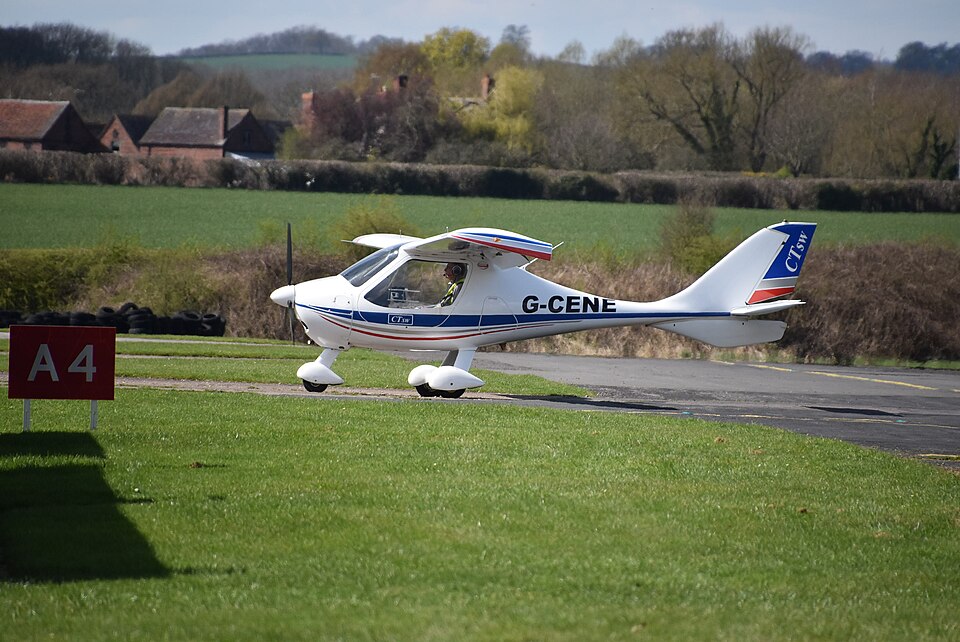
Synopsis
On 3 October 2010 at 1050 hrs, a Flight Design CTSW, registration G-CENE, sustained damage during a landing accident at Arclid airstrip, Cheshire. The single-engine aircraft, powered by a Rotax 912 ULS piston engine (year of manufacture 2007), was being operated on a private flight from Wycombe Air Park to Barton Aerodrome. The pilot held a National Private Pilot’s Licence, was 39 years old, and had 124 hours total flying experience (99 hours on type), with 28 hours in the last 90 days and 5 hours in the last 28 days. One passenger was on board.
History of the Flight
The pilot had checked the Manchester Airport TAF before departing from Wycombe Air Park. The TAF forecast a 40% to 50% probability of 3,000 m visibility in heavy rain, with a broken cloud layer at 900 ft agl for the planned arrival time at Barton Aerodrome, which is 8 nm from Manchester Airport. While en route, the pilot encountered low cloud and decided to make a precautionary landing at Arclid airstrip. He descended to 500 ft agl while positioning the aircraft on a right-hand downwind leg for Runway 20.
During the turn onto final approach, the aircraft flew into heavy rain. The pilot reported that the airspeed shown on the airspeed indicator (ASI) fell to zero. The final approach was high and fast, and the aircraft touched down approximately halfway along the 400 m grass runway. Following a bounce, the aircraft landed and during heavy braking, it departed from the runway approximately 15 m from its end. The nose landing gear leg collapsed and the aircraft overturned. The pilot and passenger were able to vacate the aircraft without further incident.
Injuries and Damage
The pilot sustained no injuries; the passenger suffered minor injuries. The aircraft sustained damage to the engine cowling, propeller, nose landing gear, right wing, windscreen, passenger window, and rudder hinge.
Probable Cause
No probable cause was stated in the source.