Incident Overview
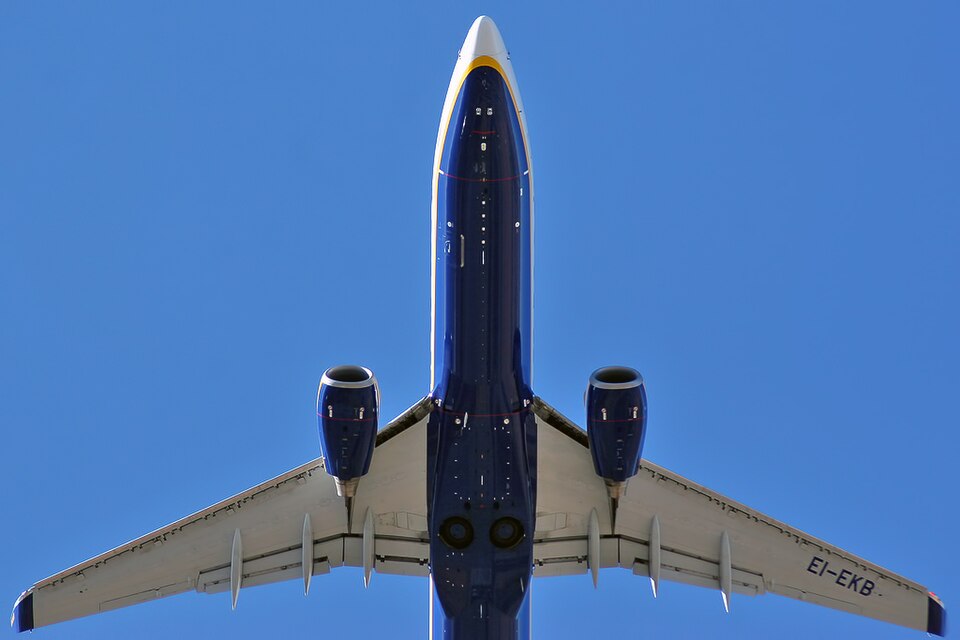
On 14 April 2011 at approximately 08:30 UTC, a Boeing 737-800 operated by Ryanair was taxiing on taxiway K toward the runway 25L holding point at Barcelona Airport. A Boeing 767-300 operated by American Airlines was stopped at holding point G3. The Ryanair aircraft needed to pass behind the American Airlines aircraft to access an unoccupied holding point. The captain of the B737 reduced speed, turned left of the taxiway centerline, and asked the copilot to monitor separation. Unsure if the B737's right wingtip would strike the B767's tail, the copilot requested a stop. The captain stopped, stood up, and checked the separation from the copilot's window. The B767 then moved forward a few meters, and the B737 continued behind it to holding point G1. After the maneuver, passengers reported contact to the cabin crew, who informed the flight crew, but the flight crew believed no contact occurred. Both aircraft were cleared for takeoff and departed without further incident.
Aircraft Information
The B737-800 is a narrow-body aircraft with a wingspan of 35.8 m, classified as ICAO category C. The B767-300 is a wide-body aircraft with a wingspan of 47.6 m, classified as category D. According to Boeing documentation, the winglets of the B737-800 are not directly visible from the seated pilot or copilot position; they must move sideways to see them. The B767 pilots cannot see the ground immediately forward of the aircraft, with restricted vision for the first 50 ft ahead.
Aerodrome and Communications
The runway 25L holding point at Barcelona Airport can accommodate three aircraft at positions G1, G2, and G3, accessed via a single taxiway K. Restrictions on aircraft categories apply to maintain separation. Ground control is handled from the tower, approximately 600 m northwest of the holding point. The visibility from the tower is ideal, but controllers cannot evaluate separation between an aircraft at G3 and those moving into G1 or G2. The airport uses surface movement radar (SMR). During the incident, communications followed normal procedures: the American Airlines B767 was cleared to G3, and the Ryanair B737 was initially cleared to the holding point without a specific position. At 08:32:04, ATC asked the B737 to proceed to G1; the crew hesitated. After the B767 moved forward, the Air France aircraft behind was cleared to G2.
Meteorological Conditions
Horizontal visibility on the day of the incident was in excess of 10 km.
Investigation Findings
Flight data recorders from both aircraft were analyzed. The exact time of contact could not be identified from acceleration data due to the minor nature of the contact. FDR inaccuracies prevented precise reconstruction of ground paths. Estimates indicate the B737 deviated about 1 m from its initial course. The B767 had stopped approximately 50–60 ft before the holding point marking and later moved forward about 15 ft. During a walk-around before the next flight, the B737 crew discovered damage to the right winglet. American Airlines personnel later found damage to the outboard section of the left horizontal stabilizer, requiring the aircraft to be removed from service for repairs. The damage to both aircraft was minor.