Casualties unknown

Landing Gear Malfunction on an Airbus A300 During Initial Climb (YV560T)

AEROPUERTO INTERNACIONAL “SIMÓN BOLÍVAR”, MAIQUETIA,, VE

On July 29, 2021, an AIRBUS INDUSTRIE A300-B4-203 (registration YV560T) operated by TRANSCARGA INTL. AIRWAYS, C.A was involved in an aviation accident near AEROPUERTO INTERNACIONAL “SIMÓN BOLÍVAR”, MAIQUETIA,, VE. Investigators recorded the probable cause as: The landing gear failure was preliminarily determined to be caused by an inoperative proximity detector sensor. This summary draws on records from the Venezuelan Civil Aviation Accident Investigation Board (JIAAC Venezuela).
Sourcesthe Venezuelan Civil Aviation Accident Investigation Board (JIAAC Venezuela)Primary reportUpdated 2026-09-15Data APIEditorial standards
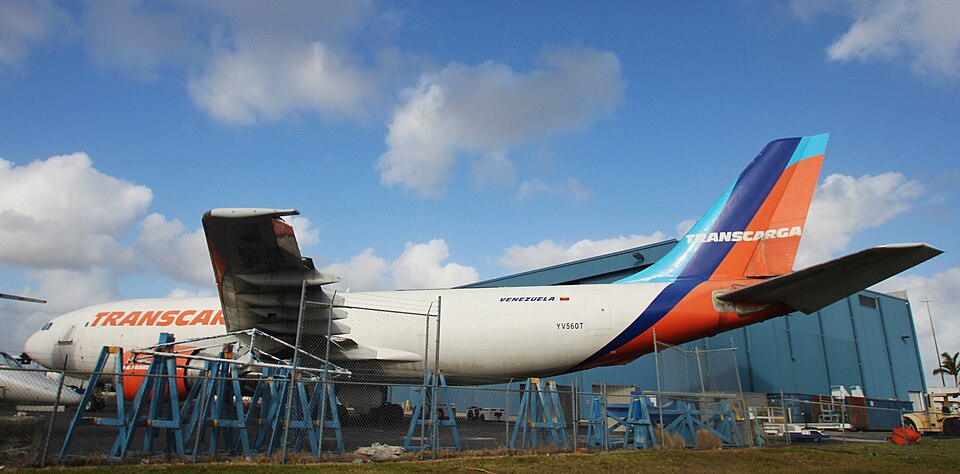
Aircraft registered YV560T
Aircraft registered YV560T. Photo: James McCloskey from Pad 39 A, Land of the free Home of the Brave / CC BY-SA 2.0, via Wikimedia Commons

On August 9, 2022, an Airbus A300-B4-203 operated by Transcarga Intl. Airways failed to retract its landing gear after takeoff from Maiquetía. The aircraft returned and landed safely with no injuries or damage.

Incident Overview and Aircraft Details On August 9, 2022, an Airbus A300-B4-203 with registration YV-560T and serial number 261, operated by Transcarga Intl. Airways C.A. (TIACA), departed from Simón Bolívar International Airport (SVMI) in Maiquetía, Venezuela, at 16:30 UTC. The flight was scheduled to El Dorado International Airport (SKBO) in Bogotá, Colombia. The aircraft, manufactured in 1983, was equipped with General Electric CF6-50C2 turbofan engines and was certified for commercial public air transport. ## Operational Sequence and Response During the initial climb, the pilot in command instructed the retraction of the landing gear. When the gear lever was moved, it became blocked in the neutral position, and the gear did not retract. The crew applied the memory item without success and then performed the Quick Reference Handbook (QRH) procedure for a landing gear lever interlock (Chapter 10, Section 10.02), which also failed to resolve the issue. Due to the persistent malfunction, the crew canceled the destination and returned to SVMI. The aircraft landed on runway 10L without incident, and all occupants evacuated by their own means. No injuries were reported, and the aircraft sustained no damage. ## Crew, Maintenance, and Weather The pilot in command, aged 47, held a valid Airline Transport Pilot license and medical certificate issued by the Instituto Nacional de Aeronáutica Civil (INAC), with 10,680 total flight hours, 6,750 hours as pilot in command, and 2,500 hours on the A300. The first officer, aged 33, held a valid Commercial Pilot license and medical certificate, with 2,160 total flight hours and 1,190 hours on the A300. The aircraft was maintained by OMAC-N° 536 B1 Transcarga Intl. Airways C.A. at SVMI and was considered airworthy according to maintenance records. Weather conditions at SVMI were normal, with unlimited visibility and winds of 090/10 knots. ## Investigation and Preliminary Findings The investigation included initial notifications to interested states, photographic records, an on-site aircraft inspection, pilot interviews, and requests for crew, maintenance, and aircraft documentation. The Junta Investigadora de Accidentes e Incidentes de Aviación Civil (JIAAC) preliminarily determined that the landing gear failure was caused by an inoperative proximity detector sensor. The investigation remains in the analysis phase, and the preliminary information is subject to change.

Probable cause

The landing gear failure was preliminarily determined to be caused by an inoperative proximity detector sensor.

Investigation report by the Venezuelan Civil Aviation Accident Investigation Board (JIAAC Venezuela). Original record: https://www.mppt.gob.ve/download/167028/. This page is a structured re-presentation; facts and quotes are in the Junta de Investigacion de Accidentes de Aviacion Civil (JIAAC), Venezuela - MppT.