History of Flight
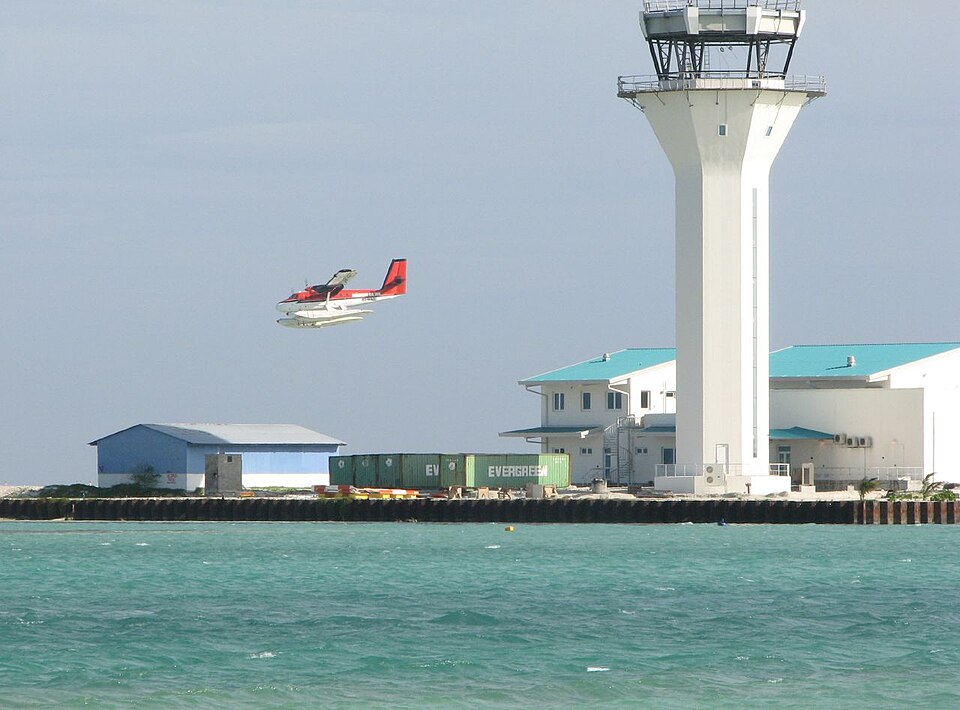
On 14 July 2008, Maldivian Air Taxi Flight 8Q-MAS, a De Havilland DHC-6-300 Twin Otter floatplane, departed from Male International Airport water aerodrome at 12:11 local time. The aircraft carried 14 passengers and 3 crew (captain, co-pilot, cabin crew). The destination was Adaaran Club Bathala in North Ari Atoll, with an estimated flight time of 20 minutes. The weather was windy and the sea rough. The aircraft made an orbit over the lagoon to inspect the water and then touched down, cutting wave tops to find an appropriate stopping location. After hitting a big swell, the aircraft became airborne and veered left. The pilot in command called for a go-around. During the climb, the aircraft collided with a speed boat moored to a buoy west of the floating platform. The right-hand (RH) float collided with the bow of the speed boat, causing the RH float and RH engine to detach from the aircraft. The pilot managed to land on the left-hand (LH) float and bring the aircraft to a halt. Due to high wave current, the aircraft drifted into shallow water and sank. All occupants escaped without injury.
Injuries to Persons
No crew or passengers sustained injuries. The injury table listed zero fatalities, zero serious injuries, zero minor injuries, and 17 persons with no injuries.
Damage to Aircraft
The RH float was detached; the keel showed 11 feet 6 inches crushed and a 3 foot by 4 foot ruptured area. The leading outer edge had a 1-foot scrape. The LH float remained attached but twisted under the fuselage. The RH engine and propeller were detached. The LH ladders were twisted, obstructing the RH main door; the RH ladder separated. The LH float was intact. The leading edge of the RH wing tip was dented and torn approximately 3 feet.
Other Damage
The speed boat (Angelina), a 34 ft Triana Express, sustained a crushed front railing, shattered left-hand windshield, scratched bow, and a detached antenna on the RH side. The starboard side light was shattered.
Personnel Information
The captain, aged 33, Maldivian male, held an Airline Transport Pilot Licence and had 3150 hours on type. The co-pilot, aged 36, Canadian male, held a validation of a Canadian Commercial Pilot Licence and had 127 hours on type. The cabin crew member, aged 31, Maldivian male, held a cabin crew licence.
Aircraft Information
The aircraft, serial number 445, was manufactured in 1975. It was registered in Maldives (8Q-MAS) and owned by Kenn Borek Air Ltd. The operator was Maldivian Air Taxi Pvt. Ltd. Total airframe hours were 49,129.7. Both engines were Pratt & Whitney Canada PT6A-27; the RH engine had 8,313.4 hours since new, the LH gas generator 9,009.5 hours. Propellers were Hartzell HC-B3TN-3DY. Fuel on board was 930 lbs of Jet A1. Takeoff mass was 11,874 lbs, within the certified 12,500 lbs.
Meteorological Information
Wind was westerly 20 to 25 knots. Sea state was rough.
Wreckage and Impact Information
The collision occurred with the speed boat moored at a buoy located approximately 165 feet west of the floating platform. The impact detached the RH float and engine.
Medical and Pathological Information
No medical or pathological information was reported.
Fire
No fire occurred.
Survival Aspects
All occupants evacuated without injury. The aircraft sank after drifting into shallow water.
Tests and Research
No tests were conducted.
Organizational and Management Information
Maldivian Air Taxi operated under a Maldivian Air Operator Certificate. The flight was conducted under day VFR self-dispatch procedures.